
Livraison le jour même ou le lendemain

Qualité garantie

Débloquez vos offres de bienvenue: Livraison GRATUITE | Jusqu'à -80 % | 30 jours d'essai gratuits à JoyPlus
Téléchargez l'application
A 3-ton horizontal hydraulic jack can work for a saloon car as well as an SUV, an MPV or a light commercial vehicle. But the stated capacity alone isn’t enough to make the right choice. Minimum height, stability, weight and compliance are all factors to check before you buy.
Here are the most common pitfalls and the points to compare, so you can find a jack that suits your vehicle, your garage and how often you use it.
A 3-ton capacity doesn’t mean the jack will suit every vehicle. You need to consider the total weight of the car, the load placed on the lifting point, and the space available under the chassis.
A model may easily handle the stated load yet be unusable if its minimum height exceeds your car’s ground clearance. This is especially an issue with sports cars, lowered saloons and vehicles fitted with very low bodywork.
The phrase “fast lifting” might indicate an efficient pump, but it tells you nothing specific about ease of use, stability or the maximum height you can reach. A dual-pump hydraulic jack reduces the number of pump strokes needed, but you also need to look at its lifting range and handle design.
Speed should never take priority over safety, especially when you need to change a wheel on uneven or awkward ground.
A steel jack usually offers a robust structure, but its weight can make it awkward to transport. On the other hand, a 3-ton aluminium hydraulic jack is easier to move around, provided you carefully check the stated capacity, the quality of the wheels and the strength of the base.
For home use, weight is rarely a problem. If the jack needs to live in the boot, a portable workshop jack will often be more practical.
The minimum height is the first figure to compare with your vehicle’s specifications. An ultra-low-profile car jack must be able to slide under the lifting point without touching the sill or any aerodynamic parts.
The maximum height also needs to be sufficient for your suspension and wheel diameter. For an SUV, MPV or light commercial vehicle, a longer lifting range is often essential. Some models come with a height extension or a removable part that broadens their range of use.
A 3-ton jack is suitable for relatively heavy vehicles, but the load it supports must never exceed the manufacturer’s instructions. The vehicle should be parked on a stable surface, with the handbrake firmly applied and the opposite wheels properly chocked.
A steel structure is particularly well suited to heavy workshop use. Aluminium reduces the overall weight, which can be handy if you move the jack around often. In either case, check the quality of the wheels, the width of the base and the presence of a safety valve.
The EN 1494 standard covers mobile or movable lifting equipment for vehicles. The CE marking indicates that the manufacturer declares the product meets the applicable European requirements. These markings do not remove the need to follow safety rules, nor do they guarantee that a model will be compatible with every car.
Before you buy, make sure the capacity, usage instructions and warnings are clearly stated. When working under a vehicle, always use proper axle stands. A jack is for lifting a car, not for holding it up for an extended period.
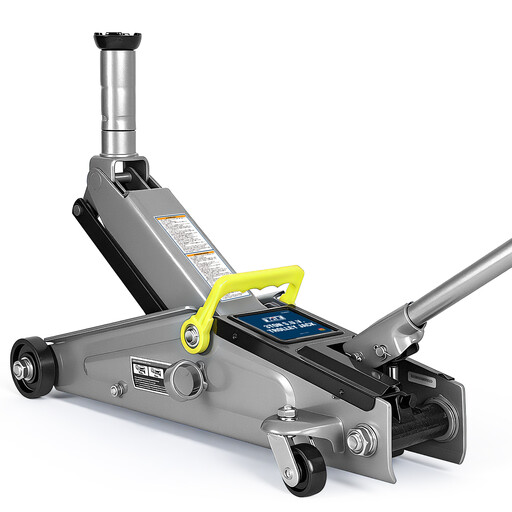
Why this model fits this profile: Its lifting range of 150 to 530 mm suits many cars, as well as SUVs and MPVs. Its steel construction is well suited to routine home maintenance tasks.
The maximum height is clearly stated, which stops you from choosing a device based only on the 3-ton rating. The safety valve and CE marking are also mentioned in the description.
Stated 3-ton capacity, lifting range of 150 to 530 mm and overload safety valve.
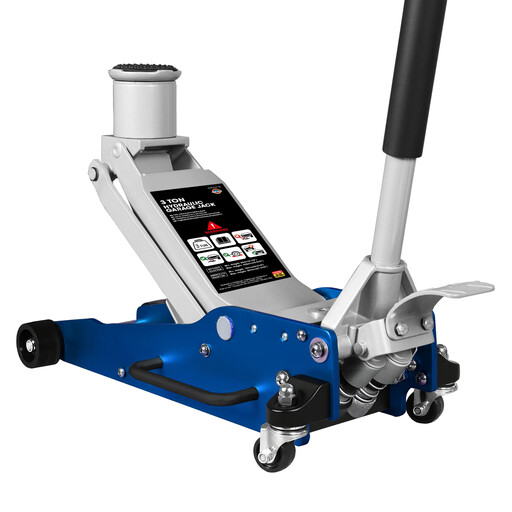
Why this model fits this profile: Its minimum height of 85 mm meets the needs of owners of sports cars or lowered vehicles. Its aluminium alloy also makes the jack easier to move around a garage or a breakdown vehicle.
The minimum height and the height with the extension are listed separately. This makes it easier to check compatibility with a low car before you buy.
Height range of 85 to 465 mm, up to 541 mm with the included extension, dual pump and stated EN 1494 and CE compliance.
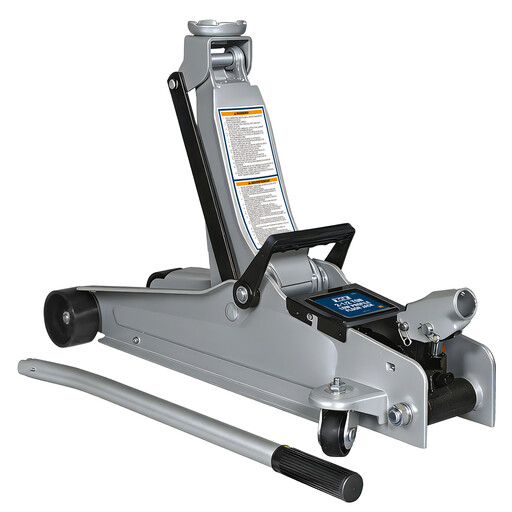
Why this model fits this profile: It is aimed at drivers of supercars, performance cars and low saloons that weigh less than 2.5 tonnes. It can also serve as a compact jack for emergency repairs.
Its minimum height of 85 mm reduces the risk of incompatibility with a low chassis. Its 2.5-ton capacity also reminds you to choose the load based on your vehicle, not just the jack’s appearance.
Lifting range of 85 to 380 mm, steel construction and EN 1494 and CE references stated in the description.
Before each use, inspect the wheels, handle and visible welds. Also check that there are no oil leaks. Place the jack on a hard, perfectly level surface, then locate the lifting point shown in your vehicle’s manual.
To work safely:
A hydraulic jack typically uses no electricity or fuel. Its maintenance is mainly limited to storing it away from moisture, regularly checking for leaks and following the manufacturer’s recommendations for hydraulic oil.
It can work if the vehicle’s weight is less than the jack’s capacity and if the maximum height is enough to lift the wheel off the ground. Always compare the vehicle’s weight, ground clearance and lifting point with the model’s specifications.
For a low car, start by checking the minimum height. A model of 85 mm, described as a sports car jack, will be easier to position than a standard one. However, measure the actual ground clearance, especially if the vehicle has a diffuser or side skirts.
Its lifespan depends on how often it is used, the weight it handles, storage conditions and maintenance. Check its general condition regularly and stop using it immediately if you notice a leak, uneven lowering, deformation or loss of pressure.