High-volume buffet organisers
You need to plan water for breaks and organise transport, storage and replenishment. A pack of six 2 L bottles, such as the Aurèle product listed by Carrefour, provides 12 L to distribute across your service points.


For a buffet where water is poured into glasses, 2 L bottles make it easier to plan service, as you’ll need to set out fewer bottles than with smaller sizes. If your brief requires natural mineral water, check that exact description on the product you order: a pack of 2 L bottles of spring water is a different category. For individual or mobile service, consider smaller sizes too. A larger format can work at a fixed service point, provided you have planned how to set it up.
You need to plan water for breaks and organise transport, storage and replenishment. A pack of six 2 L bottles, such as the Aurèle product listed by Carrefour, provides 12 L to distribute across your service points.
Your brief calls for natural mineral water, or you want to compare the mineral compositions shown. Check the exact product description and mineral information, rather than treating all still waters as equivalent.
You need to decide whether guests will pour water into glasses at a fixed point or take an individual bottle. The way you serve it determines how much space to allow for the bottles and how to manage those that have been opened.
First decide how the water will be served, then check the required category and how much water to set out at each break point.
Choose this: if this category is required and the bottles will be shared at the buffet or table.
Plan ahead: check the size and availability of the product when you order. Auchan lists a 2 L Evian bottle, while Carrefour lists a 2 L Vittel bottle.
Choose this: if you need several 2 L bottles and your brief allows spring water. Carrefour lists Aurèle in this pack size.
Bear in mind: spring water is not a substitute for natural mineral water when that specific category is required.
Consider: smaller bottles if guests need to take water individually, or a larger format for a fixed service point.
Plan ahead: smaller bottles mean more individual units to hand out; a larger container needs a suitable space and serving method.
| Criteria | What to check | Who is it for? |
|---|---|---|
| Volume and logistics | Work out how much water you need across the breaks; check the number of bottles per pack, transport arrangements and storage space. | When I need to supply several break points, I want to organise replenishment without having to move too many bottles. Around 42% of consumers prioritise this need for volume and logistical planning. |
| Category and mineral content | Check whether the product is described as “natural mineral water” or “spring water”, then look at the composition listed for the product you’ve chosen. | If the brief specifies a water category, I need to confirm what will be served before placing the order. This is a priority for around 33% of consumers. |
| Serving method | Decide whether the water will be poured into glasses or served in individual bottles; plan how to manage opened bottles. | For self-service where guests are moving around, I prefer a size they can pick up easily. Around 25% of consumers prioritise the way the service is organised. |
A pack of 2 L bottles may contain spring water, even when your event requires natural mineral water. The size of the bottles doesn’t tell you which category they belong to.
Check the product description and label before confirming your order.
Auchan lists Evian in 2 L bottles, and Carrefour lists Vittel in 2 L bottles. Contrex’s range includes bottles of 1.5 L, 1 L and 50 cL, among other sizes, so the brand alone doesn’t confirm that you’ve found the size you need.
Check the volume and availability of the product at your chosen store or through your chosen ordering channel before finalising your service plan.
A last-minute change of size may mean your team has to rethink how the bottles are distributed and handled.
The mineral information must match the bottle you choose. Auchan’s listing for 2 L Evian gives a total mineral content of 345 mg/L; Carrefour’s listing for 2 L Vittel gives a dry residue at 180 °C of 1 084 mg/L. These figures measure different things and shouldn’t be presented as a single like-for-like comparison.
If composition is one of your criteria, check the label details and units for the product you order.
These products give you an idea of the categories and sizes available. Check each one before adding it to your order.
Natural mineral water listed in a 2 L bottle by Auchan.
Natural mineral water listed by Carrefour in a 2 L bottle and a pack of six 2 L bottles.
Natural mineral water, which Volvic describes as low in minerals.
Natural mineral water. Contrex’s range includes bottles of 1.5 L, 1 L and 50 cL.
A retailer listing products including Aurèle spring water in packs of six 2 L bottles.
A retailer offering several categories and brands of still water through E.Leclerc DRIVE.
The product featured here is natural mineral water in a large 6 L format. It could work at a fixed service point, but it isn’t suitable for an order requiring 2 L bottles.
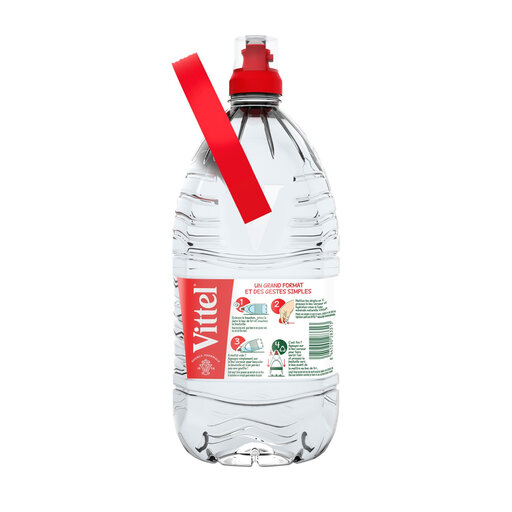 Image unavailable
Consider it for a buffet with a fixed service point, if a 6 L container suits your set-up.
The product description mentions a pouring spout. Check the label if the precise mineral composition is one of your criteria.
Yes, but only if the brief allows spring water instead of natural mineral water. E.Leclerc lists these as two separate categories, so check the product description before ordering.
Start with the volume you need for your serving method and the size actually available for each product. Then compare its description and the mineral information on its own label, without treating differently labelled measurements as equivalent.
Follow the instructions for the product you’ve bought. For 2 L Evian, Auchan’s listing advises keeping the bottles away from sunlight, in a clean, dry, cool place.
Look for details including the water category, net quantity and the information you need to identify the product you ordered. The DGCCRF says that labelling information must be visible, legible and written at least in French.