
Livraison le jour même ou le lendemain

Qualité garantie

Débloquez vos offres de bienvenue: Livraison GRATUITE | Jusqu'à -80 % | 30 jours d'essai gratuits à JoyPlus
Téléchargez l'application
A 28 cm sauté pan with lid can replace several utensils in a family kitchen: a deep non-stick frying pan for searing, a sauté pan for simmering, or a suitable dish for frying vegetables or preparing a complete meal in one pan. However, product listings do not always provide all the useful information needed to compare models.
Before making your choice, three common pitfalls should be kept in mind: a stated diameter that does not match the actual heated surface, a coating described as durable without clear care instructions, and induction compatibility that may be limited. Here are the key points to check before buying, followed by a few options suited to different needs.
A model advertised as “28 cm” may have a very different base size. This is particularly important on an induction hob, as the magnetic zone needs to match the compatible base of the pan. A base that is too small may slow heating or reduce even heat distribution.
For a family, high sides are also important. They help prevent splashes and provide more room for preparing a sauce, stew or generous stir-fry.
The term non-stick does not tell you either what the coating is made of or what precautions are required. For example, a ceramic non-stick pan may need to be used over a low or medium heat, with wooden, silicone or heat-resistant plastic utensils.
The claims “PFAS-free”, “PFOA-free” and “PTFE-free” are not interchangeable. Check exactly what the product listing states, without assuming a feature that is not mentioned. For the models featured here, the coating information comes from the descriptions supplied by the manufacturers or sellers.
A tempered glass lid lets you monitor cooking without allowing all the steam to escape. However, its handle may become hot, and the overall weight increases when the pan is full.
Finally, “dishwasher-safe” does not necessarily mean that this cleaning method will preserve the coating for as long as hand washing. For everyday care, it is generally better to use a soft sponge and a mild detergent.
A pan suitable for all hobs should specify which heat sources it supports: induction, gas, electric and ceramic hobs. For induction, look for the explicit statement induction-compatible and, if available, the diameter of the magnetic base.
Models advertised as compatible with halogen or infrared hobs may require additional confirmation from the manufacturer. The shape of the base and the presence of a magnetic layer can affect how they work.
For everyday use, a deep non-stick frying pan makes releasing food and cleaning easier. For high-temperature searing, check the maximum permitted temperature and any restrictions relating to the coating.
A sauté pan designed for slow-cooked dishes should have sides high enough to hold liquids and ingredients without spilling over. Oven use can be convenient for finishing a dish, but the maximum permitted temperature must be checked separately for the pan and the lid.
A removable lid or handle may also affect oven compatibility. Manufacturers often recommend removing the lid before placing the pan in the oven and using suitable oven gloves.
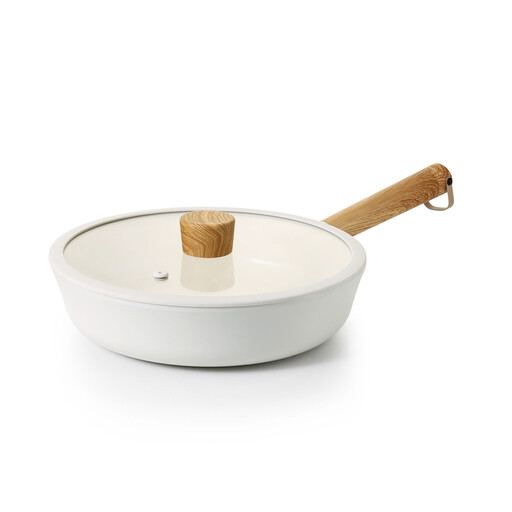
Why this choice suits this type of user: This aluminium pan, with a ceramic coating and magnetic base, is suitable for everyday use on gas, induction, electric and ceramic hobs.
The listing clearly states that a lid is included, that the pan is compatible with several types of hob, and that hand washing is recommended. It also mentions a PFAS- and PTFE-free coating, according to the product information provided.
28 cm diameter, stainless steel magnetic base and ceramic surface designed to make releasing food easier.
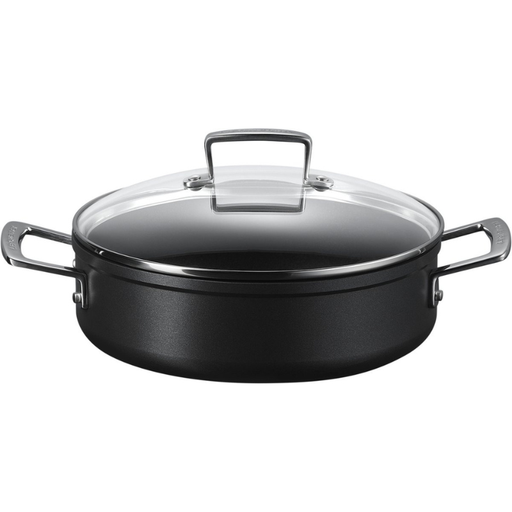
Why this choice suits this type of user: Its 28 cm size and stated 5,4 litre capacity are suitable for family meals, covered cooking and moving from the hob to the oven.
The listing distinguishes between the anodised forged aluminium body, the reinforced coating and the tempered glass lid. Induction compatibility and the maximum oven temperature are also specified.
Stated 5,4 litre capacity, transparent lid and compatibility with induction, gas, electric, ceramic and halogen hobs.
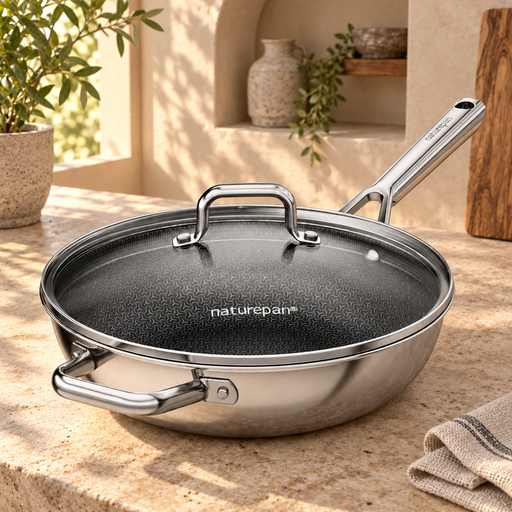
Why this choice suits this type of user: Its multi-layer stainless steel construction, with a conductive aluminium core, promotes even heating. Its textured surface is equally suited to searing and deglazing.
The listing specifies the usage limits: oven-safe up to 230 °C without the lid, not suitable for microwave ovens, with checks recommended for infrared or halogen hobs.
Multi-layer base, engraved hexagonal surface, included lid and stated compatibility with induction, gas, electric and ceramic hobs.
We have put together a comprehensive, real-time updated selection of products that meet these demanding criteria and European safety regulations.
To extend the life of a pan with a lid, a few simple habits can make all the difference:
A heavy, deep 28 cm induction sauté pan is practical for dishes with sauces. However, its weight when full must still be suitable for the way you cook. The length and material of the handle should also be checked, particularly if you regularly use a narrow hob or an oven.
This size is generally suitable for standard family portions, but the actual capacity depends on the height of the sides and the shape of the base. For large quantities of slow-cooked dishes, check the stated capacity rather than relying on the diameter alone.
No. Being PFAS-free concerns the declared composition of the coating. Its durability also depends on the manufacturing process, cooking temperature, utensils used and care. Follow the instructions for the specific model and stop using it if the coating becomes damaged.
It depends on the model. The maximum temperature, handle compatibility and presence of the lid must be checked separately. Some products are oven-safe only without the lid; others are simply not designed for oven use.