
Livraison le jour même ou le lendemain

Qualité garantie

Débloquez vos offres de bienvenue: Livraison GRATUITE | Jusqu'à -80 % | 30 jours d'essai gratuits à JoyPlus
Téléchargez l'application
A 24 × 32 cm squared notebook with 96 pages offers more space than a classic A4 notebook, while remaining easy to slip into a schoolbag, place on a desk or store in a school folder. It is suitable for primary and secondary school pupils, sixth-form students, university students, teachers and professionals who want to organise their notes without running out of room.
Two similar-looking models can nevertheless have significant differences. An overly flexible cover, paper that absorbs ink or a fragile binding can quickly shorten a notebook’s lifespan. Here are the points to check before placing your order.
The mention 24 × 32 cm refers to the notebook’s overall dimensions. It does not necessarily guarantee the same writing area from one model to another: margins, binding and page layout can reduce the space actually available. Larger than A4, this format is particularly practical for homework, diagrams and well-structured note-taking.
Also remember to check the ruling. A 24 × 32 cm Seyès notebook follows the conventions of French school handwriting, while a model with more widely spaced squares may be preferable for taking notes, creating tables or completing certain exercises.
A laminated cardboard cover stands up well to everyday rubbing and knocks, but it does not necessarily protect the pages from moisture or damaged corners. A polypropylene cover, on the other hand, is generally easier to clean and may save you from buying a separate notebook cover.
However, the material is not the only consideration. Also look at whether it has flaps, how flexible the cover is and the quality of the construction.
The number of pages alone is not enough to judge writing comfort. With a paper weight of 90 g/m², as found in several Clairefontaine models, the paper can feel denser and more pleasant than standard school paper. That does not mean ink will never show through: the result also depends on the pen, felt-tip pen or marker you use.
The binding also deserves a closer look. A stitched notebook opens easily and lies flat, making it ideal for everyday homework. However, its staples may suffer if the notebook is handled frequently or filled with loose sheets. In this case, flaps or integrated pockets can make all the difference.
When choosing a large-format school notebook, check these three features:
Commercial descriptions are not always completely consistent. A product described as “large squares” may therefore refer to Seyès ruling, particularly when sold by French stationery manufacturers. It is therefore better to consult the technical details rather than relying on the title alone.
For writing with a ballpoint pen, rollerball or pencil, a smooth surface makes movement more fluid. Clairefontaine Vélin Velouté paper, weighing 90 g/m², is described as suitable for comfortable writing. Oxford’s Optik Paper is described as smooth and resistant to ink bleed-through.
If you plan to use felt-tip pens, always test them on a few pages before deciding that the paper does not show anything through. The phrase “does not bleed through” in a brand description should be understood as a feature stated by the manufacturer, not as a guarantee that applies to every writing instrument.
Models fitted with flaps and pockets allow you to store sheets, tickets, index cards or small accessories without needing to add a pencil case. A transparent cover makes it easy to identify the subject at a glance and can be cleaned with a lightly damp cloth.
To keep your notebook in good condition:
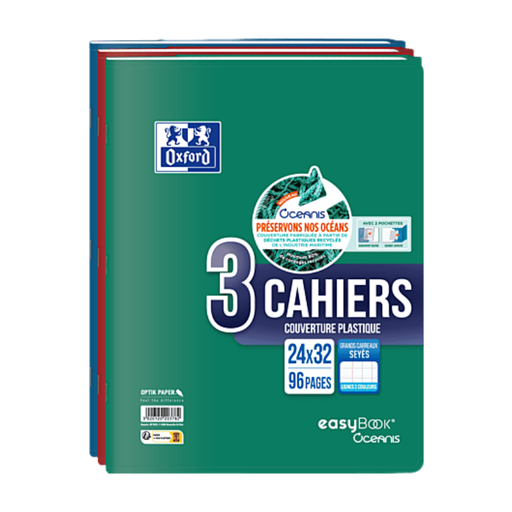
Why this choice suits this profile : this pack of 24 × 32 cm notebooks lets you allocate one to each subject or keep a spare supply for the new school year, without having to buy each notebook separately.
The listing specifies three 24 × 32 cm notebooks, each with 96 pages, Seyès ruling and stitched binding. The key specifications are therefore clearly stated.
A pack of three large-format notebooks, 96 pages per notebook and stitched binding suitable for everyday schoolwork.
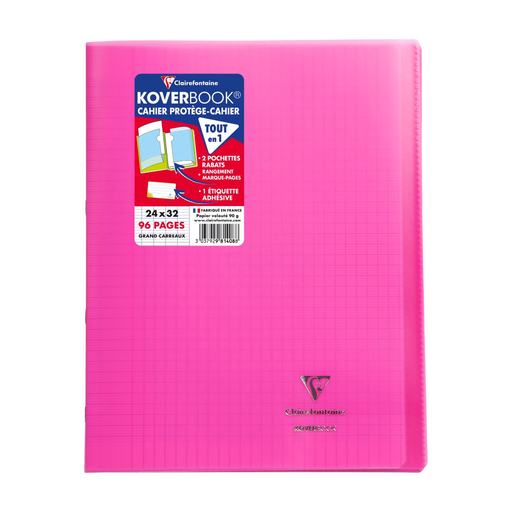
Why this choice suits this profile : this model is aimed at users who prioritise paper quality, page protection and integrated storage.
The integrated polypropylene cover removes the need to buy a separate notebook cover and includes two large flaps for storing documents.
90 g/m² Vélin Velouté paper, 96 pages, Seyès ruling, stitched binding, customisable label and manufacturing stated as taking place in France.
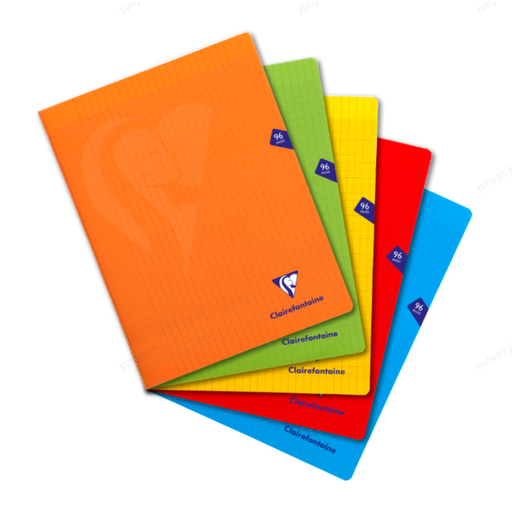
Why this choice suits this profile : this pack is suitable for a family, class or office that uses several notebooks across different subjects and projects.
Each notebook has a transparent polypropylene cover and contains 96 pages. As the colours are described as assorted, the contents of the pack take priority over aesthetic preferences.
Five notebooks, 90 g/m² Clairefontaine Vélin Velouté paper, three-colour Seyès ruling, protective cover and manufacturing stated as taking place in France.
We have brought together a comprehensive, real-time updated selection of products that meet these demanding criteria as well as European safety standards.
In France, Seyès ruling generally refers to the large squares used in primary and secondary schools. It combines closely spaced horizontal and vertical lines with a margin. Some manufacturers add several colours to make visual referencing easier. If your school requires a specific ruling, be sure to check the product details carefully.
It depends on the subject and how often you write. In a subject involving lots of exercises, a 96-page notebook can fill up quickly. For occasional notes or professional use, however, it may last much longer. A pack of three or five notebooks can also help you avoid having to buy replacements repeatedly.
Carry it flat whenever possible, avoid overfilling the pockets and keep it away from moisture. A polypropylene cover can be cleaned with a soft cloth, while the pages should be kept away from water and heat sources.