
Livraison le jour même ou le lendemain

Qualité garantie

Débloquez vos offres de bienvenue: Livraison GRATUITE | Jusqu'à -80 % | 30 jours d'essai gratuits à JoyPlus
Téléchargez l'application
A 24 x 32 cm squared exercise book offers more space than a standard A4 notebook. It works equally well for schoolwork, note-taking, diagrams and professional files. The key is choosing a model that suits your needs.
Before you buy, three common mistakes keep cropping up:
Here are the criteria to examine when choosing a notebook that will stand up to daily use, whether at school or in the office.
The 24 x 32 cm format is very common in primary school, secondary school and sixth form. It leaves enough margin around the text and offers a comfortable surface for writing assignments, adding corrections or creating technical diagrams.
The Séyès ruling corresponds to the French school line system, with its regular line spacing and margin. Some notebooks adopt a three-colour Séyès ruling, with a red margin and lines in different colours. This visual code can help pupils who are still learning to form their letters.
A 96-page Séyès notebook suits subjects that require regular note-taking. For occasional use or a rough work book, 48 pages may be perfectly sufficient. Also check whether you can select the colour when ordering, or whether it is sent at random.
The weight refers to the paper's mass per square metre. At 90 g/m², the Clairefontaine Vélin Velouté paper used in several models feels denser and more pleasant than very thin school paper.
Bear in mind that this weight does not guarantee that no ink will ever bleed through the page. The result also depends on the type of pen or felt-tip you use, and the pressure you apply. For everyday use, check:
Several notebooks made in France from this selection use Clairefontaine 90 g paper, while Oxford models use a different paper. It is therefore worth comparing the technical specifications rather than assuming all notebooks are the same.
A plastic cover or a transparent polypropylene notebook generally protects the pages better from splashes and rubbing than a simple cardboard cover. However, plastic can scratch and does not provide sufficient protection against prolonged exposure to moisture.
Models with flaps and pockets offer a handy space for storing handouts, tickets, index cards or notes you want to keep. This can save you buying a separate folder, even if the flaps take up a little more room in your bag.
The binding should mainly match how you use the notebook:
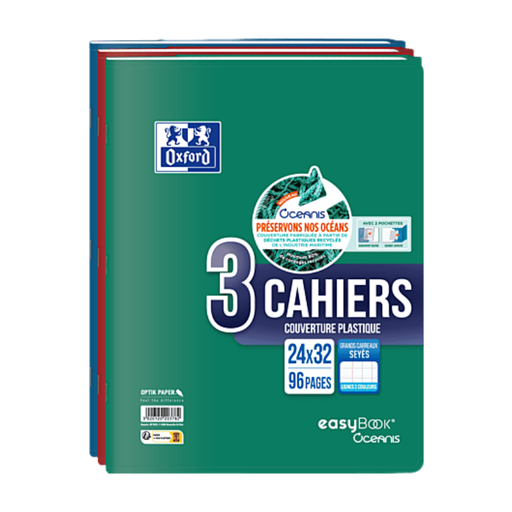
Why this choice suits this profile: This pack of three notebooks lets you organise different subjects without buying each one separately. Each notebook has 96 pages, features Séyès ruling and has a stitched binding.
The product page clearly details the size, ruling and quantity of three notebooks. This makes it easier to compare the actual contents of the pack.
Three 96-page notebooks in the school-standard 24 x 32 cm format, with Séyès ruling.
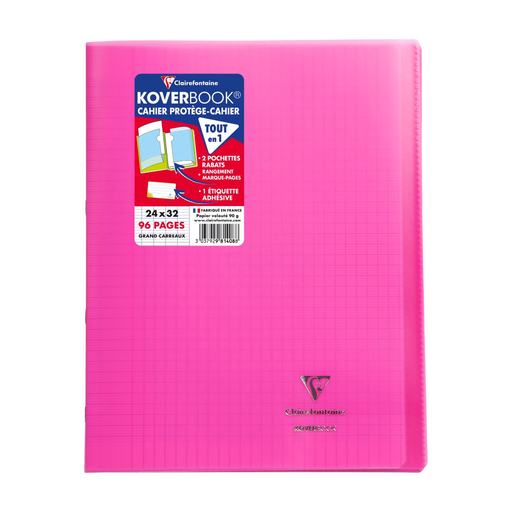
Why this choice suits this profile: This model combines Vélin Velouté 90 g/m² paper, a transparent polypropylene cover and two large flaps with pockets.
The integrated cover saves you buying a separate protective sleeve, while the flaps let you store documents directly with the notebook.
96 pages, 90 g/m² paper, two integrated pockets and stated manufacture in France.
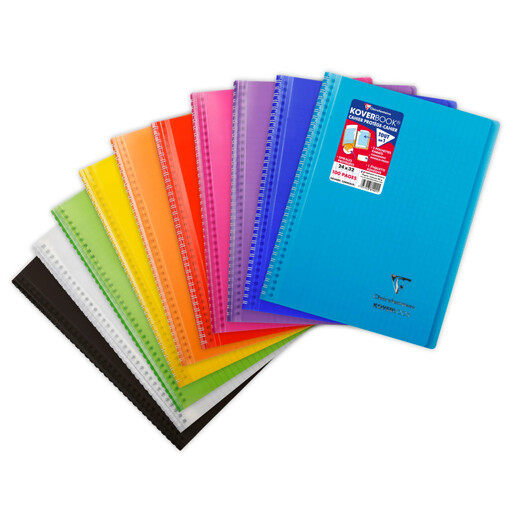
Why this choice suits this profile: Its advertised 360-degree opening suits students, professionals and anyone who writes in a confined space or regularly consults their notes.
The cover also protects the spiral, while the two flaps let you store sheets or keep bookmarks within easy reach.
100 pages, Clairefontaine 90 g/m² paper, 360-degree opening and polypropylene cover.
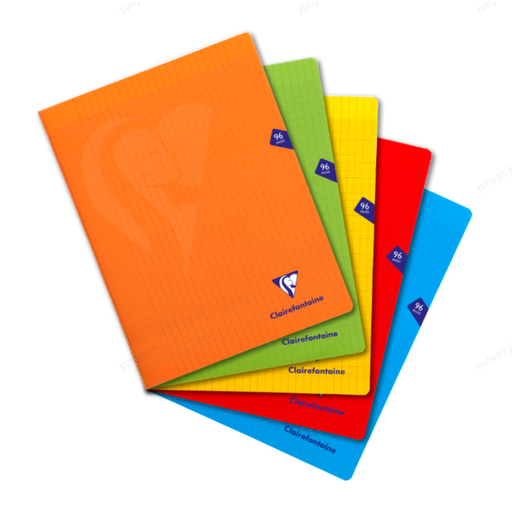
Why this choice suits this profile: This pack of five notebooks is handy for preparing for the new school year, covering several subjects or building up a stock for the office.
The size, number of pages and polypropylene cover are specified for each notebook, so you know exactly what the pack contains.
Five notebooks of 96 pages each, 90 g/m² paper, three-colour Séyès ruling and stated manufacture in France.
We have gathered a comprehensive selection, updated in real time, of products that meet these strict criteria as well as European safety regulations.
Séyès ruling is generally the most suitable for handwriting exercises and school homework in France. For professional notes, tables or diagrams, wide ruling offers more freedom.
It all depends on how often it is carried, the weight of the bag and how the pages are handled. A polypropylene cover withstands everyday rubbing well, but it is best to keep the notebook dry and clean the cover with a soft cloth.
A stitched notebook is generally lighter and works perfectly for standard homework. A spiral notebook opens wider and can be more practical for taking notes on the go. However, check how much space the spiral takes up in your bag, and whether the pages are perforated or detachable.