
Livraison le jour même ou le lendemain

Qualité garantie

Débloquez vos offres de bienvenue: Livraison GRATUITE | Jusqu'à -80 % | 30 jours d'essai gratuits à JoyPlus
Téléchargez l'application
Back-to-school 2026 is approaching, and with it, the famous rush for school supplies. At the heart of every middle or high school supply list, one essential stands out: the 24x32 notebook. Favoured by teachers, this large format is taking over the aisles. But beware—faced with an overwhelming selection, it's easy to make a mistake. Notebooks with bent corners, torn pages, covers ruined in a few weeks… these are headaches that are easy to avoid.
I'm a Lead Product Curator at Joybuy, and my mission is to guide you. Let's break down the pitfalls to avoid and the essential criteria for finding THE 24x32 notebook that will last the whole year, with no unpleasant surprises.
Online and in-store, the stationery aisle is overflowing with options, but not all are created equal. Here are the classic mistakes that turn a bargain into a purchase you'll regret.
To sidestep these traps, you only need to check a few technical details. This is what separates a "disposable" notebook from a true ally for the school year.
Paper weight, expressed in grams per square metre (g/m?), measures the paper's thickness and density.
In France, from middle school to high school, large grid ruling (or Sèyes ruling) is the absolute standard. It is specifically designed to guide handwriting and structure note-taking. A nice touch? Some manufacturers like Clairefontaine offer a two-tone ruling that improves visual comfort by distinguishing the margin, lines, and interlines.
The smartest and most durable solution remains the notebook with an integrated cover. A polypropylene (PP) cover—a plastic that is both flexible and highly resistant—shields the notebook from bumps, stains, and wear. The most clever models, like the Koverbook, even include flaps that double as bookmarks or pockets for loose sheets. A real way to save time, money, and effort.
To put theory into practice, here is our selection of notebooks that check all the boxes, designed for different profiles.
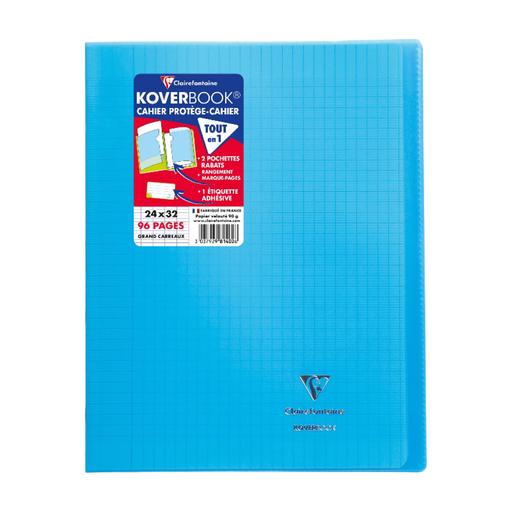
Why we love it: It's the ultimate all-in-one solution. It checks all the boxes on school lists (format, ruling) and includes a robust cover designed to last the entire year. The flaps are a clever detail to ensure you never lose a loose sheet again.
It sidesteps the "false economy" by merging the notebook and cover. Its flexible polypropylene cover is unbreakable, and its 90g/m? paper guarantees perfect opacity.
Durability and convenience. A single purchase for a stress-free school year. The transparent cover lets you see the label or title page at a glance.
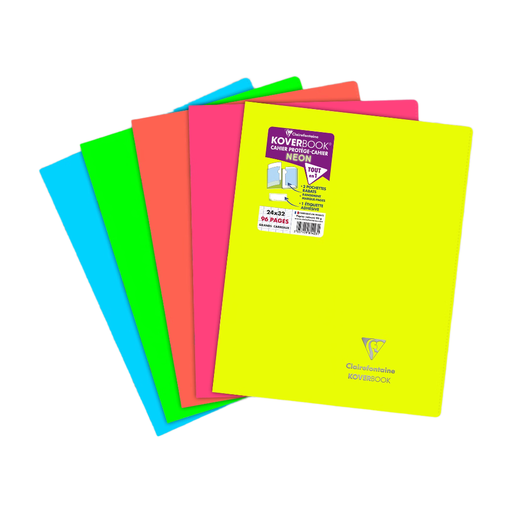
Why we love it: For those who want the sturdiness of the Koverbook with an added touch of style. The bright, opaque colours make it easy to spot the right subject in your bag in a second.
It has the same technical strengths as its transparent cousin: an indestructible polypropylene cover and 90g/m? paper. Bonus: the opaque cover protects the contents from prying eyes and light.
Organisation by colour-coding. One colour per subject lets you pack your bag with your eyes closed and find what you need faster during revision sessions.

Why we love it: As a companion to the large 24x32 notebook, this set of pocket-sized notebooks is perfect for to-do lists, vocabulary, formulas to memorise, or fleeting ideas. Its mini format slips into any pocket.
It prevents cluttering your main notebook with temporary notes. The spiral binding allows for 360° opening, ideal for writing on your lap or on the go.
Compact and specialised. The four-pack allows you to create themed notebooks: one for maths, one for languages, one for key dates, and so on.
In addition to class notebooks, exam season requires the right tools. A good revision notebook can make all the difference.
Discover our complete selection of revision notebooks and flashcards, all approved by our experts for their quality and practicality.
1. Why do teachers always ask for the 24x32?cm format? The 24x32?cm format is slightly larger than an A4 sheet (21?x?29.7?cm). This extra space is crucial: it allows you to glue in handouts and worksheets (usually A4) without them sticking out or getting creased. It's the secret to keeping a notebook neat all year long.
2. 96 pages or 192 pages: which one to choose? The page count indicates the number of writable sides. A 96-page notebook (which has 48 sheets) is the most common. It's suitable for most subjects for a term or a semester. The thicker 192-page format (96 sheets) should be reserved for main subjects with a large volume of notes, allowing you to use it for the entire year without switching notebooks.
3. Is a notebook with an integrated cover really more cost-effective? Yes, if you think about the entire school year. A good separate book cover already costs a few pounds. If it cracks (which often happens), you have to replace it. The integrated cover, on the other hand, is designed to last the whole year and protects the notebook better. This prevents you from having to buy a new notebook in a panic in the middle of March because the old one is damaged. The initial investment quickly pays for itself.