
Livraison le jour même ou le lendemain

Qualité garantie

Débloquez vos offres de bienvenue: Livraison GRATUITE | Jusqu'à -80 % | 30 jours d'essai gratuits à JoyPlus
Téléchargez l'application
The back-to-school supply run can quickly become a headache. Among the essentials, the 24x32 notebook is a staple on middle and high school lists. But with an overwhelming number of options, how can you be sure you're making the right choice? A poor-quality notebook can quickly become a source of frustration, with pages that tear at the slightest touch, ink that bleeds and ghosts through the paper, and a cover that falls apart before the first school break.
Before you fill your shopping cart, watch out for these common traps that can waste your time and money:
To avoid these disappointments, a few technical specifications are worth a closer look. They make all the difference in daily use and are the secret to a stress-free school year, at least when it comes to supplies.
A notebook's durability primarily depends on its cover. While classic card covers are budget-friendly, they sorely lack the durability to withstand the rigours of a middle or high schooler's life.
The solution? The polypropylene (polypro) cover. This plastic material, both flexible and sturdy, is waterproof and virtually tear-proof. A notebook with a polypro cover doesn't need a separate protector. It stays pristine for much longer and effectively protects the pages inside. It's the smart and cost-effective choice in the long run.
Paper weight, expressed in grams per square metre (gsm), is the heart of the matter. It determines the paper's thickness and opacity. Standard paper is around 70-80 gsm. For optimal writing comfort and to prevent ink from bleeding or ghosting, 90 gsm paper is the quality standard to aim for.
Clairefontaine's 90 gsm Vellum paper, for example, is a benchmark for its whiteness and perfectly smooth surface, which ensures an unparalleled glide. It's your guarantee that you can use every page, front and back, without any frustration.
A common feature in French schools, the Sèyes ruling, also known as a "large grid", is the standard in our educational institutions. It is designed to help with learning and structuring handwriting by guiding letter height and line spacing. Some notebooks go a step further with a three-colour ruling (red margin, purple writing lines, blue interlines) to improve visual comfort and the readability of notes.
To help you make an informed decision, we've selected models that tick all the boxes, suited for different profiles and needs.
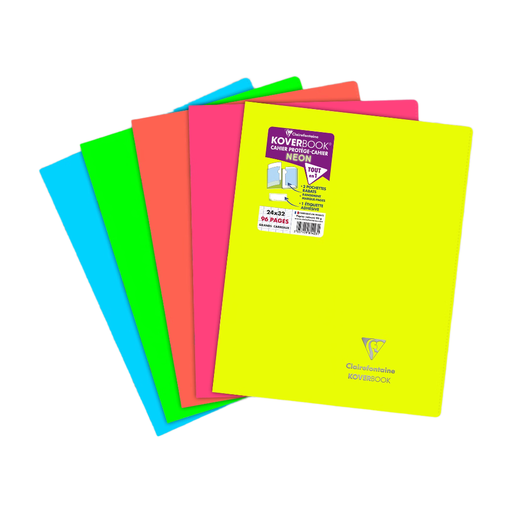
Why we chose it: This is the ultimate all-in-one solution. Its polypropylene cover includes two large flaps that double as bookmarks and pockets for storing loose papers. Perfect for heavy use throughout the year.
The integrated polypro cover makes buying a separate notebook protector obsolete. It's designed to withstand wear and tear and last the entire school year.
Clairefontaine 90 gsm paper for a premium writing experience. The storage flaps are a major asset for keeping documents from getting lost.
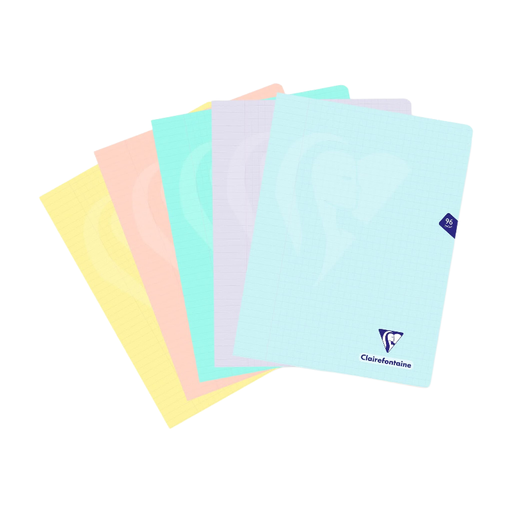
Why we chose it: Perfect for parents who want to tick off the school supply list in one go. This bundle covers multiple subjects with quality notebooks, all while optimising your budget.
Buying a pack of notebooks is much more cost-effective than buying them individually. Since each notebook has a polypro cover, you also avoid hidden costs.
Excellent value for money for 5 sturdy notebooks with 90 gsm paper. The pastel colours make it easy to assign a notebook to each subject at a glance.
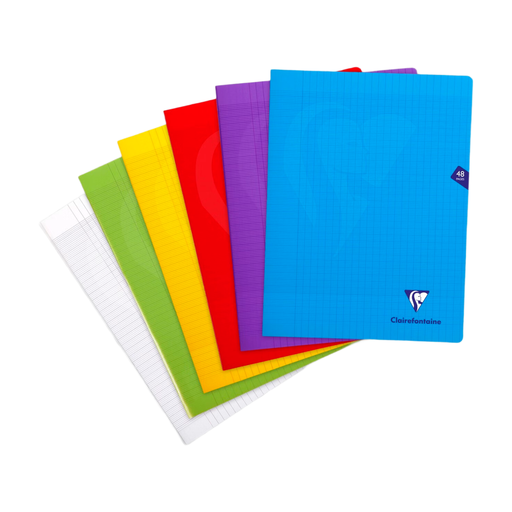
Why we chose it: For a subject that requires few notes or for a one-off project, a 48-page notebook is more than enough. It lightens the school bag and prevents paper waste.
This notebook makes no compromises on quality. It retains a polypro cover and 90 gsm paper, ensuring the same durability and comfort as its larger counterparts.
A smart, lightweight 48-page format, perfect for targeted use without sacrificing the cover's sturdiness or the paper's quality.
Explore our full selection of notebooks that meet our quality and educational standards.
The 24x32 cm format is slightly larger than A4 (21x29.7 cm). This wider format, typically French, is favoured in schools because it allows students to glue in A4 sheets (handouts, documents distributed in class) without them sticking out. It's a practical detail that makes all the difference for organisation.
The ideal number of pages depends on the subject and the teacher's preferences.
90 gsm paper is synonymous with absolute writing comfort. Ink doesn't bleed through, allowing you to use both the front and back of every sheet with no readability issues. The pages are also more resistant to repeated erasing. Even if it's slightly more expensive upfront, it quickly pays for itself: by allowing you to use 100% of the notebook, it prevents waste.