
Livraison le jour même ou le lendemain

Qualité garantie

Débloquez vos offres de bienvenue: Livraison GRATUITE | Jusqu'à -80 % | 30 jours d'essai gratuits à JoyPlus
Téléchargez l'application
A 22 kW Type 2 charging cable may seem simple to choose. However, several factors determine its compatibility with your electric car, ease of use and durability. A stated power rating of 22 kW does not, on its own, guarantee charging at that speed.
The main pitfalls concern socket compatibility, the power actually accepted by the vehicle and the cable’s ability to withstand repeated handling. Choosing the wrong length can also make parking more difficult or force you to leave the cable on the ground, in a pedestrian area.
A three-phase 32 A electric car charging cable may be rated at 22 kW, but charging power also depends on the on-board charger, or OBC. If your vehicle only accepts 11 kW of alternating current, the cable will not allow charging at 22 kW.
Before placing your order, check your car’s manual or technical specifications for:
Plug-in hybrid vehicles often have a more limited on-board charger. A 22 kW cable may work perfectly well, but the car will not necessarily charge any faster.
The Type 2 connector is very common in France for accelerated alternating-current charging. A vehicle fitted with a combined CCS2 socket generally uses the Type 2 section for AC charging. This does not mean that a Type 2 cable can replace a CCS2 cable for rapid direct-current charging.
A male-to-female Type 2 cable is not suitable for J1772, CCS1 or CHAdeMO sockets. Before ordering, check the shape of the socket on both the car and the charging point.
A 5 m three-phase Type 2 cable is often the most practical option when the charging point is directly in front of the car. A 10 m three-phase Type 2 cable offers greater flexibility if the space is tight, the charging point is to the side or the vehicle has to be parked in a particular position.
The trade-off is that 10 m means more weight and bulk to store. Avoid leaving the cable looped in an area where it could be driven over or cause someone to trip.
To reach the stated power of 22 kW, three conditions generally need to be met:
A 22 kW cable can therefore be used with a lower-powered charging point, but charging will be limited by the charging point or the vehicle. The maximum power shown on the packaging is not a universal promise of charging speed.
For regular use, look for precise information about standards and certifications. A reference such as TÜV, CE, RoHS or IEC should be accompanied by a clear product specification relating to the model concerned. TÜV certification does not remove the need to check electrical compatibility with your car.
Silver-plated contacts, ultrasonic welding and a PA66 housing combined with TPU are all construction features worth considering. They provide information about the product’s design, but do not on their own guarantee the same service life in every condition.
A cable advertised as IP54 water-resistant is protected against harmful quantities of dust and water splashes. This rating does not mean that the connectors can be immersed or left outside in the rain without precautions.
A TPU sheath, an operating range of -40 °C to +50 °C and a stated resistance of more than 20,000 bends may be useful if you transport the cable frequently. Nevertheless, after each charge, store it with its protective caps fitted and avoid excessive twisting.
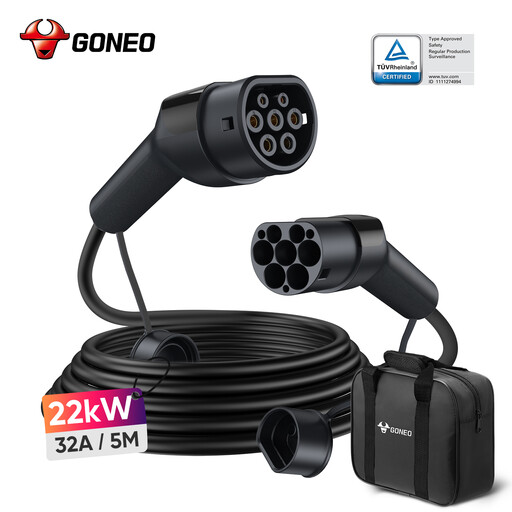
Why this choice suits this profile : its 5 m length is ideal for charging at home or at a charging point installed close to the parking space. The carry bag makes it easy to store in the boot.
The power rating, current, three-phase design and TÜV certification are clearly stated. This reduces the risk of choosing an underspecified cable simply because it is cheaper.
22 kW, 32 A, three-phase, IP54 rating, TPU sheath and a stated operating temperature of -40 °C to +50 °C.
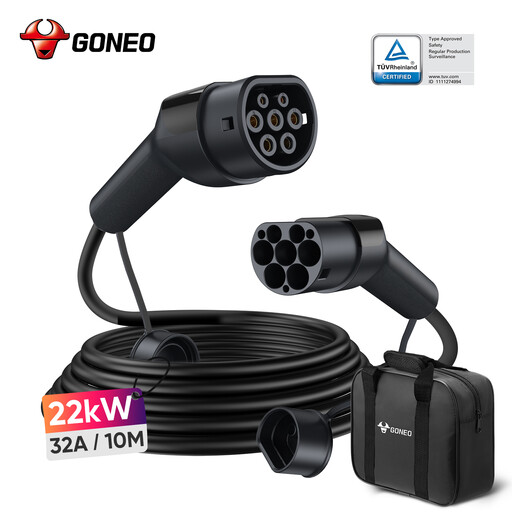
Why this choice suits this profile : its 10 m length provides plenty of flexibility in public car parks when the charging point is offset or the parking layout is awkward.
Its length means you do not have to move the car when the charging point is poorly positioned. However, make sure you have enough storage space for its bulk.
Silver-plated connectors, stated ultrasonic welding, TPU sheath and compatibility indicated for Type 2 and CCS2 vehicles.
No. Power depends on the vehicle, charging point and electrical installation. If the car’s OBC is limited to 11 kW, the cable will work, but charging will remain capped at that level.
Choose 5 m when the charging point is close to the car’s charging socket. The 10 m model is better suited to public charging points or spaces where the vehicle’s orientation may vary. However, a longer cable requires more care to prevent twisting and loops.
The IP54 rating indicates protection against dust and water splashes, not immersion or all forms of prolonged exposure to the weather. After charging, dry the connectors if necessary, replace the caps and store the cable in a covered area.