
Livraison le jour même ou le lendemain

Qualité garantie

Débloquez vos offres de bienvenue: Livraison GRATUITE | Jusqu'à -80 % | 30 jours d'essai gratuits à JoyPlus
Téléchargez l'application
If you drive an electric vehicle, you know that charging time is a key factor. Upgrading from a slow domestic socket to a more powerful solution can completely transform your daily routine. The 22?kW mobile wallbox emerges as the holy grail: the promise of speed and flexibility. But beware of marketing hype. The market is flooded with confusing claims, and without a minimum of vigilance, your investment could prove unsuitable, or even dangerous.
This guide breaks down the essentials for you, without unnecessary jargon, to help you make a truly informed choice.
The promise of lightning-fast charging can make it easy to overlook some fundamental technical details. Here are the two most common pitfalls to avoid:
To avoid making a mistake, focus on these three points. They determine the daily efficiency and safety of your charging.
Charging power is directly dependent on the socket type. It is crucial to match your charger to your electrical installation.
Your car is the deciding factor.
A smart wallbox with an app can be very practical... if it's well-designed. The features that make a real difference include:
Instead of a generic product list, here are targeted solutions for specific needs, taking into account the criteria and pitfalls we've just discussed.
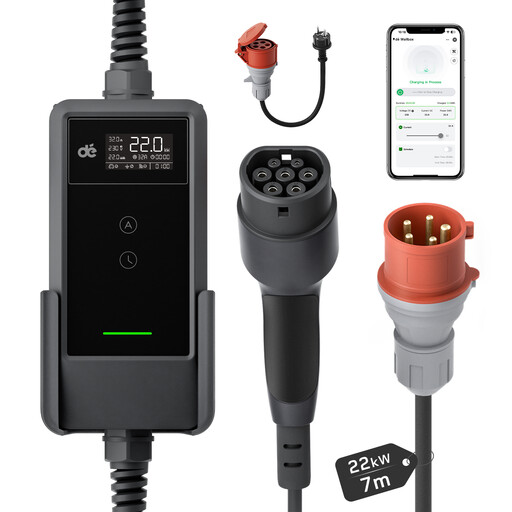
Their Need: They own a vehicle that accepts fast charging (11 or 22 kW) and have a CEE 32 A socket at home or at the office. Their goal: maximum charging speed without sacrificing the flexibility of a portable charger.
No false promises here. This charger is built for the CEE 32 A socket, ensuring that 22 kW is genuinely achievable with the right installation. The app provides real control, not just a gimmick.
Maximum power of 22 kW three-phase. Smart control via the app (scheduling, current adjustment). Generous 7-metre cable.
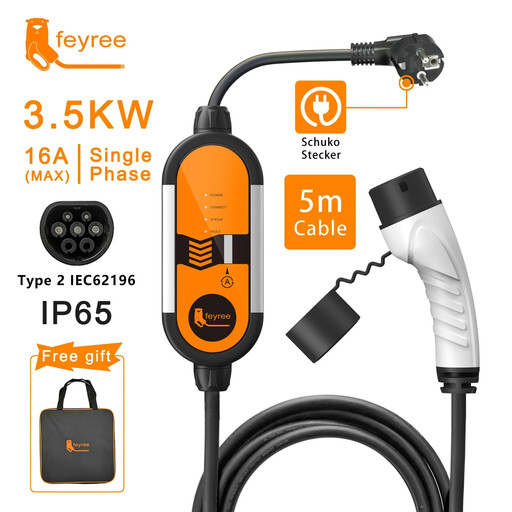
Their Need: Perfect for someone who plugs in just about anywhere (home, second home, at a friend's house) and usually only has access to standard domestic sockets. For them, the priority is simplicity and portability.
This charger is upfront and honest. Designed for a Schuko socket, it delivers a realistic 3.5 kW and avoids the "22 kW mirage" pitfall. It includes all the essential safety protections.
"Plug-and-play" solution for any domestic Schuko socket. Adjustable current (from 8 A to 16 A) to adapt to any circuit. Ultra-compact and easy to store in the trunk.
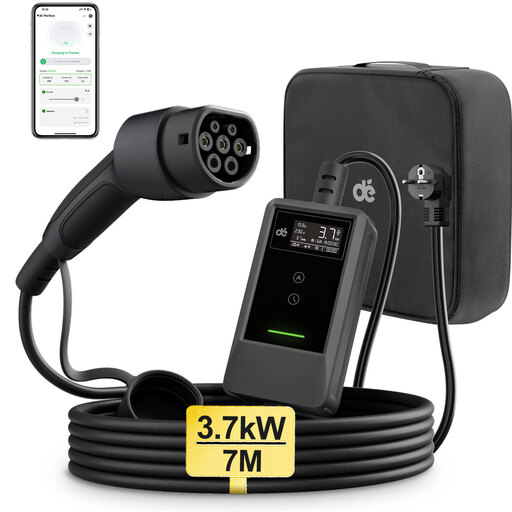
Their Need: They only have a standard socket available but want to get the most out of their charging with smart technology. Their goal: to schedule sessions and monitor consumption from their smartphone.
This model combines genuinely useful smart features (scheduling, monitoring) with a realistic 3.7 kW output. It thus avoids the trap of gimmicky apps paired with chargers that have unrealistic performance claims.
Full control via a mobile app on a simple Schuko socket. Generous 7-metre cable and comprehensive protections (IP66, Type A RCD + 6mA DC).
We have curated a complete selection of chargers that meet our selection criteria and European safety standards.
Is a 22?kW mobile wallbox compatible with my car that only accepts 11?kW? Yes, absolutely. The system is designed to be backward compatible. The charger and the vehicle "communicate" to agree on the maximum power the car can receive. In your case, the charge will automatically be limited to 11?kW. The advantage? Your charger is already future-proof for your next vehicle, which might be capable of 22?kW charging.
Do I need an electrician to install a 22?kW mobile charger? For the charger itself, no, it's a "plug-and-play" device. However, to use it at full power, you need the right socket: a three-phase CEE 32?A industrial socket. If your garage isn't equipped with one, the intervention of a qualified electrician (EVSE-certified is recommended) is essential to install it and verify that your electrical panel can safely handle the load.
What is the difference in charging time between a 3.7?kW and a 22?kW charger? The difference is colossal. A 22?kW charger is up to six times faster than a 3.7?kW model. For example, with a 50?kWh battery, a full charge will take about 14 hours at 3.7?kW. With a 22?kW charger (and a compatible car), this time drops to about 2.5 hours. It's a spectacular time-saver for high-mileage drivers.