
Livraison le jour même ou le lendemain

Qualité garantie

Débloquez vos offres de bienvenue: Livraison GRATUITE | Jusqu'à -80 % | 30 jours d'essai gratuits à JoyPlus
Téléchargez l'application
For any electric vehicle owner, reducing charging time is a top priority. Waiting hours for a full battery can be a real hassle, both at home and on the go. The 22?kW mobile charging station stands out as a premium solution, provided you have a suitable electrical setup and a compatible vehicle.
This guide breaks down the essential criteria to consider before making a purchase and presents our selection of the best models currently available. Our goal: to give you all the information you need to make an informed decision, with full transparency and without the marketing jargon.
Choosing a portable electric car charger isn't something to be taken lightly. Several technical criteria must be carefully reviewed to ensure the product meets your needs and is compatible with your setup.
The 22?kW power output is achieved through a three-phase 32-amp power supply (3P+N+E, 400V). Before you commit, it's crucial to check two things:
The main advantage of a portable EV charger is its versatility. You can use it at home, at a second home, or at an equipped workplace. The most advanced models go even further by offering comprehensive management via a mobile app.
A connected 22?kW station typically allows you to:
Safety is non-negotiable. A good charger must include multiple protections. Insist on a built-in Type B Residual Current Device (RCD) (or Type A + 6?mA DC), which protects against the DC leakage currents specific to electric vehicles. The IP (Ingress Protection) rating is also crucial: an IP66 rating ensures complete protection against dust and powerful water jets, allowing for outdoor use with complete peace of mind.
Here are a few options that cater to different needs, from ultra-fast charging to a portable solution for everyday use.
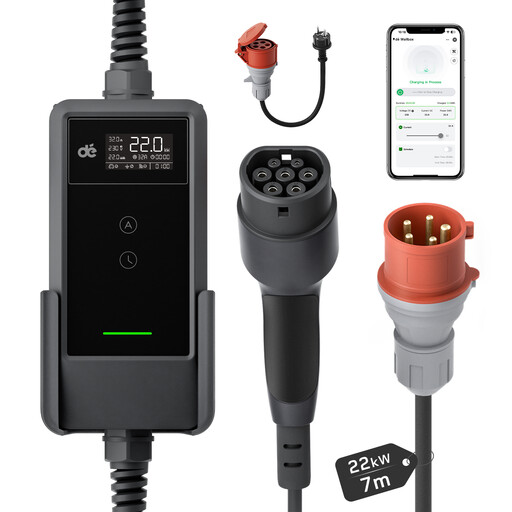
Why it stands out
This model is the epitome of a high-performance three-phase mobile wallbox. It combines a maximum power of 22?kW with the flexibility of remote control via an app, creating a comprehensive solution that optimises charging.
Pros
Who is it for?
For owners of Renault Zoe, Tesla, or other compatible electric vehicles with an 11/22?kW onboard charger, who have access to a CEE 32A socket and want to minimise their charging time while maintaining precise control over their energy use.

Why it stands out
Although its power is limited to 7?kW (single-phase 32?A), this feyree charger stands out as a robust alternative designed for fixed installation. Its aluminium alloy body ensures excellent durability, making it a reliable choice for a garage or outdoor parking space.
Pros
Who is it for?
For those looking for a primary home charging solution on a single-phase 32?A system. It's suitable for almost all electric and plug-in hybrid vehicles on the market, offering a very respectable charging speed (recovering about 40 to 50?km of range per hour).

Why it stands out
This GONEO charger is the ultimate portable tool. By plugging into a standard domestic socket (Schuko 16?A), it lets you charge your vehicle absolutely anywhere: at a friend's house, on holiday, or in an emergency. Its scheduling function is a real bonus for managing your electricity costs.
Pros
Who is it for?
For all EV/PHEV owners looking for a backup or travel charger, or for those who can't install a dedicated station. It's the perfect emergency solution or for slow, economical charging.
If these models don't tick all your boxes or if you need specific accessories to adapt your equipment to different types of sockets, other options are available.
? Explore our full range of car plug adapters to find the accessory you need.
1. What is the real-world difference between 11?kW and 22?kW charging?
A 22?kW station can, in theory, charge a vehicle twice as fast as an 11?kW station. For example, a 52?kWh battery (like in a Renault Zoe) would fully charge in about 2.5 hours at 22?kW, compared to nearly 5 hours at 11?kW. However, it all depends on your car's onboard charger capacity: a model limited to 11?kW will never charge any faster, even when connected to a 22?kW station.
2. Can I install a CEE 32A industrial socket at home?
Yes, it's entirely possible, but it requires the work of a certified professional electrician. They will need to ensure your electrical service is three-phase and has sufficient capacity. They will then run a new dedicated line from your electrical panel, protected by an appropriate circuit breaker, to guarantee a safe and professional installation that is up to code.
3. Is a mobile charger as safe as a fixed wallbox?
Absolutely, as long as you choose a quality product that complies with European standards (CE marking). Mobile chargers incorporate the same electronic protections as fixed wallboxes (over-voltage, current leakage, etc.). The only real difference is the connection point. You just need to ensure that the socket you plug it into is in perfect condition and properly rated for the required power.