
Livraison le jour même ou le lendemain

Qualité garantie

Débloquez vos offres de bienvenue: Livraison GRATUITE | Jusqu'à -80 % | 30 jours d'essai gratuits à JoyPlus
Téléchargez l'application
A centrepiece in our kitchens, the cast iron Dutch oven is the promise of slow-simmered dishes and unforgettable flavours. But faced with a vast array of available models, how do you find your way? A poor choice can quickly turn this beautiful investment into a regret. To ensure you make the right choice, it's crucial to understand the pitfalls to avoid and the criteria that truly make a difference. This guide breaks down the technical features that guarantee a successful purchase and years of cooking pleasure.
Don't be swayed by marketing: a Dutch oven's true value lies in its technical details. Here are three deal-breakers that can turn preparing your meals into a real chore.
To be certain of your choice, get back to basics. Three key criteria determine the performance, versatility, and lifespan of your Dutch oven.
The secret to a perfectly simmered dish lies in the exceptional thermal inertia of an enameled cast iron Dutch oven. It stores heat, diffuses it evenly, and releases it gently. The quality of the enamel is just as crucial: inside, a light-coloured interior is ideal for monitoring the caramelisation of juices; outside, it must be robust enough to withstand daily bumps and simplify cleaning.
A 20 cm round Dutch oven (approximately 2.4 L) is often the best compromise. It's the perfect size for a couple or a small family (2 to 3 people), but also for cooking side dishes, soups, or even homemade bread. Neither too bulky for daily use nor too small for a dinner with friends, it offers an ideal balance.
Demand compatibility with all heat sources, including induction. A 20 cm induction-ready Dutch oven worthy of the name must have a perfectly flat, ferromagnetic base. Another non-negotiable point: oven compatibility. Check that the Dutch oven and its lid knob can withstand high temperatures (over 220°C), a prerequisite for roasts or baking bread.
For every type of cook, there's an ideal Dutch oven. To help you find yours, we have selected several models that meet specific needs, based on purely technical criteria.
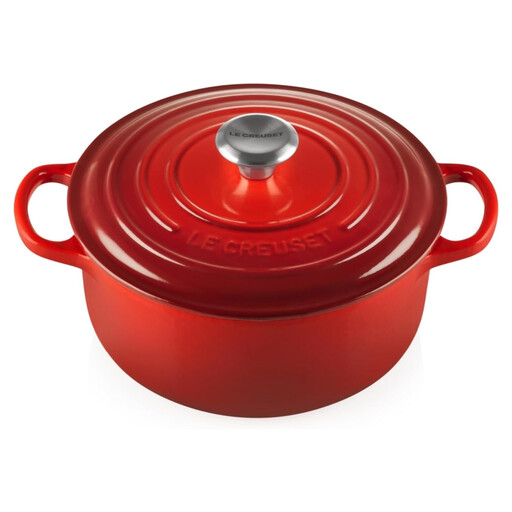
Why this choice: For those who want the icon, French craftsmanship, and culinary performance that is second to none. Its Le Creuset Cerise colour is a timeless classic that will sit elegantly on your table.
Its enamel, renowned for its exceptional durability, is designed to last for decades. The base is machined to ensure perfect flatness on induction hobs, and the large handles of the Signature range offer a secure grip.
Unparalleled heat retention and distribution for gentle, perfectly even cooking. Absolute versatility: all hobs, oven, and straight to the table for serving.
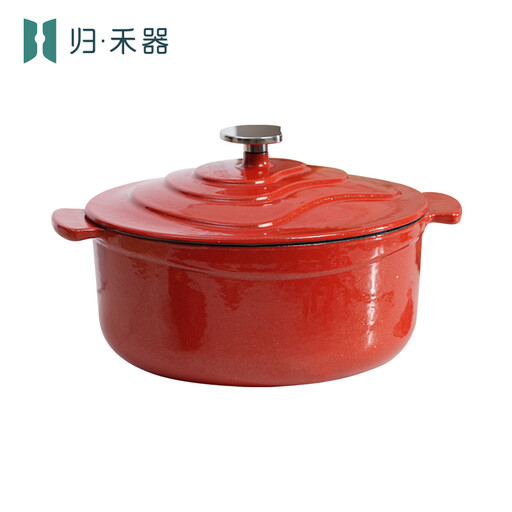
Why this choice: A functional alternative to enjoy the benefits of enameled cast iron daily, with a comfortable capacity (3.3 L) at a more accessible price point.
Made of enameled cast iron, its induction compatibility is clearly stated, which implies a suitable flat base. Its unibody handles (integrated into the pot) are a guarantee of robustness.
An excellent capacity-to-price ratio for 3-4 people. Its versatility (soups, stews) and touch of colour make it a valuable ally in the kitchen.
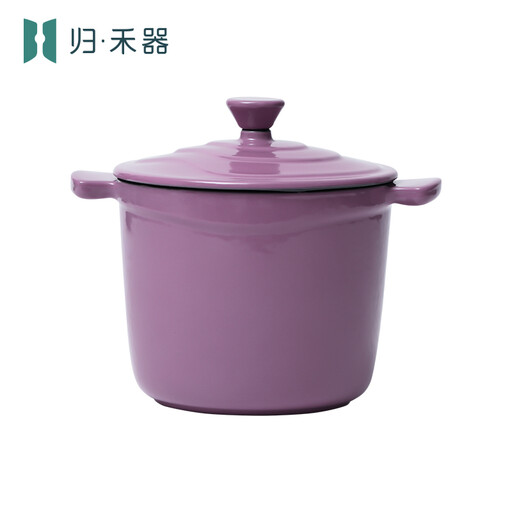
Why this choice: Ideal for a single person, for reheating an individual portion, making a sauce, or preparing a baby's meal. Its compact size makes it very easy to handle and store.
Its small size ensures rapid heating and excellent cooking control. It is designed to be versatile and compatible with induction.
An ultra-practical mini format for small quantities, which saves you from using (and cleaning) a large, energy-intensive Dutch oven. Its colourful design is a nice bonus.
Discover our complete selection of Dutch ovens that meet our quality charter and European safety standards.
A 20 cm (2.4 L) Dutch oven is perfect for 2 to 3 people. For a family of four or more, or if you often cook in large quantities (batch cooking), you should opt for a 24 cm (approx. 4.2 L) or 26 cm (approx. 5.3 L) model for your main dishes.
Absolutely! It's actually one of the best techniques. By trapping steam, a closed Dutch oven recreates the atmosphere of a professional baker's oven. The result: your bread rises beautifully and develops a golden, incredibly crispy crust. The only requirement: check that the lid knob can withstand the very high temperatures required (often 250°C).
It's very simple. Always let it cool down before cleaning to avoid thermal shock. A little hot water, washing-up liquid, and a soft sponge are all you need. Even though many models are dishwasher-safe, hand washing will preserve the enamel's shine for decades. Remember to dry it thoroughly before storing.