
Livraison le jour même ou le lendemain

Qualité garantie

Débloquez vos offres de bienvenue: Livraison GRATUITE | Jusqu'à -80 % | 30 jours d'essai gratuits à JoyPlus
Téléchargez l'application
The idea of off-grid energy independence, whether you're deep in nature or on a van life adventure, is compelling. A 200W portable solar panel seems like the perfect solution to power your devices, no matter where you are. However, the market is flooded with products that rarely deliver on their promises, making buyer's remorse a common feeling. Before you commit, it's crucial to know how to avoid the common pitfalls that could turn your investment into a major disappointment.
Here are the key things to watch out for to make an informed decision.
Enthusiasm for a 200W portable solar kit can quickly fade when faced with products that don't live up to their claims. Here are three common pitfalls:
To ensure your solar panel will meet your needs, focus on these key technical specifications rather than on marketing claims.
The type of photovoltaic cells determines your panel's efficiency. For portable use, monocrystalline silicon cells are the clear winner. They offer a higher conversion efficiency (often over 20%) compared to polycrystalline cells. In practical terms, this means that for the same wattage, a monocrystalline panel will be more compact and lighter—a crucial advantage for an RV solar charger or for general transport.
A good portable solar panel should be adaptable to various pieces of equipment. Check the available outputs:
A 200W panel can quickly become cumbersome. Carefully examine its physical characteristics:
Rather than drowning you in an endless list of products, we've identified options that cater to distinct user profiles, based on our criteria for performance and versatility.
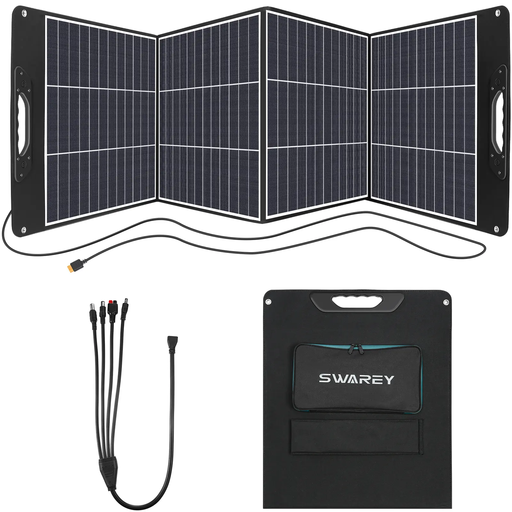
Why it's a great choice: Ideal for van, camper, or RV owners who need substantial power to run a solar generator for a van, a refrigerator, a laptop, and other power-hungry devices.
This panel uses high-efficiency monocrystalline cells (up to 23% according to the manufacturer). It sidesteps the compatibility trap with its XT60 output and included 4-in-1 adapter cable (Anderson/DC), making it compatible with most power stations on the market.
Its versatility: it delivers a strong 200W output for power stations, but also includes USB-A, QC3.0, and USB-C (18W) ports for directly charging smaller devices. Its adjustable kickstands and manageable weight (5.5 kg / 12.1 lbs) make it very practical in the field.
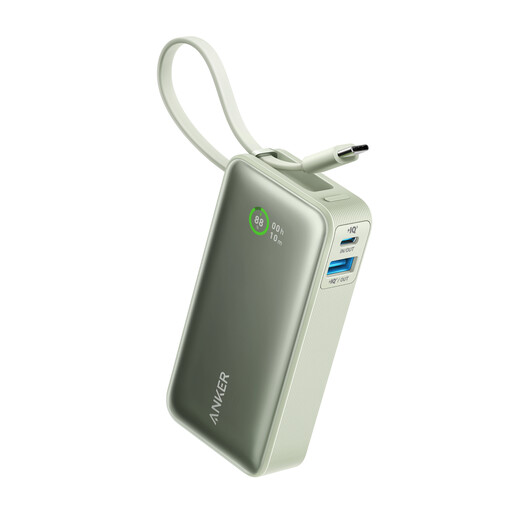
Why it's a great choice: For day hikes, lightweight camping, or as an everyday backup battery. When a 200W panel is overkill, this compact power bank handles the essentials: keeping your phone and small devices charged.
As a power bank, it offers a guaranteed and predictable power solution that is completely independent of the weather. It eliminates the uncertainty of solar generation for short-term energy needs.
Its ultra-compact design and integrated USB-C cable make it an everyday companion. The 30W two-way fast charging allows you to recharge the power bank itself, as well as your compatible devices, very quickly.
To efficiently connect all your devices to your new panel or power station, a quality cable is essential. Make sure you have the right USB-C cable to take advantage of fast and reliable charging.
We've compiled a comprehensive, up-to-date list of products that meet these strict selection criteria and current safety standards.
The actual power output depends on many factors: sun intensity, panel angle, temperature, and the cleanliness of its surface. On a bright, sunny day with optimal angling, you can expect to get between 70% and 85% of the rated power, which is about 140W to 170W. This level of performance is more than enough to efficiently recharge most portable power stations.
Yes, but the output will be significantly reduced. Modern monocrystalline cells can still generate some energy under an overcast sky, but don't expect more than 10% to 25% of the rated power. This is enough to maintain a battery's charge or very slowly charge a smartphone, but it's insufficient for more power-hungry devices.
It's not mandatory if your needs are modest. Many panels, like the SWAREY model featured, include built-in USB-A and USB-C ports. You can directly plug in a phone, tablet, or power bank. However, to store energy for later use (especially at night) or to power devices that require a 230V AC outlet, a portable power station becomes essential. It acts as a buffer, stabilising the current and offering much greater flexibility.