
Livraison le jour même ou le lendemain

Qualité garantie

Débloquez vos offres de bienvenue: Livraison GRATUITE | Jusqu'à -80 % | 30 jours d'essai gratuits à JoyPlus
Téléchargez l'application
Energy independence has become a quest for a growing number of outdoor enthusiasts, van lifers, and anyone seeking a reliable backup solution at home. The 200W portable solar panel often emerges as the ideal solution, but the market is saturated with promises that don't always hold up in the real world. Our mission: to help you decode spec sheets and avoid marketing traps to make a truly informed choice.
Before you invest, it's crucial to know the three common mistakes that can turn a promising purchase into a regret:
To avoid these disappointments, ignore the marketing slogans and focus on objective technical specifications. Here are the three points to scrutinise.
Efficiency is the crucial factor: the panel's ability to convert sunlight into electricity. A high-efficiency solar panel will provide more energy for the same surface area—a decisive advantage in overcast weather.
For a 200W portable solar panel, opting for monocrystalline technology is therefore the guarantee of more consistent energy production and a smaller footprint.
A good portable solar panel kit must be able to charge all your devices, without exception. Its versatility is therefore a non-negotiable criterion. Check for the presence of:
Portability is the very essence of a foldable solar charger.
Rather than listing random products, here are options that meet specific needs, validated against the criteria we've just discussed.
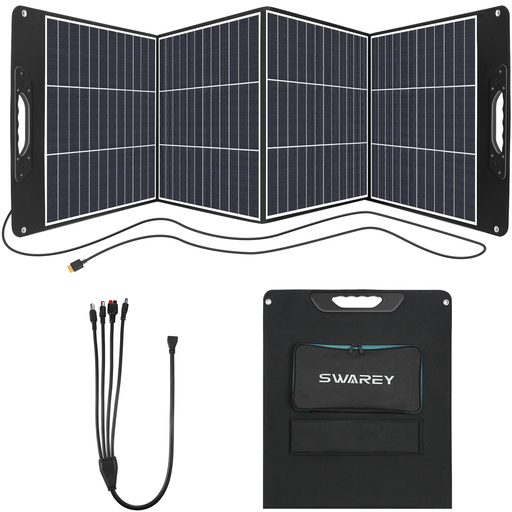
Who is this for? Ideal for camper van solar panel users or power station owners who need a powerful and reliable power source for their off-grid adventures.
It sidesteps the compatibility trap with its XT60 cable and 4-in-1 adapter set (Anderson/DC). Its monocrystalline cells deliver on their power promise with high efficiency.
High conversion efficiency (up to 23%). Adjustable kickstands for optimal exposure. USB-A, QC3.0, and USB-C (18W) ports for direct charging.
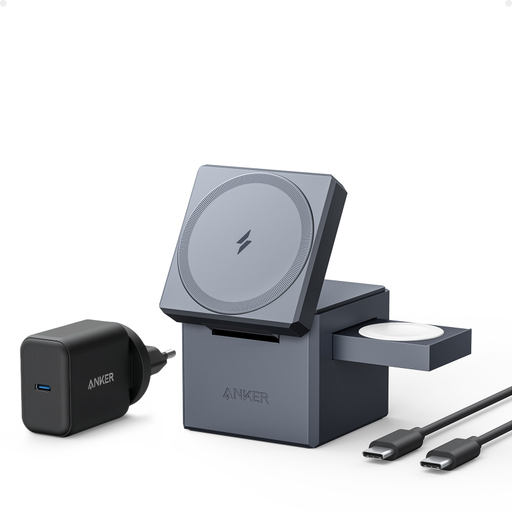
Who is this for? For those who travel with an iPhone, Apple Watch, and AirPods, and want a single, compact, wireless charging solution to plug into a power station or wall outlet.
It eliminates the clutter trap by replacing three chargers and their cables with a single foldable cube. No more tangled messes or forgotten chargers.
Simultaneous 3-in-1 charging (iPhone, Watch, AirPods). Ultra-compact, foldable design. 15W MagSafe compatible for fast iPhone charging.
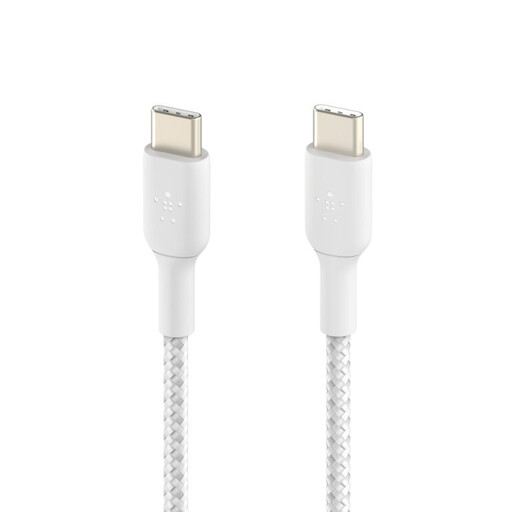
Who is this for? For those who already have a power source (panel, station, wall charger) and are looking for a single, rugged, certified cable to fast-charge all their USB-C devices.
It ends the nightmare of cheap cables that fray, charge slowly, or aren't recognised. Its braided jacket is designed to withstand over 30,000 bends.
Exceptional durability and USB-IF certification, guaranteeing safety and fast-charging performance (up to 60W). Universal compatibility with USB-C devices.
A great solar panel isn't everything: reliable cables and chargers are just as crucial. Discover our complete selection of charging accessories, all tested for safety and performance.
The 200-watt rating is a "peak power" measured under Standard Test Conditions (STC): 1,000 W/m? of sunlight, a cell temperature of 25°C, and an Air Mass of 1.5. In practice, you should expect a real-world output of 60% to 80% of this value, or 120W to 160W in direct sunlight. On a cloudy day, this output will be significantly lower.
Most quality portable solar panels have a waterproof rating (e.g., IP67), meaning the panels themselves can withstand rain. However, the junction box where the USB and DC ports are located is generally not waterproof. It is therefore imperative to protect it from moisture to prevent any damage.
The charging time depends on the power station's capacity (expressed in watt-hours, Wh) and the sunlight conditions. For example, to charge a 500 Wh station with a panel providing an average real-world output of 140W, the approximate calculation is: 500 Wh / 140 W ≈ 3.6 hours. This time can, of course, vary depending on the sun's angle, cloud cover, and temperature.