
Livraison le jour même ou le lendemain

Qualité garantie

Débloquez vos offres de bienvenue: Livraison GRATUITE | Jusqu'à -80 % | 30 jours d'essai gratuits à JoyPlus
Téléchargez l'application
Whether you're outfitting your van, prepping your RV for a holiday, or setting up an emergency power supply, choosing the right power inverter is a critical step. A 2000W 12V to 220V pure sine wave inverter promises to turn your vehicle's battery into a truly portable power outlet, available anywhere. The problem?is that the market is flooded with marketing promises and confusing spec sheets that too often lead to a poor purchase decision.
As the Head of Product Recommendations at Joybuy, my mission is to help you cut through the noise. Let's set aside the technical jargon and focus on what truly matters?: here are the most common mistakes to avoid and the essential criteria for making a smart choice.
To ensure you make the right choice, focus on these three non-negotiable technical features.
First step: estimate your actual needs. List the devices you want to use simultaneously and add up their power in watts (indicated on their labels). Always allow for a safety margin of at least 20?%.
Pure sine wave technology generates a perfectly stable and clean alternating current, identical to that of your wall outlet at home. It's the essential prerequisite for?:
A good inverter should be a fortress. Check that it includes a full suite of protections?:
To help you put theory into practice, here are a few models that meet specific needs, all selected according to the criteria we've just established.
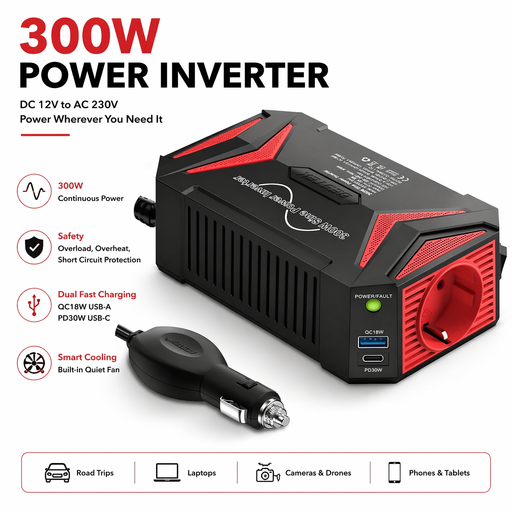
Why it's the right choice : Perfect for powering a laptop and rapidly charging a smartphone or tablet in your car. Its 300W output is more than enough for light office work or entertainment, all without any complex setup.
It features pure sine wave technology to protect your electronics, and its 300W nominal power is clearly stated, avoiding any confusion with the peak power (700W).
It includes modern fast-charging ports (USB-C PD and USB-A QC3.0). Its built-in 40A fuse and comprehensive protections ensure worry-free use.
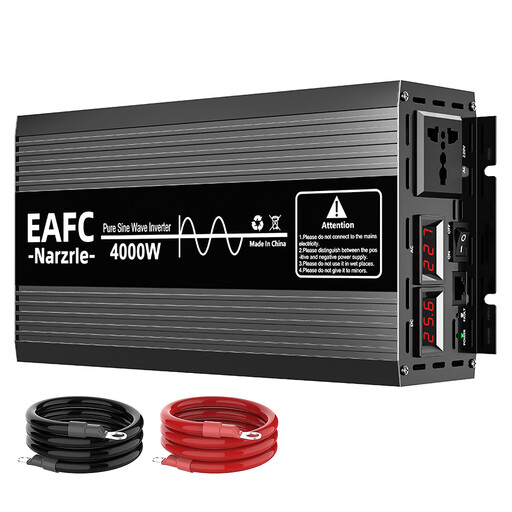
Why it's the right choice : This is the go-to solution for those with serious power needs. With its 2000W of nominal power, it can simultaneously run a refrigerator, power tools, or a microwave. The perfect companion for a fully-equipped RV or a work van.
The distinction between peak power (4000W) and nominal power (2000W) is crystal clear. It is equipped with two smart fans for efficient heat dissipation and a dual digital display to monitor input and output voltages in real time.
Pure sine wave technology for universal compatibility. A full suite of protections (overload, overheat, short-circuit...) ensures rock-solid reliability.
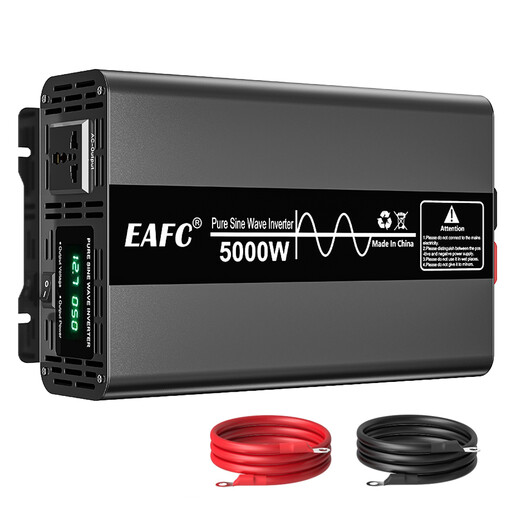
Why it's the right choice : For those who want no compromises. With 2500W of continuous power, it serves as an excellent emergency power solution during an outage, or for powering an off-grid cabin. It can handle multiple power-hungry appliances simultaneously.
It boasts a very comfortable nominal power rating (2500W) and a conversion efficiency of over 91 %, minimising energy loss. Its detailed LCD screen provides all the key information for fine-tuned management of your consumption.
Designed to operate in extreme conditions (-30 °C to +60 °C). It incorporates premium components (capacitors, MOSFETs) for maximum durability and stability.
We have curated a comprehensive and up-to-date selection of products that meet our strict selection criteria and current safety standards.
It all depends on your equipment. For basic use (charging phones, a laptop, powering LED lights), a 300W to 500W pure sine wave model may be sufficient. If you plan to use a compression refrigerator, a coffee maker, or small appliances, aim higher with a nominal power of 1500W to 2000W for peace of mind. The golden rule?is to always add up the wattage of the devices you might use simultaneously.
No, not if it's a quality model and used correctly. A good inverter includes low-voltage protection?: it will automatically shut off before your vehicle's battery is too drained to start the engine. For extended use or with power-hungry devices, it is highly recommended to keep the vehicle's engine running so the alternator can continuously recharge the battery.
This is THE fundamental distinction to understand. The nominal power (2000W) is the power the inverter can supply in a stable, continuous manner. This is the only value you should base your choice on. The peak power (4000W) corresponds to a surge of power that the device can handle for a very short moment (often less than a second). It is only used to manage the start-up power draw of certain motorised devices (like a fridge compressor or a drill). Therefore, never rely on the peak power rating to assess your daily needs.