
Livraison le jour même ou le lendemain

Qualité garantie

Débloquez vos offres de bienvenue: Livraison GRATUITE | Jusqu'à -80 % | 30 jours d'essai gratuits à JoyPlus
Téléchargez l'application
By Joybuy, your high-tech shopping guide.
A laptop dying mid-video conference, a dead smartphone when you're expecting an important call... For mobile professionals, students, and digital nomads, a dead battery is more than just an inconvenience: it's a major roadblock to productivity. A 20,000 mAh power bank often represents the perfect compromise between generous capacity, capable of charging multiple devices, and a manageable footprint.
Faced with an overwhelming number of options, it's easy to get lost. This guide breaks down the essential criteria for choosing the model perfectly suited to your needs, based on power, compatibility, and reliability.
Before diving into our selection, let's review the key points to check to make the right choice.
While capacity in milliampere-hours (mAh) indicates the energy reserve, the power output in watts (W) determines the charging speed and, most importantly, which devices you can charge. For a power bank intended for a laptop, a power output of at least 45W is the minimum. The most powerful models, such as a 65W portable battery or higher, can efficiently charge a MacBook or other ultrabooks via their USB-C port compatible with the Power Delivery (PD) standard. Remember to check the power required by your computer to ensure perfect compatibility.
A 20,000 mAh capacity is a theoretical value. In practice, due to losses from voltage conversion, the actual capacity transferred to your devices will be slightly lower. However, it's still enough to charge a recent smartphone 3 to 4 times, or a laptop about once. It's an ideal format for a backup battery for travel, as its energy capacity remains below the 100 Wh limit imposed by most airlines for cabin luggage, while still offering a very comfortable amount of extra power.
Ensure the power bank has the ports you need. USB-C has established itself as the standard for fast-charging power banks, as it handles both input (to recharge the battery itself) and output (to power your devices). Some models include multiple ports to charge several devices at once. Finally, technologies like Power Delivery (PD 3.0 or 3.1) or Quick Charge (QC) guarantee optimised charging times for compatible devices.
From theory to practice. Here are the models that caught our eye, each catering to specific needs.
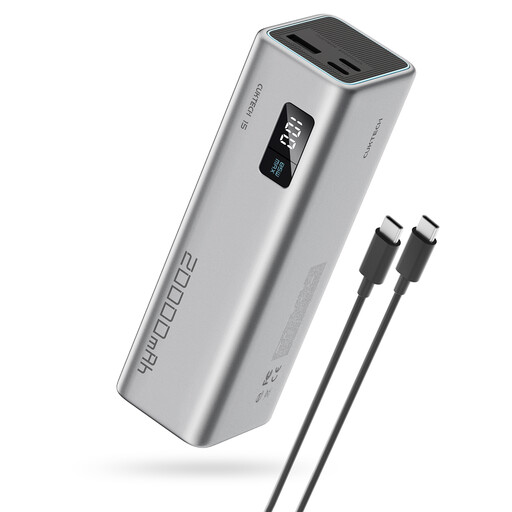
Why it stands out This model is the Swiss Army knife of versatile power banks. With its 65W power for both input and output, it can quickly charge a compatible laptop while recharging itself in just two hours. Its compact cylindrical design and three ports (2 USB-C, 1 USB-A) make it an ideal travel companion.
Highlights
Who is it for? For professionals and students looking for a powerful all-in-one solution for their smartphone, tablet, and laptop (like a MacBook Air or Dell XPS 13).
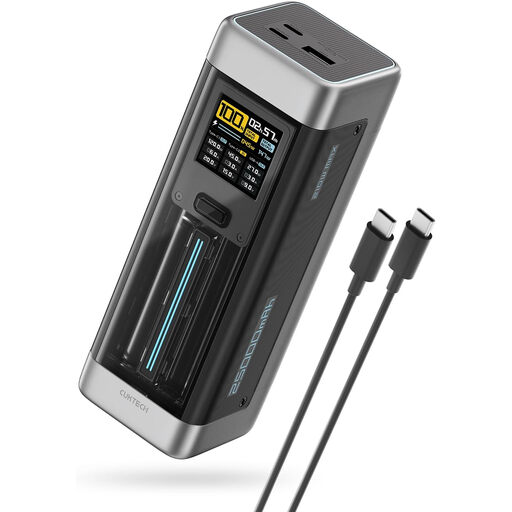
Why it stands out With a 140W output via the PD 3.1 protocol, this powerhouse is designed for the most demanding users. It can power power-hungry laptops, like a 16-inch MacBook Pro, at full speed. Its built-in TFT screen, which displays real-time power, voltage, and remaining capacity, is a real bonus for precise monitoring.
Highlights
Who is it for? For digital nomads, creatives, and pros who use powerful laptops and for whom charging speed is non-negotiable.
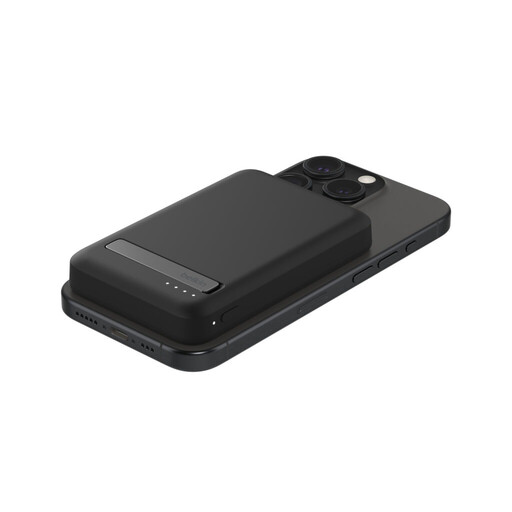
Why it stands out Although its 8,000 mAh capacity is more modest, this Belkin model stands out for its specialisation. It incorporates the new 15W Qi2 wireless charging standard, offering an experience similar to MagSafe for compatible iPhones. Its pass-through feature allows you to charge the battery and your phone simultaneously, making it an excellent charging station for the office or on the go.
Highlights
Who is it for? Mainly for recent iPhone owners who prioritise the convenience of magnetic wireless charging and are looking for a compact solution for a full day of heavy use.
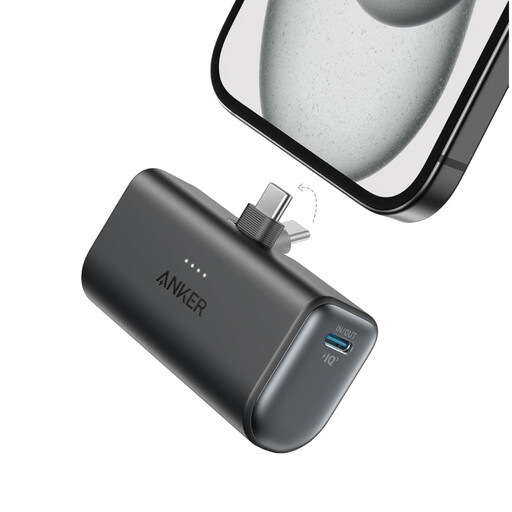
Why it stands out This Anker model's masterstroke is its ingenuity. With its built-in foldable USB-C connector, there's no need to carry a cable. Its 5,000 mAh capacity is designed for a top-up charge (about one full charge for most smartphones), but its tiny size allows it to slip into any pocket.
Highlights
Who is it for? For those looking for an ultra-minimalist backup solution for their smartphone, to keep in a bag or pocket at all times for emergencies.
The mobile charging ecosystem doesn't stop at power banks. To complete your setup, a good adapter is often essential. If you need a black USB-C adapter to connect all your devices at home, in the office, or on the go, there are many solutions available.
Discover our selection of USB-C adapters to find the right model for you.
This depends on your device's battery capacity. As a guideline, a 20,000 mAh power bank can charge:
Yes, in most cases. Airlines limit the capacity of lithium-ion batteries to 100 watt-hours (Wh) in the cabin. A 20,000 mAh (or 20 Ah) power bank with a nominal voltage of 3.7V is equivalent to 74 Wh (20 Ah x 3.7V), which is well below the permitted limit. It must be carried in your cabin baggage (hand luggage) and not in checked luggage.
Imagine a water bottle. The capacity in mAh is the total amount of water in the bottle (the stored energy). The power in W is the width of the bottle's neck: the wider it is, the faster the water can flow out (the energy is delivered more quickly). For a laptop, you therefore need not only a large bottle (high mAh) but also a wide neck (high W) to charge it quickly and efficiently.