
Livraison le jour même ou le lendemain

Qualité garantie

Débloquez vos offres de bienvenue: Livraison GRATUITE | Jusqu'à -80 % | 30 jours d'essai gratuits à JoyPlus
Téléchargez l'application
Keeping your countertop clear and your kitchen tidy is the secret to a more peaceful daily life. Yet, the post-meal ritual is often the same?: a mountain of wet dishes colonising the precious space next to your sink. A 2-tier stainless steel dish rack then seems like the perfect solution to leverage vertical space and free up your work surface. The problem?? Too many buyers end up disappointed with a model that ultimately fails to deliver on its promises.
To prevent your purchase from turning into a nightmare, let's review the most common pitfalls?:
Knowing how to spot these warning signs is the first step toward a smart purchase and a dish rack that will serve you well for years to come.
To turn your dish-drying area into a model of organisation, you need to scrutinise a few technical details that make all the difference. Often overlooked, these are the features that guarantee the longevity and practicality of your future kitchen organiser.
The term "stainless steel" actually covers several different qualities of alloys. And in a kitchen, where moisture reigns supreme, not all stainless steel is created equal. The gold standard is 304 stainless steel. Its high chromium and nickel content ensures optimal resistance to corrosion and rust. Entry-level models often settle for lower-quality steels. Although "stainless" on paper, they eventually develop rust spots when exposed to hard water or certain detergents. A good stainless steel dish rack is an investment built to last.
The main advantage of a two-tier model is, of course, its large drying capacity with a minimal footprint. But this verticality should never come at the expense of stability. A well-designed model can be identified by several signs?:
A dish rack with a drainboard is non-negotiable for keeping your countertop dry. The most effective systems don't just collect water?: they actively drain it. Favour models equipped with a swivel spout or a drainage channel that directs water straight into the sink. A simple flat tray will need to be emptied manually and will quickly become a hotbed for limescale if not cleaned very regularly.
Because every kitchen and every household has its own needs, here is a selection of models suited to different profiles, always keeping our criteria of quality and practicality in mind.
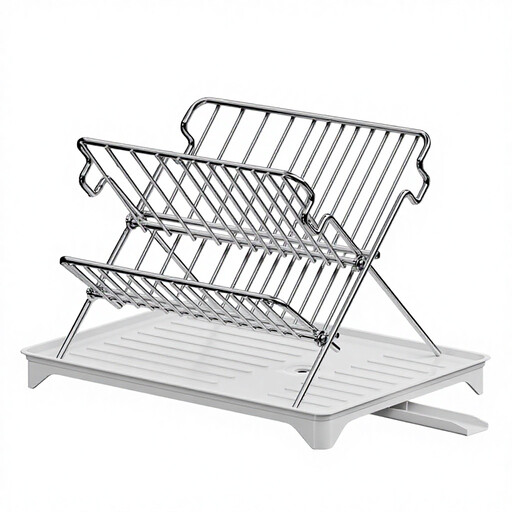
Why it stands out : Perfect for small kitchens or for those who want a pristine countertop between uses. It offers the capacity of a two-tier model without the permanent clutter.
Its mixed-material design (stainless steel and PP) protects it from rust. Its integrated drainage channel ensures efficient water removal without stagnation.
Its function as a foldable dish rack allows it to be stored flat, completely freeing up the countertop when not in use.
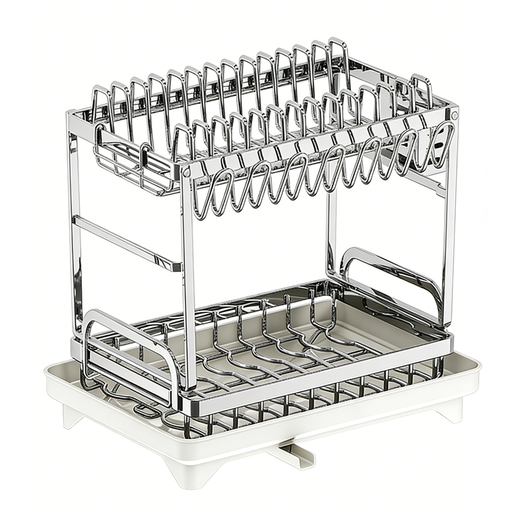
Why it stands out : Built for large volumes of dishes, it's the perfect ally for families and avid cooks. Its dedicated compartments simplify sorting and storage.
Its reinforced structure guarantees excellent load capacity and rock-solid stability. The drainage pipe ensures direct water evacuation.
A high-capacity dish dryer with compartmentalised storage that makes every utensil visible and easy to grab.
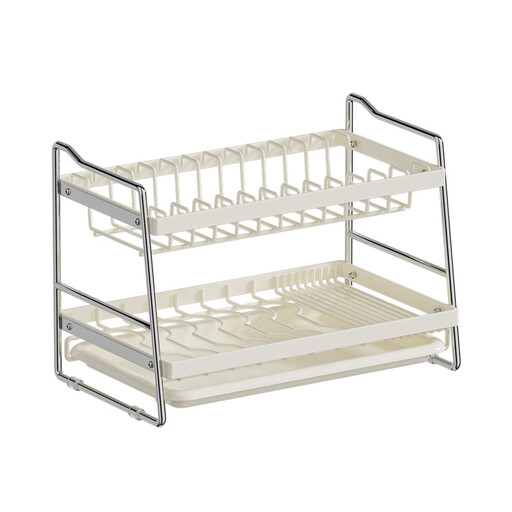
Why it stands out : It offers the space-saving benefit of a vertical model at a very accessible price. It's the smart choice for anyone looking for a functional solution without necessarily needing stainless steel.
Made from composite plastic, it completely eliminates the risk of rust. Its integrated drainboard is designed to keep the countertop dry.
An excellent capacity-to-price ratio. It maximises the drying area on a small surface thanks to a simple and effective two-tier design.
Discover our complete and up-to-date selection of products that meet our strict selection criteria and current safety standards.
Even high-quality stainless steel benefits from regular maintenance. A weekly cleaning with soapy water and a soft sponge is sufficient. Absolutely avoid steel wool pads?: they scratch the surface and can leave behind iron particles that will eventually rust. If you have very hard water, wiping it down with a cloth from time to time will prevent limescale buildup.
It all depends on the product's design. A quality model is designed with a wide base, non-slip feet, and a reinforced structure. The pro tip for maximum stability?: always place the heaviest items (plates, pans) on the bottom tier.
A fixed dish rack is generally more robust and always ready for use, but it permanently occupies space. Conversely, a foldable dish rack offers unbeatable flexibility?: once the dishes are put away, it folds up for storage, completely freeing up the countertop. It's the ideal solution for small kitchens or fans of minimalism. The only trade-off is sometimes slightly less rigidity compared to an equivalent fixed model.