
Livraison le jour même ou le lendemain

Qualité garantie

Débloquez vos offres de bienvenue: Livraison GRATUITE | Jusqu'à -80 % | 30 jours d'essai gratuits à JoyPlus
Téléchargez l'application
Choosing a 3D printing refill might seem simple at first, but with the wide variety of materials and finishes available, the task can quickly become a headache. Are you looking for a 1 kg yellow PLA filament for a specific project but can't decide between standard PLA, high-speed PLA for rapid prototyping, matte PLA for an artistic finish, or even a tougher yellow PETG filament?
Don't worry, we're here to help you make sense of it all. This article breaks down the essential criteria to help you choose the spool of yellow PLA that perfectly matches your needs and your printer—all without the unnecessary marketing jargon.
Before we dive into our top picks, here are a few key points to consider to guide your decision.
The choice of material is crucial, as it directly determines the properties of your final object.
3D printer technology is evolving at a rapid pace, and filaments are keeping up.
The final look of your print is just as crucial, especially for artistic or design-focused projects.
Here are three top picks that cater to very different needs, from functional to aesthetic.
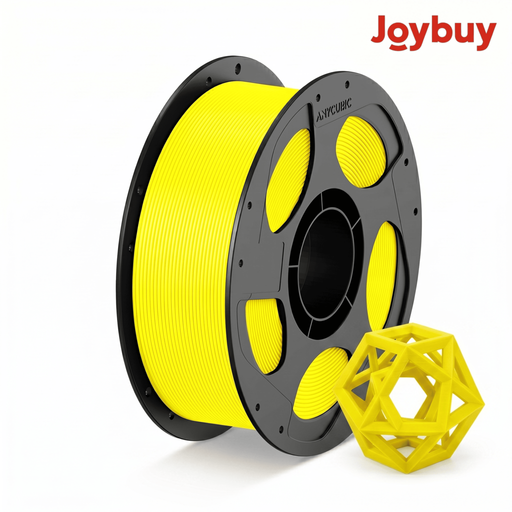
Why it stands out This PETG filament from ANYCUBIC is all about toughness. It's the ideal solution for prints that need to withstand mechanical stress or outdoor conditions. Its formulation gives it enhanced resistance to water and chemicals, making it perfect for more technical applications than standard PLA.
Advantages
Who is it for? For makers and DIY enthusiasts who print mechanical parts, protective cases, garden accessories, or any object that requires rock-solid strength.

Why it stands out CaiLab's filament is all about aesthetics. Its excellent matte finish hides layer lines, giving prints a smooth, professional look. It's the top choice for those who prioritise appearance and want to create objects with a soft touch and no reflections.
Advantages
Who is it for? For creators, designers, and artists making decorative objects, figurines, or models, for whom surface quality is the number one priority.
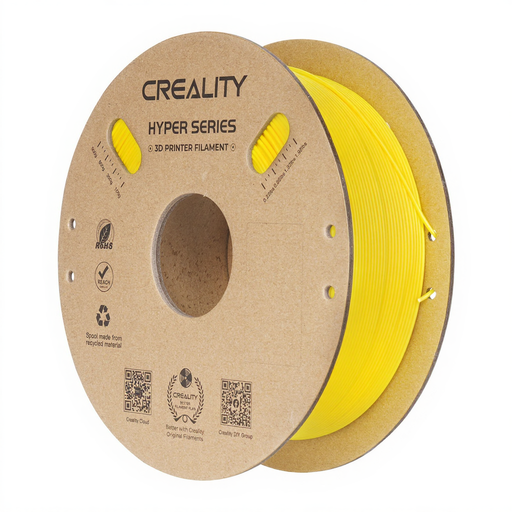
Why it stands out Creality's Hyper PLA is built for efficiency. Designed for breakneck speeds of up to 600 mm/s, it literally slashes print times on compatible machines. Its high fluidity and rapid cooling ensure excellent quality even at high speeds, while guaranteeing a dimensional accuracy of ±0.02 mm.
Advantages
Who is it for? For pros, makers, and enthusiasts who do rapid prototyping or print large volumes, and who want to optimise their production time without ever sacrificing quality.
Our selection covers three key needs, but the world of 3D printing is vast. If you're looking for a different shade of yellow, another brand, or a material with very specific properties, the possibilities are nearly endless.
? Explore our full range of Yellow 3D Printer Filament to find the perfect spool for your next project.
The main difference lies in their mechanical and thermal properties. To put it simply: PLA is more rigid but more brittle, and above all, easier to print. It's perfect for decorative objects. PETG, on the other hand, is more flexible and much more resistant to impacts and heat, making it ideal for functional parts that need to withstand stress.
Both PLA and PETG are hygroscopic materials, meaning they absorb moisture from the air. Too much moisture is a recipe for disaster: print quality degrades (bubbles, grainy surface, brittle filament). The ideal way to store your spool of yellow PLA is in an airtight bag with a desiccant packet (silica gel). If your filament has already absorbed moisture, don't panic: it can be dried in a suitable oven or a filament dryer before use.