
Livraison le jour même ou le lendemain

Qualité garantie

Débloquez vos offres de bienvenue: Livraison GRATUITE | Jusqu'à -80 % | 30 jours d'essai gratuits à JoyPlus
Téléchargez l'application
A 1/4-inch drive metric socket set can simplify many tasks: assembling furniture, maintaining a bike, carrying out small household repairs, or working in the engine bay. However, not all sets are created equal. A high number of pieces doesn't guarantee better coverage, and a ratchet with many teeth will never compensate for a poorly fitting socket.
Here are the criteria to consider before buying, along with a selection suited to different types of users in the UK.
Some sets boast several dozen pieces, but this total often includes bits, extensions, adapters and storage accessories. For everyday repairs, focus on the sizes actually available. An assortment of sockets from 4 to 13 mm can prove more useful than a bulky set filled with rarely used sizes.
The 1/4-inch format is ideal for small nuts, screws and tight spaces. It is not designed for loosening stubbornly seized bolts or wheel nuts. For those jobs, a 3/8 or 1/2-inch drive will generally be more suitable. Using a small ratchet with an improvised extension risks damaging the mechanism or the fastener.
A 72-tooth ratchet allows a shorter swing arc than a mechanism with fewer teeth. This is handy in confined spaces, but this figure alone says nothing about strength, selector precision or build quality. Also examine the release button, the direction of rotation and the grip.
For home use and light automotive work, choose a set covering the most common sizes. Sockets from 4 to 13 mm are suitable for the small fasteners found on appliances, furniture, bikes and certain car components.
A complete assortment in this range may include the following sizes: 4, 4.5, 5, 5.5, 6, 7, 8, 9, 10, 11, 12 and 13 mm. Always check the detailed list rather than relying solely on the mention "metric".
Chrome-vanadium steel sockets offer a common balance between mechanical strength and corrosion resistance. Their chrome-plated surface also makes cleaning easier after working in a dusty or slightly greasy environment.
A nice finish doesn't eliminate the need for regular maintenance. After use, wipe the tools dry and store them away from moisture. A light lubrication of the ratchet mechanism can also help preserve its smoothness, following the manufacturer's recommendations.
A quick-release reversible ratchet lets you change sockets without wasting time. The release button is particularly handy when you need to work through a series of fasteners.
In tight spaces, a 72-tooth mechanism with a claimed 5° swing arc limits handle movement. However, this doesn't turn the set into a heavy-duty loosening tool: always respect the stated maximum torque and do not use an extension bar not intended for the purpose.
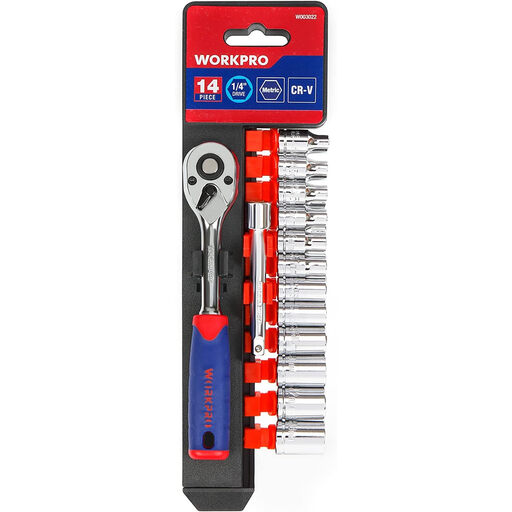
Why this choice suits this profile: This compact set brings together the most common metric sizes for small jobs around the house, bike maintenance or occasional car repairs.
The 4 to 13 mm range is clearly stated, and the set doesn't rely solely on a high number of accessories.
Chrome-vanadium steel, 72-tooth reversible ratchet, quick-release button and 76 mm extension bar.
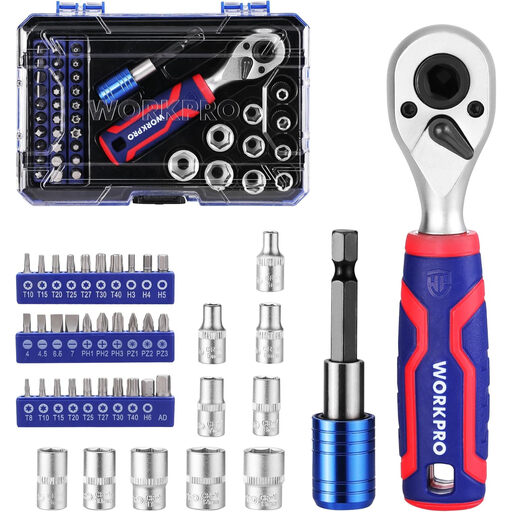
Why this choice suits this profile: Those who want to combine sockets and bits in a single set get a more complete configuration here, suitable for regular DIY.
The contents clearly distinguish metric sockets, bits and the magnetic bit holder, so you can quickly check what's inside.
42 pieces, 72-tooth mechanism with a claimed 5° swing arc, portable storage and a ratchet that can be used as a bit driver.
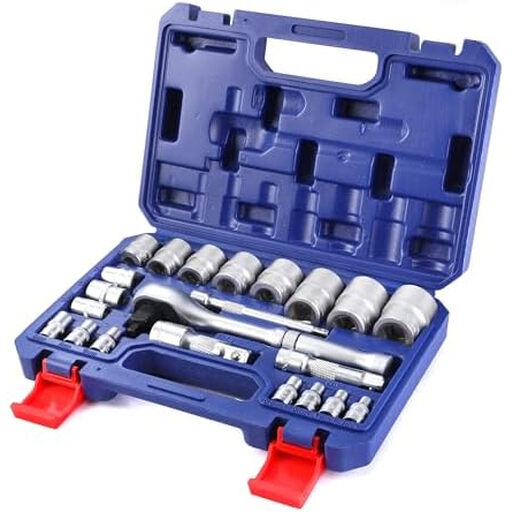
Why this choice suits this profile: Tradespeople and hobbyist mechanics who switch between small fasteners and larger assemblies can rely on three drives combined in one set.
The 1/4, 3/8 and 1/2-inch drives are clearly identified, as are the metric ranges and the extensions supplied.
22 pieces, metric sockets up to 24 mm, 72-tooth ratchet and moulded storage case.
We have compiled a comprehensive, real-time updated list of products that meet these demanding selection criteria and European safety standards.
Before each job, choose a socket that matches the size of the nut exactly. Push it fully onto the drive square and check it is secure before turning. Use the selector to choose tightening or loosening.
To limit wear:
For wheels, spark plugs or heavily tightened fasteners, choose a tool whose drive square and design match the task. A compact DIY tool set can complement your equipment, but it does not replace a torque wrench when tightening torque must be respected.
Yes, for small fasteners, interior components, accessories and some maintenance work. It is less suitable for wheel nuts, seized bolts and jobs requiring high torque. In those situations, a 3/8 or 1/2-inch drive will generally be more appropriate.
A 72-tooth ratchet typically has a 5° swing arc, while a 90-tooth model can go down to around 4°, depending on its design. A shorter arc makes movement easier in tight spaces, but strength, grip and torque limits matter just as much.
Dry them after use, avoid corrosive products and do not use them for striking or prying. Store the set in a dry place and regularly inspect the drive square and the ratchet mechanism.