
Livraison le jour même ou le lendemain

Qualité garantie

Débloquez vos offres de bienvenue: Livraison GRATUITE | Jusqu'à -80 % | 30 jours d'essai gratuits à JoyPlus
Téléchargez l'application
Whether it's a long holiday road trip, a day of remote work on the go, or just a movie to keep the kids busy in the back... Having charged devices in the car is no longer a luxury; it's a matter of (digital) survival! A laptop dying mid-video call, a tablet giving up at the best part of the movie... these are everyday scenarios that have become unacceptable. The solution? The 12V to 230V inverter, a clever accessory that transforms your vehicle's cigarette lighter socket into a true mobile power outlet.
This guide is here to help you make sense of it all, decode the technical jargon, and choose the model that will safely accompany you on the road.
Before you dive in, there are a few criteria to understand to ensure you make the right choice. They will guarantee compatibility with your devices and your vehicle.
Power, measured in watts (W), is the number one criterion. A 300W car inverter is often the best compromise: powerful enough for everyday devices (laptop, tablet, game console, small electric cooler), while remaining compatible with most cars.
Be careful, though: most cigarette lighter sockets are protected by a 15A fuse, which limits the actual continuous power to about 150W. To use the full 300W, you will often need to connect the inverter directly to the battery. The 12V to 230V cigarette lighter inverter is therefore perfect for moderate use; for more power-hungry needs, a direct connection to the battery is required.
This is a technical detail, but it's vital for the health of your devices.
A good inverter isn't just a simple 230V car outlet. Modern models add USB ports to plug everything in. For a fast car USB charger that's truly efficient, look for devices equipped with USB-C Power Delivery (PD) or Quick Charge (QC 3.0) ports. These technologies recharge your compatible smartphones and tablets at lightning speed compared to standard USB ports.
We have selected a few models that stand out for their reliability and performance, catering to different budgets and uses.
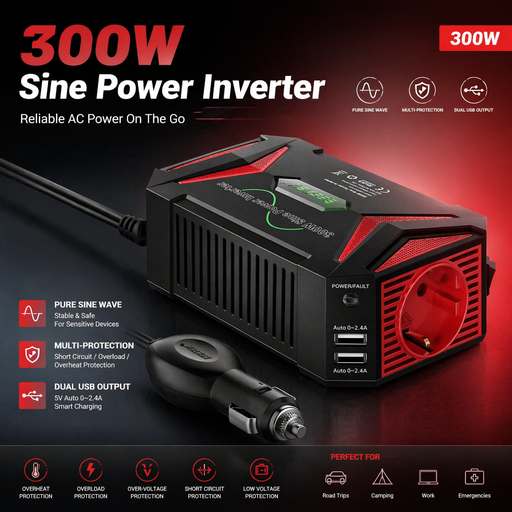
What sets it apart: The quality of the current. Unlike modified wave inverters, this model delivers a stable, interference-free power supply, perfect for multimedia equipment and fragile electronic devices.
Highlights:
Who is it for? Those who want to power valuable devices (laptop, console, hi-fi equipment) without taking any risks, ideal for long trips, van life, or camping.
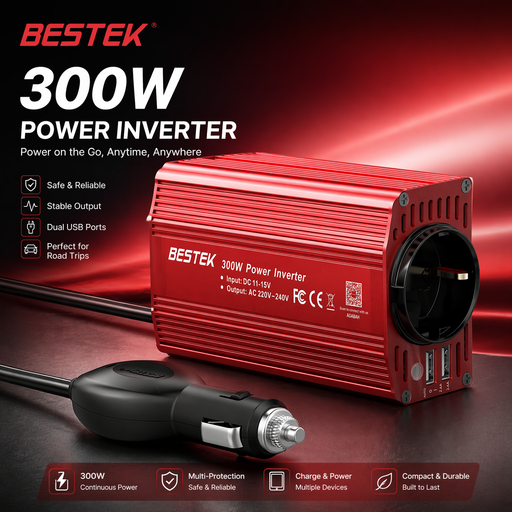
What sets it apart: The excellent performance-to-price ratio. This is the reliable, no-frills model for everyday needs and outdoor getaways.
Highlights:
Who is it for? Drivers and campers looking for a budget-friendly and robust solution to plug in less sensitive devices (chargers, lamps, fans) and recharge their phones.
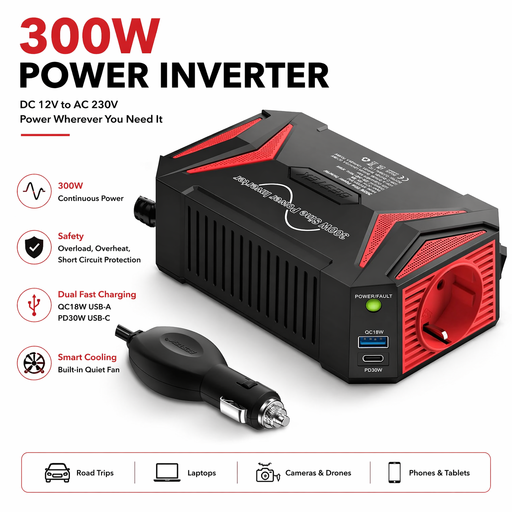
What sets it apart: Next-generation fast charging. With its USB-C PD 30W and QC 18W ports, it's designed for users of recent devices (iPhone, MacBook, Android smartphones) who don't have time to waste.
Highlights:
Who is it for? Professionals on the go, hyper-connected families, and tech enthusiasts who want top speed and security for their fast-charging compatible devices.
The models presented here cover most needs, from occasional use to powering professional equipment. If you want to explore other power ratings or simpler solutions, take a look at our complete selection.
? Discover our full range of car USB solutions
For everyday use (charging a laptop, a tablet, and a phone), a 300W model is perfect. For more power-hungry devices, check their wattage consumption and remember that the cigarette lighter socket is often limited to 150W.
Absolutely not. The golden rule: never plug in a device that is more powerful than the inverter. Forget about high-resistance appliances (hair dryers, straighteners, coffee makers, drills) on a 300W model plugged into the cigarette lighter; they are not designed for that.
Modified sine is the budget-friendly option for basic devices. The pure sine wave inverter generates a clean current, which is essential for valuable electronic devices (computers, audio equipment, consoles, etc.) to avoid humming, glitches, or irreversible damage. For peace of mind, pure sine wave is always the best choice.