
Livraison le jour même ou le lendemain

Qualité garantie

Débloquez vos offres de bienvenue: Livraison GRATUITE | Jusqu'à -80 % | 30 jours d'essai gratuits à JoyPlus
Téléchargez l'application
A 12 V electric ride-on car for children can make an excellent gift, provided you choose a model suited to your child’s age, weight and the space available. Between claims of record battery life, light-up features and parental remote controls, some criteria matter far more than appearance.
Before placing your order, check the actual speed, charging time, maximum load and conditions of use. A rechargeable children’s car intended for a few laps around the garden will not necessarily meet the same needs as a model used regularly by two children.
The 12 V rating refers to the voltage of the electrical system. It is not enough to determine the vehicle’s power, speed or battery life. Two 12 V models may have very different motors, batteries, dimensions and settings.
So, examine the entire specification:
A speed of between 3 and 8 km/h may be suitable for very different uses. For a young child, a slow mode and gradual start generally make it easier to get used to the vehicle.
Music, LED headlights, illuminated wheels and Bluetooth connectivity make the toy more appealing, but they do not replace adult supervision or a suitable environment. A children’s car with music and LED lights is still an electric ride-on toy, not a vehicle intended for use on public roads.
A helmet and protective equipment may be considered depending on how the vehicle is used. In all cases, the car should be used on a clear, level surface, away from roads, stairs, swimming pools and steep slopes.
A two-seater children’s car may be almost 1.20 m long and weigh more than 20 kg. Measure the garage, storage area and route to the garden before ordering. Also consider transport: a bulky model may not fit in the boot of a small city car.
The battery also requires a few simple precautions: use the charger supplied, keep the connectors dry and avoid leaving the battery completely discharged for a long period.
The age recommended by the manufacturer provides a useful starting point, but your child’s height and build are just as important. An electric vehicle for a 3-year-old must allow them to sit correctly, reach the controls and maintain a stable position.
For models intended for children aged 3 to 8, check:
On a two-seater children’s car, the maximum load applies to both occupants together. This limit must never be exceeded, even for a journey lasting only a few minutes.
A children’s car with parental remote control allows an adult to remain in control while the child is getting started. Depending on the model, it may provide access to several speed settings, forward and reverse gears, and even an emergency stop button.
The remote control does not remove the need to stay nearby. Check its range, power supply and how simple the controls are to use. For a child learning gradually, the combination of ‘manual controls + parental control’ is more flexible than a vehicle left entirely in their hands.
An all-terrain children’s car is not necessarily designed to drive through mud, over deep gravel or on steep slopes. The term ‘all-terrain’ often refers to wide wheels, suspension or two motors, but the actual usage limits still apply.
For use at home, choose sturdy wheels, a stable base and, if possible, suspension. On grass, asphalt or concrete, performance will also depend on the child’s weight, the battery’s charge level and the condition of the ground.
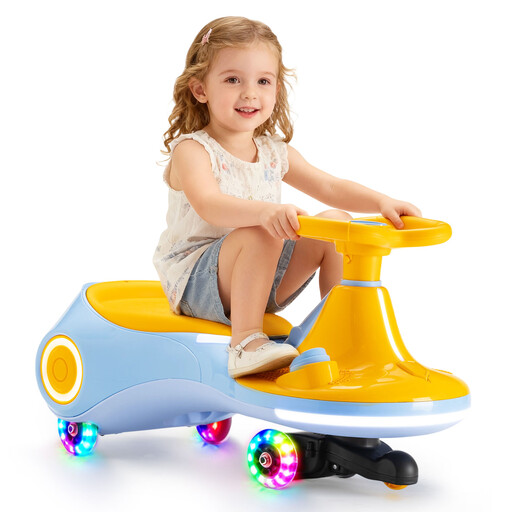
Why it suits this type of user : This compact model is ideal for families looking for a first electric car for a child aged 3 or over. Its stated speed of around 5 km/h allows it to be used either seated or standing.
The specification lists three speed settings, an anti-tip structure and a rechargeable battery included as standard. However, you should still check the dimensions and battery life for the version on offer.
A format measuring around 80 × 38 × 38 cm, stated battery life of up to 70 minutes and wheels that light up when the vehicle is moving.
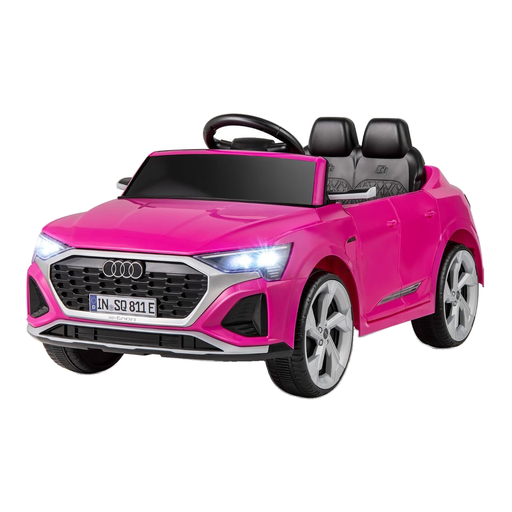
Why it suits this type of user : This electric Audi SQ8 for children takes inspiration from an SUV and combines manual driving with a parental remote control. It is aimed at families who value both design and built-in features.
The specification states three adjustable speeds from 3 to 5 km/h, a gradual start, a seat belt and lockable doors. Logos and licensed features alone say nothing about actual performance.
12 V rechargeable battery, two 12 V motors, spring suspension, LED headlights, horn and built-in music.
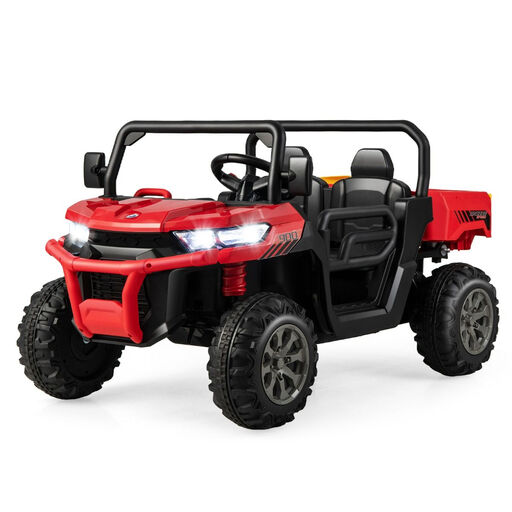
Why it suits this type of user : This red vehicle is designed for families with two young children and enough outdoor space for a model measuring 119 × 68 × 65 cm.
The stated maximum load of 50 kg, adjustable seat belt and gradual start help to keep use under control. The weight of both occupants must be added together and must never exceed this limit.
Two motors, 2.4 GHz remote control with three speeds, spring suspension, LED headlights and 12 V 7 Ah battery.
We have put together a complete, real-time updated selection of products that meet these demanding criteria and European safety requirements.
Playtime varies depending on the weight carried, the type of surface, the speed selected and how often the vehicle stops. Stated battery life therefore does not guarantee the same duration in every situation. To help protect the battery:
Before each use, check the condition of the wheels, screws, seat, steering wheel and connections. Stop using the toy immediately if you notice unusual noise, a leaking battery or irregular operation.
Choose models supplied with instructions in French, contact details for the responsible person established in the European Union and clearly stated age warnings. The EN 71 reference concerns toy safety when it is declared for the product concerned. Some product listings also mention ASTM or CPSIA certifications; these American references do not remove the need to check the requirements applicable to selling products in France.
A declaration of conformity, clear assembly instructions and accessible charging guidance are far more useful than a simple marketing promise.
The models featured are generally recommended for children aged 3 and over. However, the child must be able to sit correctly and understand the basic controls. An adult must remain present throughout the ride.
The cost depends on the battery capacity, electricity prices and how often it is charged. A modest-capacity 12 V battery generally uses very little electricity compared with a household appliance. On some models, however, charging may take 8 to 12 hours.
It is particularly useful during the first rides, in shared spaces or with a child who has not yet mastered stopping and changing direction. It should supplement direct supervision, never replace it.