
Livraison le jour même ou le lendemain

Qualité garantie

Débloquez vos offres de bienvenue: Livraison GRATUITE | Jusqu'à -80 % | 30 jours d'essai gratuits à JoyPlus
Téléchargez l'application
A flat battery can leave your hatchback stranded outside your home, a work van on a building site, or a motorhome in the middle of a long journey. A 12 V car battery booster offers a practical, portable solution – no need to rely on another driver or wrestle with long jump leads.
But spec sheets don't always tell the full story. A high peak current alone doesn't guarantee compatibility with your engine. Likewise, a compressor rated at 150 PSI won't necessarily inflate every tyre quickly. Here are the criteria to consider before buying, followed by a selection tailored to different needs.
Figures like 2,000 A, 4,000 A or 7,000 A usually refer to the peak current. They aren't enough to tell you whether a portable jump starter will actually work with your vehicle.
Instead, check:
A diesel engine often needs more power to start than a petrol engine of a similar size. For a commercial vehicle, motorhome or large SUV, it's wise to leave a margin above your engine's requirements.
A car jump starter with a built-in compressor, light and power bank can be very handy, but it will generally be larger than a simple booster. So measure the space available in your glovebox, boot or under-seat compartment.
A model with a car backup battery, USB ports and an emergency LED light also needs to stay easily accessible. A device buried at the bottom of a packed boot won't be much use when you need it in a hurry.
Even a device advertised as being able to hold its charge for a long time needs regular checks. Recommendations vary by model: some need recharging every two or three months, others more frequently. Heat inside the cabin and winter cold can also affect lithium-ion batteries.
Before a long trip, check the charge level and inspect the cables, clamps and casing. Always follow the manufacturer's instructions.
Start by checking your vehicle's specifications. The booster must be designed for a 12 V system and cover your engine's capacity. Ratings like 'up to 8 L petrol' or 'up to 6 L diesel' are the manufacturer's stated limits. They aren't a guarantee if the battery is damaged, frozen or has a mechanical fault.
Look for smart jump leads with polarity detection and protection against short circuits, overload, overheating and incorrect connections. The metal clamps need to be sturdy enough to stay firmly attached to the terminals.
These protections don't replace proper procedure: red clamp on '+', black clamp on '–' or the earth point recommended by the manufacturer. Never attempt to start a battery that is damaged, swollen or frozen.
A portable tyre compressor with auto shut-off and a digital display makes pressure control easy. The maximum pressure stated in PSI matters less than the airflow rate, the recommended running time and the cooling-off period needed.
USB outputs turn the booster into a car power bank, capable of charging a phone or sat-nav. A light with steady, flashing and SOS modes can improve visibility during a night-time stop. However, it doesn't replace your warning triangle or hi-vis vest.
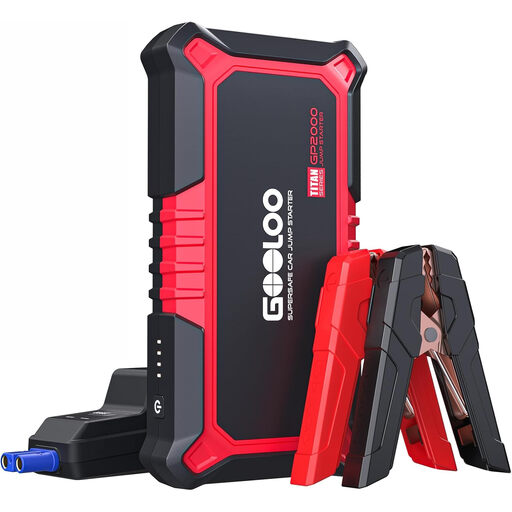
Why this suits this profile: With 2,000 A and stated compatibility up to 8.0 L petrol or 6.0 L diesel, this model is a good fit for drivers who want a compact device for everyday breakdowns.
The spec lists ten protections, including reverse polarity, short circuit and overheat protection. Always refer to the manual as your primary guide.
Two USB outputs, a 400-lumen LED light and a shock-resistant casing.
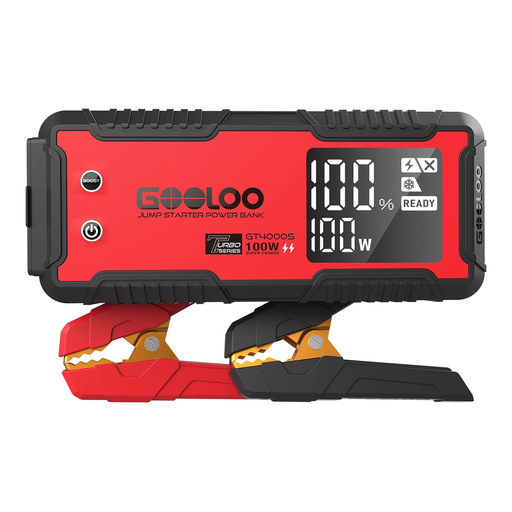
Why this suits this profile: Its claimed 100 W charging system and multiple outputs are aimed at drivers who want to power several devices during frequent trips.
The screen shows the device status and ten protection features are claimed to help prevent connection errors.
4,000 A peak current, USB ports, 12/15 V output and a 400-lumen light.
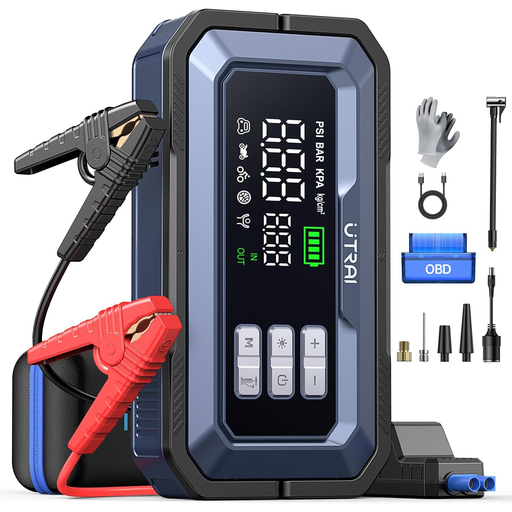
Why this suits this profile: This model is aimed at owners of large vehicles, professionals and travellers who want starting, inflation and 12 V power in one device.
The spec claims compatibility up to 14 L diesel, a digital display and ten protections. Still, check the limits for your own vehicle.
150 PSI compressor, 160 W 12 V output, OBD2 adaptor and a claimed 2,000-lumen light.
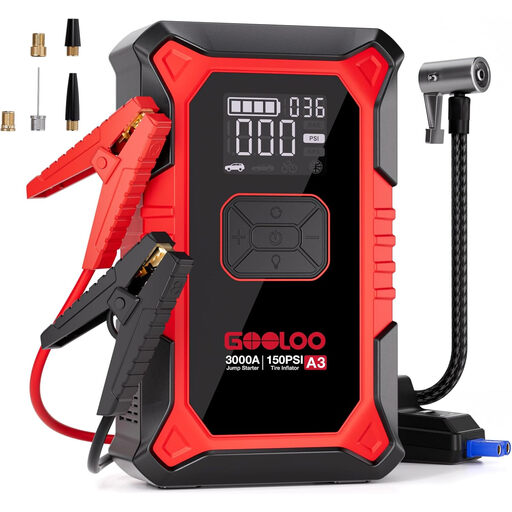
Why this suits this profile: It combines starting, inflation and USB charging in a format designed for drivers who regularly cover long distances.
The screen shows pressure and the auto shut-off reduces the risk of over-inflation – provided you've set the target pressure correctly.
Claimed 3,000 A, 150 PSI compressor, five inflation modes and ten protections.
Switch off the vehicle's electrical equipment, connect the red clamp to the positive terminal, then the black clamp to the negative terminal or the designated earth point. Only activate 'Boost' mode if the manual instructs you to. Crank the engine briefly, then remove the clamps in the order specified by the manufacturer.
The time depends on the battery capacity, the charger and the model. Give it a full charge before first use. During storage, check the device every two or three months as a general rule, even if the spec sheet claims a long standby life.
No. A booster provides a temporary surge to help the engine start. It doesn't replace a car battery charger, which is designed to recharge the battery gradually. If your battery keeps going flat, have a professional investigate the cause and replace it if necessary.