
Livraison le jour même ou le lendemain

Qualité garantie

Débloquez vos offres de bienvenue: Livraison GRATUITE | Jusqu'à -80 % | 30 jours d'essai gratuits à JoyPlus
Téléchargez l'application
Having a 230V outlet on hand, wherever you are, is no longer a luxury but a real necessity. In a camper van, on a boat, or during a simple road trip, being able to plug in your computer, tools, or a kitchen appliance is a game-changer. But faced with a jungle of models, finding the right 12v 230v pure sine wave inverter can quickly become a headache.
This guide is here to shed some light. As a section editor at Joybuy, my mission is simple: to give you clear, concrete advice to find the model perfectly suited to your needs, all without overwhelming technical jargon.
Before diving into our selection, let's review the essential criteria to ensure you make the right choice.
Power, expressed in watts (W), is the number one criterion. There are two key values to distinguish:
For example, a 2000W pure sine wave inverter can continuously power devices up to 2000W and handle start-up surges of up to 4000W.
This is THE technical detail that makes all the difference for the safety of your devices.
For maximum versatility and complete peace of mind, the "pure sine wave" option is therefore the sensible choice.
For low power needs (up to 150-200W), plugging into the cigarette lighter socket is enough to turn your car into a mobile 230v outlet. However, for an inverter for a camper van or to power more power-hungry devices, a direct connection to the 12V battery (with clamps or terminals) is imperative, both for safety and performance. Also, remember to check for essential protections: against overload, short-circuit, overvoltage, and overheating.
We have selected three products that stand out for their performance and relevance, for different uses and budgets.
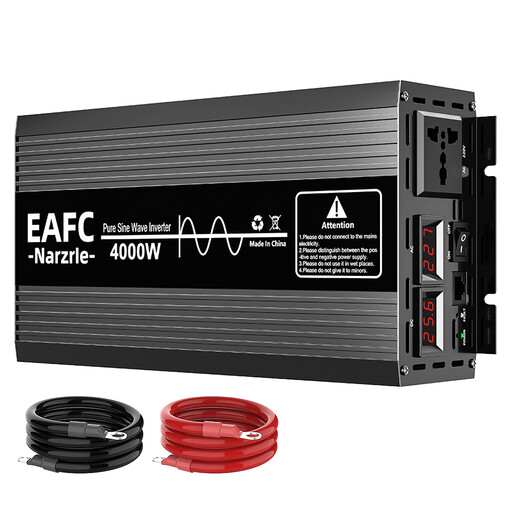
Why it stands out With a nominal power of 2000 W and a peak of 4000 W, this model is a true portable power station. Its pure sine wave output makes it compatible with absolutely all devices, including the most demanding and sensitive ones.
Advantages
Who is it for? Owners of camper vans and converted vans, mobile craftspeople, or anyone looking for a powerful and reliable energy source for intensive use.
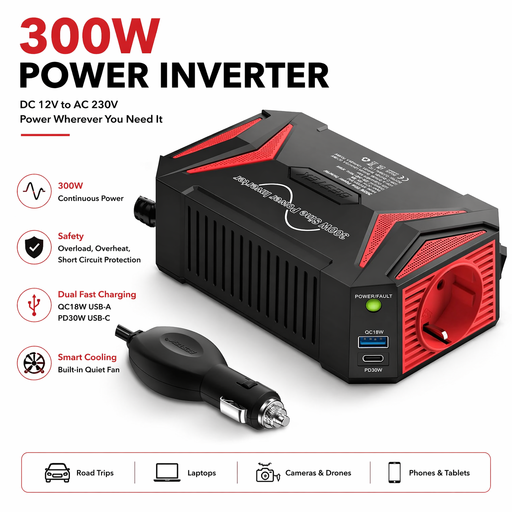
Why it stands out This compact model combines the safety of a pure sine wave with the convenience of USB-C PD 30 W and QC 3.0 fast-charging ports. It's the perfect solution for digital nomads and connected travellers.
Advantages
Who is it for? Remote workers, frequent travellers, and anyone who wants to work on their computer and charge their devices (smartphones, tablets) in the car, with complete peace of mind.
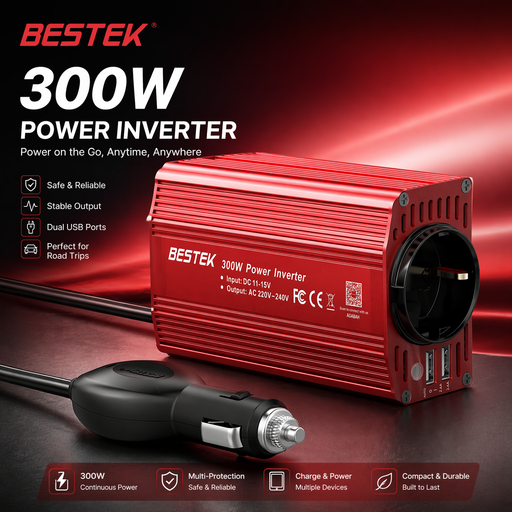
Why it stands out This 12v to 220v car transformer is the ultimate reliable and economical solution for essential needs. Its modified sine wave is sufficient for many uses, making it an excellent choice for those on a tight budget.
Advantages
Who is it for? Occasional users who want to power non-sensitive devices (lamps, chargers, small electric cooler) and are looking for an economical backup solution for the car.
If these models don't quite meet your expectations, or if you're looking for a different power level or features, we've got you covered. Explore our complete collection to find the perfect inverter for your vehicle and your devices.
Discover our full range of car inverters
1. What power inverter is needed for a camper van? It all depends on your usage. For basic needs (charging phones and a computer), a 300W to 500W model may be sufficient. For more comfort and the use of small appliances (coffee machine, microwave, hairdryer), you should aim for a 1500 to 2000 W model. In any case, opt for a pure sine wave model for the safety of your equipment.
2. Can any device be plugged into an inverter? No, it all depends on the wave type. On a pure sine wave inverter, you can plug in almost any 230V device. However, on a modified sine wave model, you should avoid sensitive electronics, medical equipment, laser printers, and certain devices with motors or speed controls. They could malfunction or even be damaged.
3. Will an inverter drain my car's battery? Yes, since it draws its energy from the vehicle's battery. However, most quality models include low-voltage protection: they automatically shut off before the battery is too low to start the engine. For prolonged use or with powerful devices, it is still advisable to run the engine from time to time.