
Same-day & Next-day Delivery

Quality Guaranteed

Unlock Your Welcome Offers: FREE Delivery | Up to 80% OFF | Free 30-day JoyPlus trial
Download the APP
A 12 V to 230 V pure sine wave inverter converts a battery’s direct current into alternating current, like the electricity supplied by a mains socket. It can be useful in a car, motorhome, boat, campervan or as a temporary backup in the event of a power cut.
However, be wary of the figures shown on the packaging. A “2000 W” rating may refer to peak power rather than the power available continuously. Similarly, a model described as universal may be limited by the cigarette lighter socket, wiring or battery capacity.
Peak power is mainly used to handle the surge in consumption when certain motors or compressors start up. For regular use, the figure to focus on is the continuous rated power.
A 2000 W pure sine wave inverter may therefore claim a peak power of 4000 W while being limited to 2000 W during continuous operation. If your appliances require a combined 1200 W, choose a model capable of handling this continuous load, with a safety margin.
A car’s 12 V socket may not allow you to use the inverter’s full advertised power. BESTEK product listings indicate that many cigarette lighter sockets are limited to around 150 W, or 200 W depending on the vehicle.
To exceed this limit, you will generally need to connect the inverter directly to the battery terminals, using cables with a suitable cross-sectional area and an appropriate fuse. This installation must comply with the vehicle manufacturer’s and inverter manufacturer’s recommendations.
A 12 V to 220 V modified sine wave inverter may be suitable for some basic equipment. With other devices, however, it may cause buzzing, excessive heat or irregular operation.
A pure sine wave is closer to the electricity supplied by the mains grid. It is the safest choice for laptops, televisions, audio equipment, chargers and devices fitted with electronic power supplies. It does not remove the need to respect power limits, provide adequate ventilation and use a suitable battery.
A 12 V inverter is designed for a 12 V battery. It cannot therefore be connected automatically to a lorry fitted with a 24 V system. Also check the input voltage range — for example, 11 to 15 V on some models — to understand how the device behaves when the battery is running low or the alternator is operating.
The output may be listed as 220 V or 230 V. In France and the European Union, the nominal mains voltage is 230 V. Both descriptions still appear on many commercial product sheets, but pay particular attention to the output tolerance, the 50 Hz frequency and the waveform.
Add together the power consumption of all devices that may be running at the same time. A 90 W computer combined with a 60 W monitor already represents around 150 W, not including conversion losses.
At high power levels, the current drawn from a 12 V battery rises very quickly. As a guide, a 1000 W load may draw more than 80 A from the battery, depending on the inverter’s efficiency and the voltage actually measured. You should therefore allow for:
Essential protection generally covers overvoltage, undervoltage, overloads, short circuits, reverse polarity and overheating. An automatically activated fan can also help reduce noise when the load remains low. Some models also feature a display showing the input voltage or output status.
USB ports allow you to recharge a phone or tablet without taking up the mains socket. A 30 W USB-C PD charger can speed up charging for compatible devices. Nevertheless, check the actual power delivered by each port, as well as the total available power.
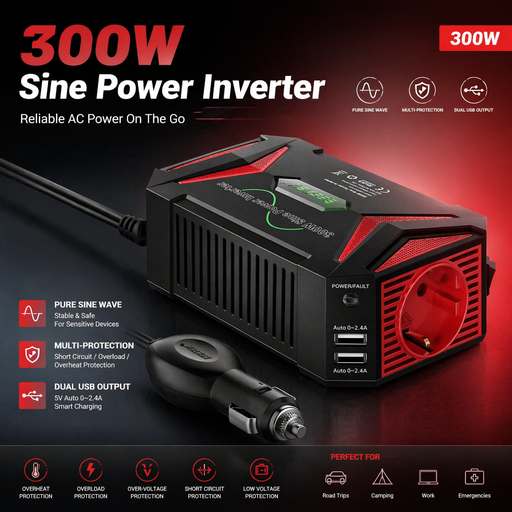
Why this choice suits this profile : Compact and easy to use, this model is suitable for journeys, occasional camping and charging small electronic devices. It offers a 230 V pure sine wave output and two USB ports.
The product sheet clearly distinguishes the pure sine wave output from the USB charging function and reminds you that the cigarette lighter socket may not be suitable for high loads.
Advertised power of 300 W, 230 V output at 50 Hz, two USB ports and a cooling fan.
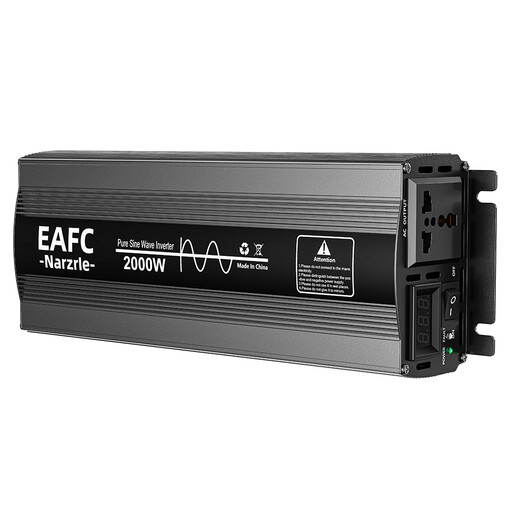
Why this choice suits this profile : Designed for 12 V motorhome systems, occasional power cuts and applications that require some extra capacity, this model offers 1000 W of continuous power and 2000 W of peak power.
The distinction between the 1000 W available continuously and the 2000 W peak prevents you from sizing the installation based solely on the maximum figure.
Digital display, intelligent fan and protection against overloads, short circuits, overheating and reverse polarity.
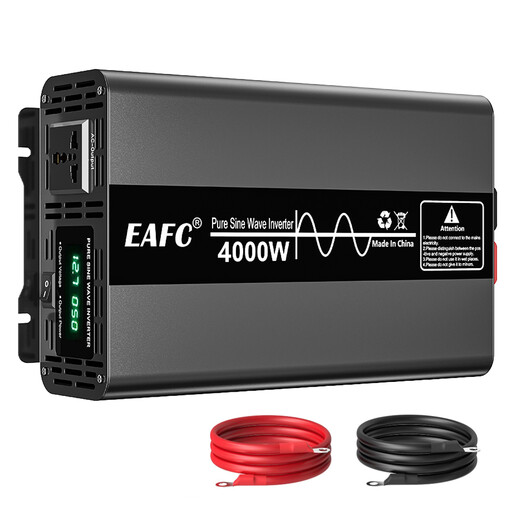
Why this choice suits this profile : With 2000 W of advertised continuous power and 4000 W of peak power, it is aimed at motorhomes, commercial vehicles, boats and backup systems capable of supplying substantial power.
Continuous power is clearly separated from starting power. However, the connection must run through a suitable battery, cables and protective devices, rather than a simple cigarette lighter socket.
Dual ventilation, universal socket and stated protection against overheating, overloads, abnormal voltages, short circuits and reverse polarity.
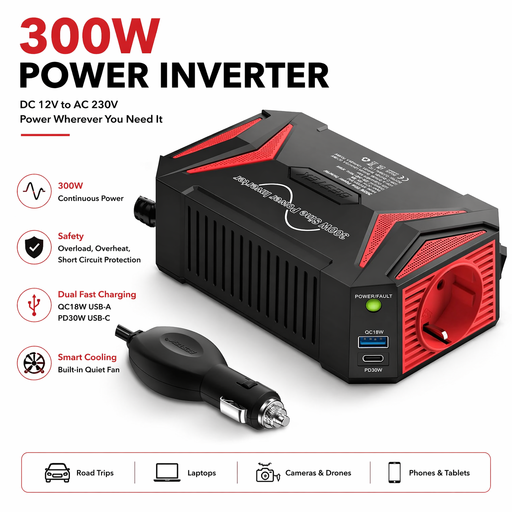
Why this choice suits this profile : Its 12 V socket and charging ports are ideal for motorists, travellers and anyone who wants to power a laptop while charging several devices.
With a maximum continuous output of 300 W, its limit reduces the risk of accidentally connecting a heating appliance or an overly demanding load.
Pure sine wave output, USB-C PD up to 30 W, USB QC up to 18 W, 230 V mains socket and built-in 40 A fuse, according to the product sheet.
We have put together a comprehensive, real-time updated list of products that meet these demanding selection criteria and European safety requirements.
Before connecting anything, check the battery voltage and the condition of the cables. Install the inverter on a stable, dry and properly ventilated surface. Never cover its cooling vents and avoid using it in a damp environment.
For a high-power installation in a motorhome, boat or commercial vehicle, connecting directly to the battery requires cables with a sufficient cross-sectional area and a suitable protective device. With smaller 300 W models, avoid heating appliances such as kettles, hairdryers, ovens and heaters.
Consumption varies according to the power required, the inverter’s efficiency and the duration of use. To protect the battery, unplug the device after use and avoid leaving equipment running when the engine is switched off, unless the battery capacity has been designed for this purpose.
Yes, provided the computer and its charger require less power than the inverter’s continuous output. A pure sine wave output is generally suitable for electronic power supplies. Even so, ensure adequate ventilation and allow a power margin.
For charging phones, a camera, tablet or laptop, a 300 W model may be sufficient. If you plan to power several devices, a fridge or a tool with a high starting current, check the rated power, peak power and type of connection to the battery. The cigarette lighter socket may limit use well before the inverter reaches its theoretical power output.
The cost depends primarily on the energy drawn from the battery. The higher the load and the longer it runs, the more the battery will discharge. Conversion losses also increase consumption. For regular use, compare the stated efficiency, battery capacity and intended usage time, rather than relying solely on the maximum power rating.