
Livraison le jour même ou le lendemain

Qualité garantie

Débloquez vos offres de bienvenue: Livraison GRATUITE | Jusqu'à -80 % | 30 jours d'essai gratuits à JoyPlus
Téléchargez l'application
A 12 V–230 V pure sine wave inverter converts a battery’s direct current into alternating current, like the electricity from a household socket. You can use one in a car, motorhome, boat or lorry, on a worksite, or to power a few appliances temporarily during a power cut.
The problem is that product specifications can be confusing, particularly when it comes to peak power, continuous power and included accessories. A model advertised as 2,000 or 5,000 W may be completely unsuitable for a cigarette lighter socket or a low-capacity battery. Here’s what to check before buying a car power inverter.
A rating such as “2,000 W” or “5,000 W” may refer to peak power, which is only available for a few seconds when a motor, fridge or power tool starts up.
The power you can actually use continuously may be considerably lower. For example, an inverter advertised as delivering 2,000 W peak power may be limited to 1,000 W continuous power. Always check both figures separately when comparing models.
A car’s 12 V socket is generally designed for a limited load, often between 150 and 200 W depending on the vehicle and its fuse rating. So you shouldn’t automatically use a 300 W inverter at full power from this socket.
For higher loads, you’ll generally need to connect the inverter directly to the battery using suitably sized cables. Cables that are too thin can cause a voltage drop and may even become dangerously hot.
A 12 V–230 V modified sine wave inverter may be suitable for some basic devices, but its electrical output isn’t equivalent to mains power. Fans, chargers, audio-visual equipment and power supplies may become noisier, heat up or work erratically.
A pure sine wave inverter produces a waveform that’s closer to mains electricity. It’s the better choice for laptops, televisions, audio equipment, chargers and other devices with sensitive electronics. You should still follow the manufacturer’s recommendations for the device you’re powering.
Add together the power ratings of all the devices you plan to use at the same time. Allow extra capacity for appliances with a motor or compressor, as their start-up current can be much higher than their rated consumption.
Here are a few useful guidelines:
At 12 V, 1,000 W already draws more than 80 A, even before you account for conversion losses. At 2,500 W, the current will usually exceed 200 A. A car starter battery may not be designed to handle this kind of load for extended periods. For a motorhome, boat or backup power system, a leisure battery will often be much more suitable.
Check the stated voltage: in France, electrical appliances generally use a 230 V, 50 Hz mains supply. Some product descriptions still use “220 V” out of habit or for marketing reasons, but what matters is whether the inverter is compatible with the device you’re connecting.
For electronics, look specifically for the terms “pure sine wave”, “pure sine wave output” or “pure sine”. If the specifications include a total harmonic distortion figure, you can use it to make a more informed comparison. Some EAFC models, for example, claim a figure below 3%: check this information on the product page before placing your order.
A 12 V inverter with overload protection should ideally include several safety features:
A display showing input voltage, output voltage, power consumption or temperature can also make it easier to keep an eye on performance. USB ports are handy for charging a smartphone or tablet, but they don’t replace 230 V sockets.
Install the inverter in a dry, well-ventilated area with enough clearance around it. Never cover it, avoid damp environments, and follow the manual’s guidance on cable size and the distance to keep between the inverter and the battery.
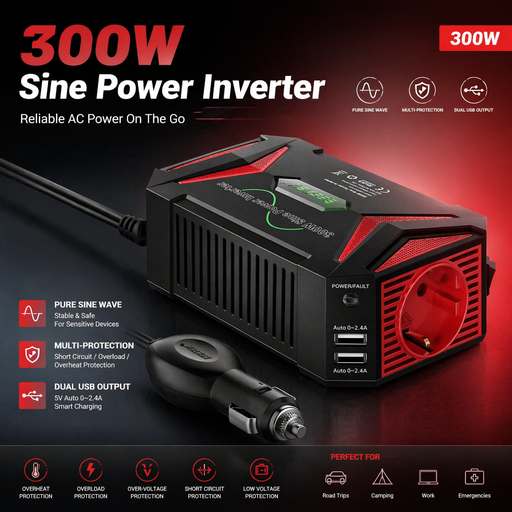
Why it’s a good fit for you : This model is suitable for daily journeys, occasional camping trips and charging small devices from a 12 V socket. The product specifications list two USB ports and one 230 V outlet.
Its stated continuous power of 300 W is clearly distinguished from its peak power of 700 W. You’ll still need to stay within the limit of your vehicle’s cigarette lighter socket.
Pure sine wave output, USB ports, a cigarette lighter plug, and stated protection against overloads, overheating and short circuits.
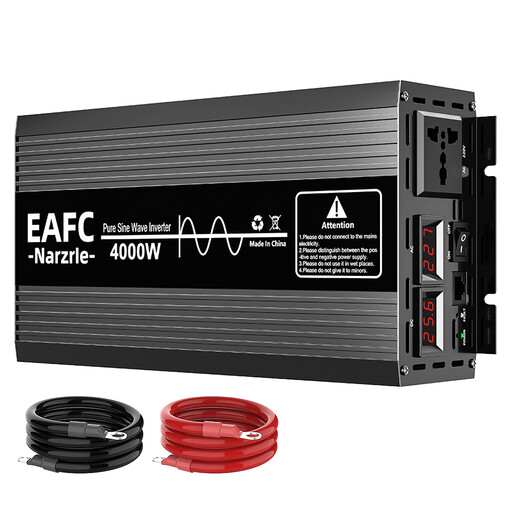
Why it’s a good fit for you : This model is designed for motorhome or boat owners, and for anyone with a leisure battery who wants to monitor power consumption easily using the display.
The specifications distinguish between 2 000 W continuous power and 4 000 W peak power. This level of power requires a direct connection and correctly sized cables.
Dual digital display, dual intelligent cooling fans, overload and reverse-polarity protection, and stated pure sine wave output.
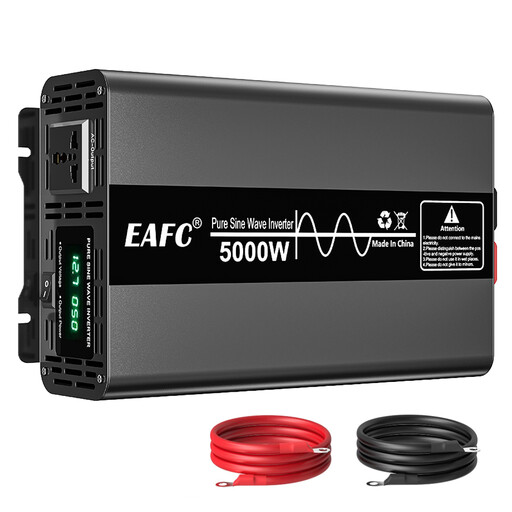
Why it’s a good fit for you : Its stated power makes it suitable for worksites, commercial vehicles, off-grid systems and backup situations where you need to power several devices.
The specifications distinguish between 2 500 W rated power and 5 000 W peak power. This level of power isn’t suitable for a standard cigarette lighter socket.
LCD screen, multiple protection features, cooling and two stated mains sockets. The specifications also mention pure sine wave output and efficiency of over 95 %.
We’ve put together a comprehensive, real-time updated selection of products that meet these strict criteria and European safety requirements.
No. Check that your vehicle has a 12 V battery and that the socket you plan to use can handle the required power. For models that exceed the capacity of the cigarette lighter socket, connect the inverter directly to the battery using a suitable fuse and cables.
It depends on the battery’s capacity and condition, the inverter’s efficiency and the power consumption of the connected devices. A 100 Ah battery won’t automatically provide 1,200 Wh of usable power: conversion losses and the reserve you need to keep reduce this figure. To avoid damaging a starter battery, don’t let it run too low. For extended use, choose a leisure battery instead.
Even when no devices are connected, an inverter may use a small amount of power in standby mode. Consumption then increases with the load and the power required. Switch it off when you’re not using it, keep an eye on the display if there is one, and avoid running several devices at once if their combined consumption is close to the inverter’s rated power.