
Livraison le jour même ou le lendemain

Qualité garantie

Débloquez vos offres de bienvenue: Livraison GRATUITE | Jusqu'à -80 % | 30 jours d'essai gratuits à JoyPlus
Téléchargez l'application
Having a reliable 220V power source on the go—whether in an RV, a van, or on a job site—is a game-changer for off-grid autonomy. The problem? The inverter market is flooded with marketing claims that are often misleading. Beyond wasting your money, making the wrong choice risks frying your electronic devices.
As a Product Recommendation Manager at Joybuy, my role is to help you cut through the noise. Together, let's break down the most common traps and the criteria that truly matter for choosing a 12V-220V inverter that fits your needs, without being fooled by inflated spec sheets.
The 2 Most Common Buying Mistakes:
To make the right choice, focus on these three technical points. They are decisive for the performance, safety, and compatibility of your future 12V-220V transformer.
As we've seen, nominal (or continuous) power is the number one criterion. This is the power that the inverter can supply in a stable and prolonged manner.
The quality of the delivered current is not always the same. This is an absolutely crucial criterion for the lifespan of your equipment.
The connectors and built-in safety features are guarantees of reliability and peace of mind.
Here are a few options that meet distinct user profiles, taking into account the criteria we've just discussed.
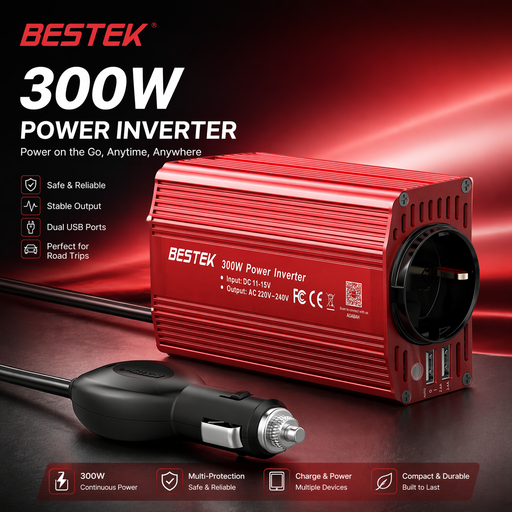
Why this model? Ideal for those who need a simple, budget-friendly solution to charge a phone or power a non-demanding device during car trips. Its cigarette lighter connection makes it ready to use out of the box.
This model is clearly positioned for basic use. By understanding that its modified signal is intended for simple devices, you avoid the trap of trying to use it for a laptop or fragile equipment.
Compact and lightweight, it's easy to store. The two USB ports (4.8A total) allow you to charge two mobile devices simultaneously in addition to the 230V outlet.
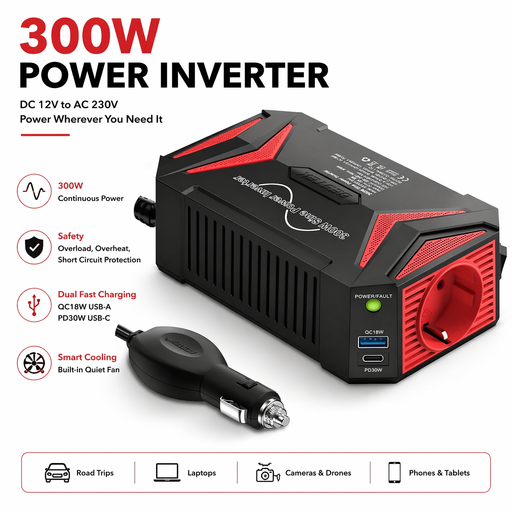
Why this model? Perfect for remote workers in a van or photographers on the go. It safely powers a laptop, camera, or drone, while offering ultra-fast charging for the latest smartphones and tablets.
Thanks to its pure sine wave technology, it eliminates the risk of damaging sensitive electronics, a common pitfall with low-end inverters. You can plug in your MacBook or PC with complete confidence.
The inclusion of a USB-C Power Delivery (PD 30W) port and a Quick Charge 3.0 port makes it a top choice for modern, power-hungry devices.
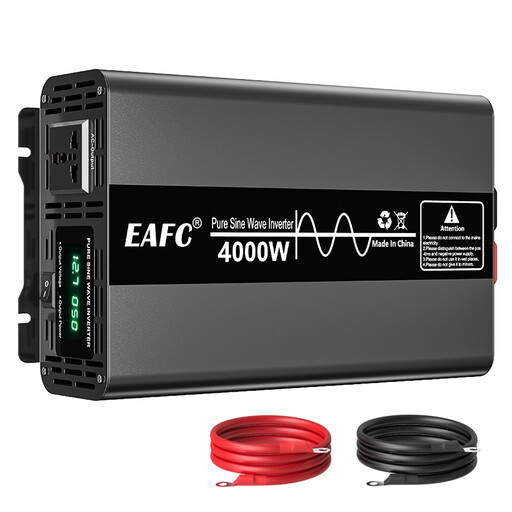
Why this model? Designed for RV owners, tradespeople, or for backup power. Its 2000W nominal power allows you to use demanding appliances like a coffee maker, a microwave, or power tools.
It emphasizes its 2000W nominal power, avoiding the misleading peak power trap. Its pure sine wave technology ensures full compatibility with all types of devices, even the most demanding ones.
The amorphous silicon technology provides better conversion efficiency, thus optimizing battery life. The dual-fan system ensures effective cooling for intensive and prolonged use.
We've curated a full range of products that meet our selection criteria and safety standards.
It all depends on your usage. For moderate use (charging devices, watching TV, using a computer), a pure sine wave inverter from 600W to 1000W nominal is often sufficient. If you want to use more power-hungry appliances like a pod coffee machine (around 1200W) or a hairdryer (over 1500W), you will need a model with at least 2000W nominal power.
No, and this is where the distinction between modified and pure sine wave is crucial. On a modified sine wave model, only plug in simple resistive loads (classic light bulb, soldering iron, heating plate). For everything else, and especially electronic devices (TV, computer, drone charger) or motor-driven appliances, a pure sine wave inverter is essential to prevent any damage.
Yes, absolutely. Since an inverter draws energy from the battery to convert it, it consumes it. Most quality models include under-voltage protection that automatically shuts off the device before the battery is completely drained, allowing you to restart the engine. However, it is not recommended to use a high-power inverter for a long period without the vehicle's engine running to recharge the battery.