
Livraison le jour même ou le lendemain

Qualité garantie

Débloquez vos offres de bienvenue: Livraison GRATUITE | Jusqu'à -80 % | 30 jours d'essai gratuits à JoyPlus
Téléchargez l'application
A 12V 220V car power inverter lets you run certain electrical appliances from your vehicle’s battery. It can be used to charge a laptop, power a lamp, run a small piece of equipment, or provide an auxiliary power source in a motorhome, lorry or on a worksite.
Not all models, however, meet the same needs. A power rating printed in large type, a mains socket and a few USB ports don’t guarantee compatibility with your gear. Here are the criteria to check before buying, along with a selection of models suited to different uses.
A 12V 220V car inverter may show a high peak power, available for a few seconds when starting a motor or compressor. Continuous power, on the other hand, is the load the device can handle over time.
A model advertised at 2,000 W might, for example, deliver 1,000 W continuously and reach 2,000 W at peak. To make the right choice, add up the consumption of the appliances you’ll plug in and keep a safety margin. Heating appliances, fridges and power tools can also draw a start-up current well above their rated power.
A compact cigarette lighter inverter is convenient, but a car’s 12 V socket is generally limited to 150 or 200 W, depending on the vehicle and its electrical circuit. A 300 W model therefore won’t necessarily be able to deliver 300 W through that socket.
Above those power levels, a direct connection to the battery with properly sized cables is usually essential. Follow the inverter’s and vehicle’s recommendations, avoid makeshift connections and protect the installation with a suitable fuse.
Modified sine wave models can work with some chargers, lamps and less sensitive equipment. With certain motors, transformers and electronic devices, however, they can cause noise, excessive heat or erratic operation.
A pure sine wave inverter produces an alternating voltage that more closely resembles domestic mains power. This technology is best for laptops, televisions, games consoles, motorised appliances and other sensitive electronics. It doesn’t remove the need to check each device’s compatibility.
Make sure the input is designed for a 12 V DC battery. Some vehicles, motorhomes and auxiliary systems run on 24 V and are therefore not compatible with a 12 V inverter.
The output may be listed as 220 V or 230 V AC. In France and the European Union, also check the type of socket supplied, the 50 Hz frequency and the presence of protection against overloads, short circuits, overheating, and voltages that are too low or too high.
To charge a phone or tablet, a small 12V 220V inverter with USB ports may be enough. For a laptop, start by checking the power rating of its charger. A coffee machine, oven, hairdryer or drill, on the other hand, can very quickly exceed the capacity of a model plugged into the cigarette lighter socket.
Searches like 12V 2000W inverter, 12V 4000W inverter or motorhome inverter should therefore be accompanied by a check of the continuous power, peak power and connection method.
An inverter doesn’t generate energy. The higher the power demanded, the faster the battery drains. As a guide, a 1,000 W load on a 12 V system already represents a significant current, to which conversion losses are added.
For extended use, consider the battery capacity, ventilation, and the length and cross-section of the cables. Depending on your vehicle’s setup, an auxiliary battery – especially AGM or gel – may be more suitable for a motorhome inverter than a starter battery.
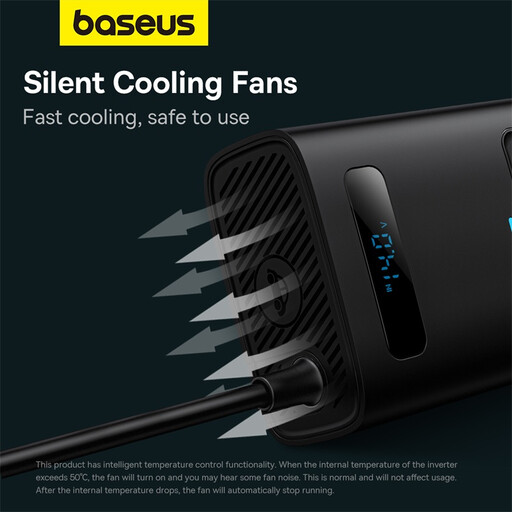
Why this choice suits this profile: Compact and powered via a 12 V socket, it’s ideal for daily commutes, occasional remote working and charging several mobile devices.
Its 150 W power is clearly stated, reducing the risk of overestimating what a cigarette lighter socket can handle.
Two USB-A ports and two USB-C ports, dimensions 176 × 71 × 39 mm, modified sine wave output.
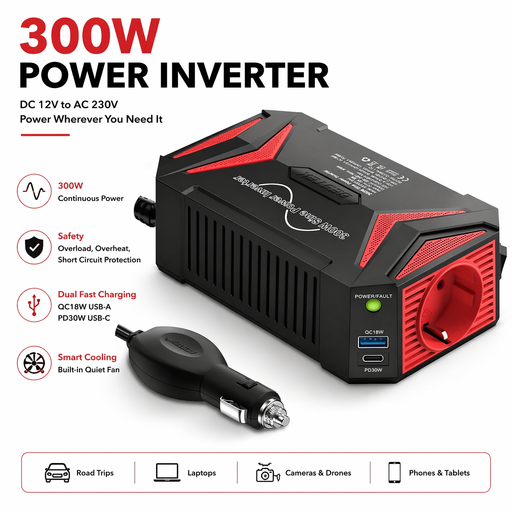
Why this choice suits this profile: Its pure sine wave output and fast-charging ports meet the needs of users who carry a laptop, camera or several electronic devices.
The 300 W continuous power and 700 W peak power are clearly distinguished. According to the product sheet, the intelligent fan also helps limit heat build-up.
Pure sine wave output, USB-C PD 30 W, USB QC 18 W, built-in fuse and 12 V connection.
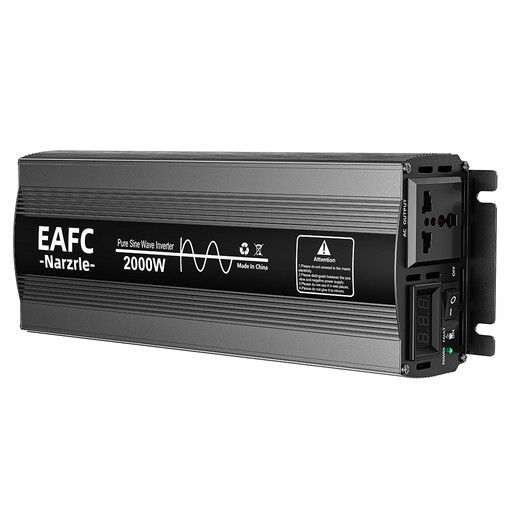
Why this choice suits this profile: With 1,000 W continuous and 2,000 W peak according to the product sheet, it’s aimed at 12 V motorhome installations, light DIY work and backup power.
The display shows input and output information. Protection against overload, overheating and reverse polarity makes it easier to monitor the setup.
Pure sine wave output, digital display, temperature-controlled fan and stated compatibility with several 12 V batteries.
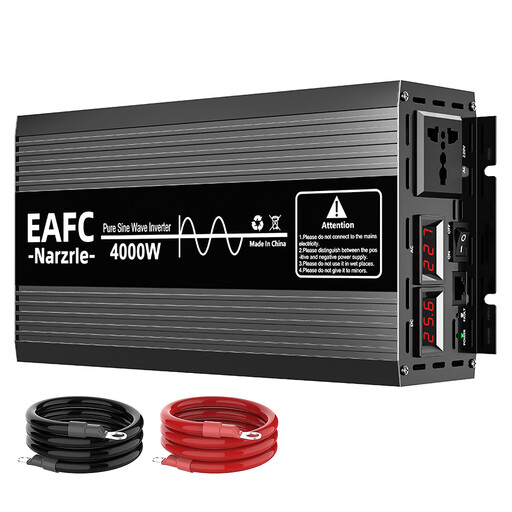
Why this choice suits this profile: Its stated continuous power of 2,000 W is aimed at users who need to run several pieces of equipment from a 12 V battery, with a suitable connection.
The product sheet distinguishes the 2,000 W continuous from the 4,000 W peak and includes two digital displays to monitor voltages.
Pure sine wave output, dual fans, protection against overload and overvoltage, stated noise level around 45 dB.
We’ve compiled a complete, real-time updated selection of products that meet these demanding criteria, as well as European safety requirements.
A model like the EAFC 5000W, advertised at 2,500 W continuous and 5,000 W peak, requires an installation capable of handling the corresponding currents. This category is not suitable for a simple cigarette lighter socket connection.
No. You need to compare the continuous power, the start-up power required and the waveform. Heating appliances and motors can quickly exceed the inverter’s capacity. For sensitive equipment, choose a pure sine wave output, while also checking the manufacturer’s recommendations.
The battery must be able to supply enough current for the required duration. A starter battery is better suited to occasional use with the engine running. For a motorhome or backup power, an auxiliary battery designed for cyclic discharge will generally be more suitable.
The cost depends mainly on the energy drawn from the battery and the inverter’s efficiency. A heavy load will quickly reduce runtime. To minimise losses, avoid leaving the inverter on when no appliance is connected, and choose a power rating that genuinely matches your needs.