
Livraison le jour même ou le lendemain

Qualité garantie

Débloquez vos offres de bienvenue: Livraison GRATUITE | Jusqu'à -80 % | 30 jours d'essai gratuits à JoyPlus
Téléchargez l'application
A 12 V to 220 V 2,000 W pure sine wave inverter lets you power appliances from a vehicle battery. However, be aware: models advertised as “4,000 W” are not all capable of delivering the same continuous power. Whether you’re in a motorhome, on a boat, in a van, or setting up a backup system at home, performance depends directly on the battery, the wiring and how long you use it.
Before you place an order, three pitfalls are particularly common:
The most important figure is the continuous rated power, not the most impressive number in the title. For a 12 V to 220 V inverter advertised as a 4,000 W model, check that the specification clearly states:
Add up the power of the equipment likely to run at the same time. A coffee machine, a fridge, a fan and a drill do not all place the same demands on the inverter: motors and compressors can temporarily draw far more than their usual consumption.
For powering a laptop, television, charger, boiler or any other device with sensitive electronics, a pure sine wave is generally preferable. However, it does not remove the need to check the available power, frequency, earthing and the manufacturer’s instructions.
An inverter with a digital display makes it easy to monitor input and output voltages. This is handy for quickly spotting a low battery or an abnormal voltage. According to their product specifications, the EAFC models shown below feature a dual digital display on the relevant version.
At a minimum, choose a model with protection against over-voltage and under-voltage, overloads, overheating, short circuits and reverse polarity. These features reduce the risk of mistakes, but they do not replace a properly carried out installation.
Cooling also deserves your attention if you plan to use the inverter for long periods. A quiet inverter fitted with thermostatically controlled fans will be more pleasant in a sleeping area or cabin. Still, leave enough space around the unit and avoid enclosed compartments or areas exposed to moisture.
For a motorhome or boat, also remember to check:
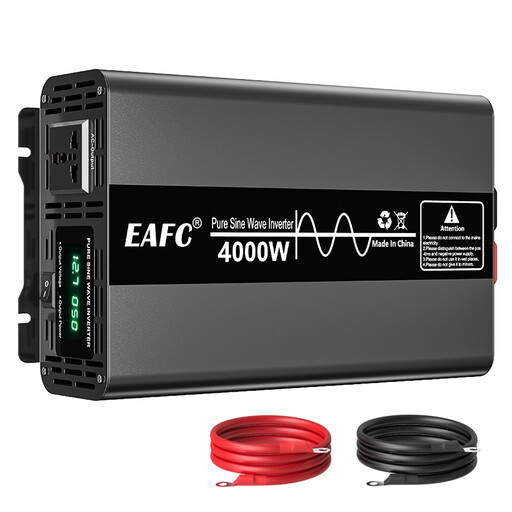
Why this choice suits this profile: This 12 V to 220 V inverter is suitable for a first installation in a motorhome, a utility vehicle or for occasional backup use, provided you follow the wiring recommendations.
The specification clearly distinguishes a rated power of 2,000 W and a peak power of 4,000 W. So there is no chance of confusing the two values. Multiple protections are also stated.
Pure sine wave, universal socket, dual ventilation and an operating range stated from -30 °C to 60 °C.
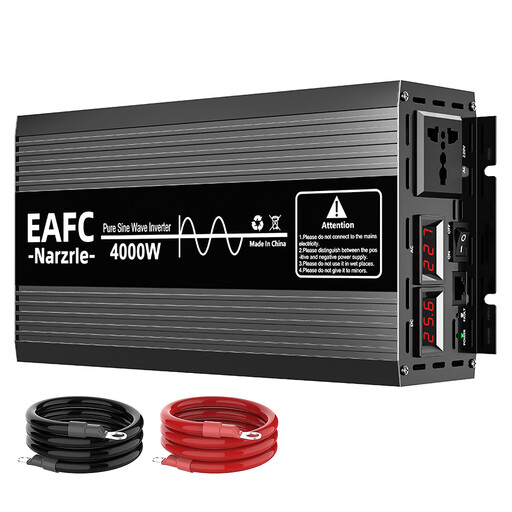
Why this choice suits this profile: This version is aimed at those who want to monitor input and output voltages directly, particularly in a converted motorhome or backup installation.
The two digital screens make essential information immediately visible. The fans are also described as intelligent, activating according to temperature.
2,000 W stated continuous, 4,000 W peak, pure sine wave output, multiple protections and a noise level given as around 45 dB.

Why this choice suits this profile: This product is aimed at drivers of trucks, vans, boats or motorhomes looking for a portable solution to start a vehicle and occasionally charge their devices.
This is not a 12 V to 220 V 2,000 W inverter, but a standalone jump starter. This distinction is essential so you don’t buy a backup battery thinking you can power 220 V appliances.
Starting current stated at 4,000 A, USB ports, built-in light and compatibility indicated with many 12 V vehicles.
We have put together a comprehensive, real-time updated selection of products that meet these demanding criteria, while also taking European safety regulations into account.
A 12 V to 220 V inverter of 2,000 W must be connected directly to the battery, using suitable cables. Avoid low-gauge extensions on the 12 V side: they can overheat and even pose a risk. Install the fuse or cut-off device recommended in the instructions, then carefully check the polarity before powering up the system.
Never connect the inverter output to the domestic mains at the same time without using a device specifically designed for that purpose. For powering a home as backup, a fixed installation must comply with the applicable electrical regulations in France. Call in a professional when the setup requires it.
The mention “quiet operation” does not mean the unit is completely silent. The fans may kick in when the load increases. A dry, ventilated and open location helps to reduce both noise and temperature rise.
Generally, no, at least not at its rated power. A cigarette lighter socket is designed for much lower currents than those needed for 2,000 W. Opt for a direct connection to the battery, with the wiring and protections specified in the instructions.
The battery must be able to supply a high current and have sufficient capacity for the intended duration of use. At full load, a 12 V 2,000 W inverter places heavy demands on it. A standard starter battery may not be suitable for prolonged use. Check its technology, capacity and the manufacturer’s recommendations.
The cost depends on the energy drawn from the battery, the inverter’s efficiency and the recharging needed. The more power-hungry the connected appliances, the faster the battery life drains. Turn off the inverter when not in use and limit energy-intensive equipment to preserve the battery.