
Livraison le jour même ou le lendemain

Qualité garantie

Débloquez vos offres de bienvenue: Livraison GRATUITE | Jusqu'à -80 % | 30 jours d'essai gratuits à JoyPlus
Téléchargez l'application
By Joybuy, your Product ExpertPublished August 26, 2026
Making the switch to a 12?V 100?Ah LiFePO4 battery for your RV, boat, or off-grid solar setup is an excellent decision. The benefits include extended runtime, a feather-light weight, and a tenfold increase in lifespan. The problem? The market is flooded with models that look identical on the surface but often hide flaws that can prove costly. Before you make a purchase, it's crucial to understand the most common marketing traps to avoid any unpleasant surprises.
Here are the 3 classic mistakes to avoid:
To make the right choice, focus on the features that truly matter for the performance and safety of your system. Here are the non-negotiable points.
The Battery Management System (BMS) isn't a gimmick; it's the guardian of your investment. A proper BMS must absolutely include:
Lithium iron phosphate (LiFePO4) technology far outperforms older lead-acid batteries. Where a 12V deep-cycle lead-acid battery maxes out at a few hundred cycles (at 50% DoD), a good LiFePO4 battery can achieve several thousand.
Demand a clear specification, such as over 4500 cycles at 80% DoD. This means you can discharge the battery to 80% of its capacity more than 4500 times before seeing any noticeable degradation. For an RV battery, this translates to over 10 years of worry-free use. A game-changing advantage when replacing a lead-acid battery.
Your energy needs may change over time. A quality battery should allow for connection with other identical units to increase either the voltage (series connection) or the capacity (parallel connection). Verify that the manufacturer allows for configurations like 4S (four in series for 48V) or 4P (four in parallel for 400Ah). This modularity is a guarantee of your system's longevity.
To illustrate these criteria, we've analysed a product that stands out for its balanced design, perfectly meeting the needs of RV owners and off-grid solar users who make no compromises on reliability.
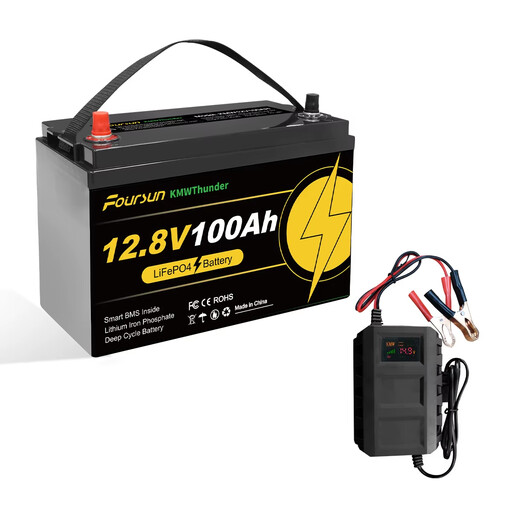
Why it checks all the boxes: This model is tailor-made for users who need a reliable power source for their RV trips or off-grid solar setup. Its feather-light weight (about one-third of a lead-acid battery) simplifies installation, while its high energy density ensures ample runtime for essential appliances (fridge, lights, inverter).
Its integrated BMS includes low-temperature protection, eliminating any risk of damage in winter. The lifespan of over 4500 cycles is clearly specified, a sign of transparency. The included charger eliminates hidden costs and ensures optimal charging right out of the box.
Comprehensive BMS with all essential protections. Proven longevity and modularity up to 4S4P for large-scale systems. Excellent performance-to-safety ratio for heavy-duty use.
Explore our complete, up-to-date selection of products that meet our strict selection criteria and current safety standards.
1. Can you use a lead-acid battery charger with a LiFePO4 battery?
No, this is strongly discouraged. LiFePO4 batteries require a specific charging profile (CC/CV: Constant Current/Constant Voltage) to ensure their safety and longevity. Using a lead-acid charger can cause overcharging, undercharging, or damage to the BMS. Choosing a model with an included charger or buying a dedicated LiFePO4 charger is the only reliable solution.
2. What is the real-world lifespan of a 12V 100Ah LiFePO4 battery?
It depends on usage, temperature, and the depth of discharge. A quality model rated for over 4500 cycles at 80% DoD can easily exceed 10 years of use in a typical RV application (with one discharge per day). That's 5 to 10 times longer than a 12V deep-cycle lead-acid battery, which makes the initial investment well worth it in the long run.
3. Is it complicated to replace an old lead-acid battery?
In most cases, it's a direct replacement (often called a "drop-in replacement"). The dimensions are often standardised to fit into existing battery trays. The main advantage is the weight: a 100Ah LiFePO4 battery weighs around 11 kg (24 lbs), compared to over 30 kg (66 lbs) for its lead-acid equivalent. This makes handling and installation significantly easier. Just be sure to respect the polarities (+/-) and ensure the connections are securely tightened.