
Livraison le jour même ou le lendemain

Qualité garantie

Débloquez vos offres de bienvenue: Livraison GRATUITE | Jusqu'à -80 % | 30 jours d'essai gratuits à JoyPlus
Téléchargez l'application
Upgrading to Lithium Iron Phosphate (LiFePO4) promises a massive boost in autonomy for your motorhome, camper van, or solar setup. But with an overwhelming number of options and often misleading spec sheets, it's easy to get lost. To ensure your investment doesn't turn into a disaster, here are the top 3 most common mistakes to avoid at all costs.
Here are the 3 most common mistakes to avoid:
Capacity isn't everything. For a long-term investment, it's the technical details that guarantee performance and durability.
The Battery Management System (BMS) is the true brain of your battery and arguably its most critical component. It protects against:
For use in a recreational vehicle or an off-grid setup, one feature is non-negotiable: low-temperature charging protection. This system stops the charge when the cell temperature drops below a certain threshold (usually 0°C), preventing permanent damage. It's a guarantee of reliability for your adventures, no matter the season.
A 12V 100Ah deep cycle battery with LiFePO4 technology offers a much higher usable capacity than its lead-acid equivalent. You can use almost all of its 100 Ah, whereas a lead-acid battery of the same capacity shouldn't be discharged beyond 50% to preserve its lifespan. In practical terms, replacing a lead-acid battery with lithium means cutting the weight by two-thirds while doubling the real-world autonomy. This is a game-changing advantage for a camper van or a sailboat where every kilogram counts.
Your energy needs aren't set in stone. The ability to connect multiple batteries in series (to increase voltage to 24V, 36V, or 48V) or in parallel (to increase capacity to 200Ah, 300Ah, etc.) is a major asset for the future. This is especially relevant when designing a scalable 12V solar battery system. Ensure the manufacturer allows these configurations and provides clear instructions for balancing the batteries before connecting them—this is a crucial step to guarantee the performance and safety of your setup.
We've selected products that tick all the boxes for performance and safety, each tailored to a specific need.
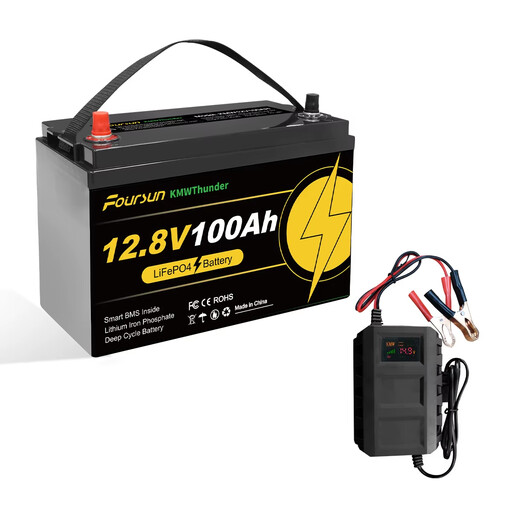
For whom? Ideal for owners of a motorhome lithium battery or boat who want a reliable, ready-to-use solution to power their equipment (heating, fridge, lights) for several days without needing to plug in.
Its advanced BMS includes low-temperature charging protection, which is essential for winter use. The package comes with a compatible charger, eliminating any guesswork.
Extra-long lifespan (over 4500 cycles advertised) and excellent scalability with support for up to 4S4P connections. Its feather-light weight (one-third of a lead-acid battery) is a significant bonus.
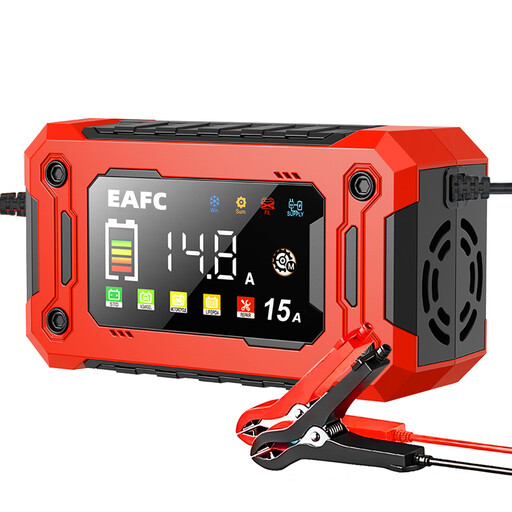
For whom? For those who have just invested in a LiFePO4 battery and want to take the best care of it, or who juggle the maintenance of multiple battery types (car, motorcycle, motorhome leisure battery).
This LiFePO4 battery charger is compatible with multiple technologies, including lithium. It applies the correct charging profile and safeguards your investment from rookie mistakes.
Fast charging thanks to its 15A current. It's versatile, offering seasonal modes (winter/summer) and a pulse repair function for lead-acid batteries. Its large screen makes monitoring easy.
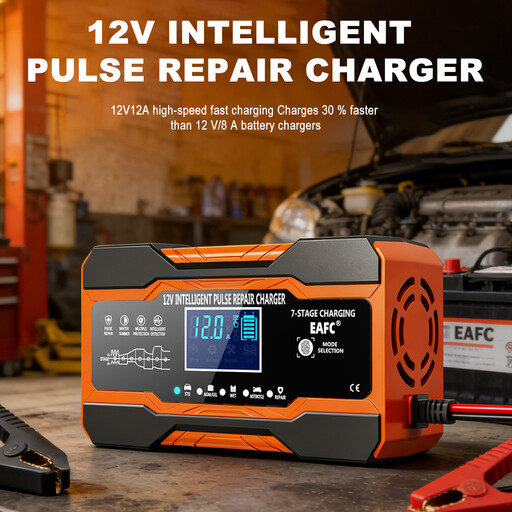
For whom? The perfect solution for anyone looking for a smart, affordable charger that can handle the leisure battery as well as the car or motorcycle battery. One device to manage it all.
With its multiple modes (car, motorcycle, AGM, etc.) and comprehensive protections (overheating, short circuit, reverse polarity), it ensures a safe and tailored charge for every technology.
Fully automatic, it stops on its own when the charge is complete. Its summer/winter modes adjust the cycle to the ambient temperature. It's compact and easy to store.
Discover our full selection of products that meet our quality criteria and current safety standards.
Yes, this is entirely possible and one of its major advantages. The dimensions are often standardized. However, there are two points of caution: your vehicle's alternator, which may not be ideal on older models, and most importantly, your charging system. Using a dedicated LiFePO4 charger or a solar controller with a lithium profile is not just recommended—it's essential to preserve your battery.
Longevity is measured in cycles. A good LiFePO4 model can handle between 2,000 and 5,000 full cycles. In practical terms, for daily use in a van (discharging to 80%), this translates to a lifespan of over 10 years. That's 3 to 5 times longer than a lead-acid battery, which puts the initial investment into perspective.
Yes, and this is non-negotiable. A LiFePO4 battery charger is essential. It applies a precise charging algorithm (CC/CV: Constant Current / Constant Voltage), which is very different from that of lead-acid batteries. Using an incompatible charger is a surefire way to get an incomplete charge, cell imbalance, and premature wear. Buying a compatible charger is the best life insurance for your battery.