
Livraison le jour même ou le lendemain

Qualité garantie

Débloquez vos offres de bienvenue: Livraison GRATUITE | Jusqu'à -80 % | 30 jours d'essai gratuits à JoyPlus
Téléchargez l'application
A 12,000 BTU portable air conditioner can cool a spacious room effectively, without building work or a fixed installation. It is particularly suitable for tenants, home workers and homes where installing a wall-mounted appliance is not an option. However, the stated power rating alone is not enough to guarantee the right choice.
Some of the information highlighted in product listings can even come with unwelcome surprises:
A 12,000 BTU/h appliance, equivalent to around 3.5 kW of cooling capacity, is generally advertised for rooms of up to 35 m². However, this estimate should be considered alongside the ceiling height, insulation, exposure and number of occupants.
In a properly insulated 30 to 35 m² living room, a portable air conditioner with this output could be a suitable choice. For a room with extensive glazing or one located in the loft, however, it is better to compare more powerful models or reduce the area you actually need to cool.
Heating power does not necessarily match cooling power. The Candy CP-12PVH1EU, for example, claims 3.3 kW in heating mode and a recommended area of up to 25 m² in this mode.
The A+ energy rating makes it easier to compare appliances using a standardised method. However, you should still check the consumption shown in watts or kilowatt-hours. According to the specifications provided for this product, the Candy model has an EER of 2.61 for cooling and a COP of 2.75 for heating.
R290 is used in many newer portable air conditioners. Compared with some refrigerants used in the past, it has a low global warming potential. It is nevertheless flammable: never pierce the circuit or attempt to modify it. The manufacturer’s instructions must be followed precisely.
A single-hose portable air conditioner must vent hot air outside through an exhaust hose. If the outlet is not fitted correctly, heat will return to the room and performance will drop. Before ordering, measure your window and check that the window kit is compatible with a vertically or horizontally sliding opening.
You should also allow for:
A product described as a dehumidifier air conditioner can improve comfort during humid periods. However, this function does not replace suitable ventilation in the home.
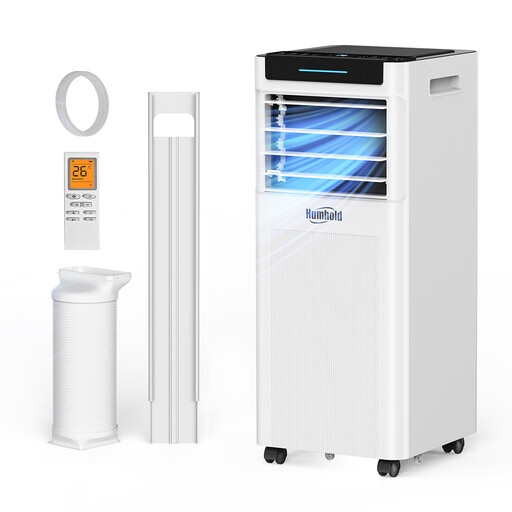
Why this choice suits this profile : With an output of 2.0 kW, this model is suitable for bedrooms, home offices and rooms of up to 28 m². Weighing 19.7 kg and fitted with castors, it can easily be moved from one room to another.
The recommended room size is clearly stated and a window sealing kit is included. This keeps additional purchases to a minimum when getting started.
Three modes, R290 refrigerant, 24-hour timer and a night mode advertised at under 49 dB.
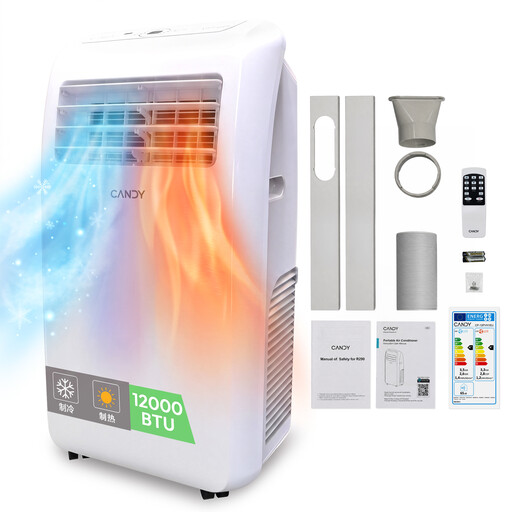
Why this choice suits this profile : This 4-in-1 air conditioner is designed for people who want to switch between cooling, heating, fan and dehumidification modes with a single appliance, in a room of up to 35 m² for cooling.
The product listing clearly distinguishes between cooling and heating capacities. You therefore cannot assume that a 12,000 BTU appliance will heat the same area as it cools.
A+ rating advertised in both modes, 400 m³/h airflow, remote control, 24-hour timer and window kit included.
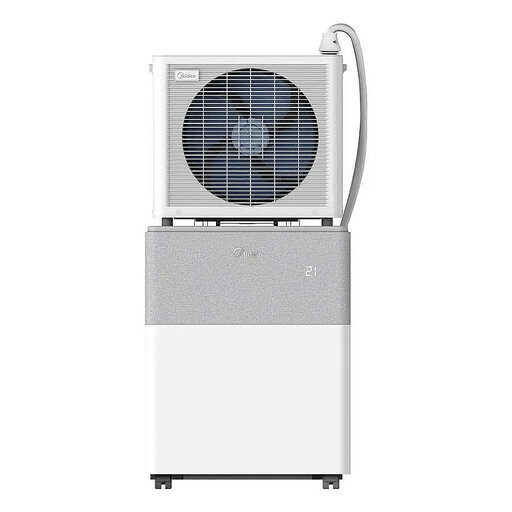
Why this choice suits this profile : Its portable design, made up of an indoor unit and an outdoor unit, is aimed at users looking for a reversible, connected appliance advertised as capable of covering up to 42 m².
The listing details both units, their dimensions and the 2 m connecting pipe: all important points to check before deciding where to position it.
A+ rating, heating and cooling modes, Wi-Fi, quiet mode advertised at between 39 and 59 dB(A), window kit and remote control.
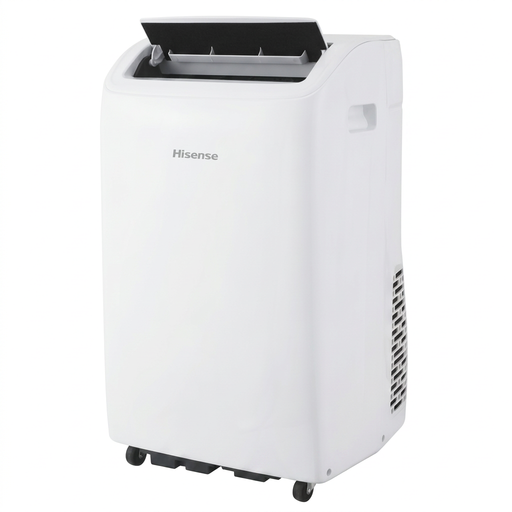
Why this choice suits this profile : With 2.6 kW of cooling power, a 2.4 kW heating function and Wi-Fi control, this model is intended for medium-sized rooms and users who want to control it remotely.
The listing states a coverage area of 14 m², so it is best not to rely solely on the 9000 BTU label when assessing whether it is suitable.
R290, 24-hour timer, remote control with LED display and a minimum noise level advertised at 50 dB.
We have put together a comprehensive, real-time updated selection of products that meet these demanding criteria and European safety standards.
Install the appliance on a flat floor near a window, then connect the exhaust hose, avoiding overly sharp bends. Follow the clearance requirements specified in the instructions and never block the air intake or outlet grilles.
After delivery, some compressors must remain switched off for several hours if the appliance was transported at an angle. The Candy CP-12PVH1EU, for example, recommends waiting two hours before switching it on for the first time. Always consult the instructions for the model you have received.
To minimise inconvenience, clean the filter at the recommended intervals and use dehumidification mode with suitable drainage. Perceived noise depends on the room, the floor and the selected power setting: even a quiet portable air conditioner is an appliance fitted with a compressor. Decibel ratings should therefore be compared under similar conditions.
It can be, in a properly insulated room with limited exposure to heat. However, the stated coverage area is not a universal guarantee: orientation, glazing, ceiling height and insulation quality all have a significant impact on the result.
It depends entirely on the appliance’s electrical power, your supplier’s tariff and how long you use it. To estimate the cost, multiply the consumption in kW by the number of hours of operation, then by the kWh price shown on your bill. A 24-hour timer and a reasonable temperature setting can also help prevent the appliance from running unnecessarily.
Yes, some models are reversible and include a heating air conditioner function. However, check the available heating power, the recommended area in this mode and the corresponding energy rating. A reversible portable air conditioner can be useful during the milder seasons, but its effectiveness also depends on the outdoor temperature and the home’s insulation.