
Livraison le jour même ou le lendemain

Qualité garantie

Débloquez vos offres de bienvenue: Livraison GRATUITE | Jusqu'à -80 % | 30 jours d'essai gratuits à JoyPlus
Téléchargez l'application
A 12,000 BTU portable air conditioner can cool a medium-sized room without requiring a permanent installation. It is particularly suitable for rented flats, home-working offices or rooms that cannot accommodate an outdoor unit. However, the stated capacity alone is not enough to guarantee the right purchase.
Before comparing offers, check the actual floor area covered, the hot-air exhaust system, noise level and stated energy consumption. Here are the criteria to consider to avoid unpleasant surprises.
BTUs indicate cooling capacity, but the area covered also depends on ceiling height, exposure to sunlight, insulation quality and the number of occupants. A portable air conditioner for 35 m² may therefore be suitable for a properly insulated living room, but less effective in a loft room or a room with strong south-facing exposure.
Also remember to distinguish between the capacity in cooling mode and that in heating mode. Some appliances advertised for 35 m² when cooling cover a smaller area when used for heating.
A portable air conditioner expels hot air outside through a hose. If this outlet is installed incorrectly, some of the heat returns to the room and the appliance becomes less effective. An air conditioner with a window kit makes installation easier, but check that it is compatible with your window: vertically opening, sliding or hinged.
Also measure the space available around the appliance. The Candy model shown below requires a clearance of 51 cm in particular to ensure sufficient air circulation.
Noise levels vary according to the selected mode, fan speed and characteristics of the room. A value expressed in decibels is therefore more useful than a simple marketing claim. For a bedroom or office, check whether the appliance has a night mode and whether you can programme it to switch off.
For a room of around 35 m², look for a capacity close to 12,000 BTU/h, equivalent to approximately 3.5 kW of cooling power. However, this figure must be considered alongside the layout and characteristics of your home. In a smaller room, a 7,000 BTU model can reduce both the space required and overall energy consumption.
For a reversible portable air conditioner, check the heating capacity separately. An appliance may display 3.5 kW in cooling mode while covering a smaller area in heating mode.
The energy class provides a basis for comparing appliances under standardised conditions. The Candy CP-12PVH1EU is listed as energy class A+ for both cooling and heating, with consumption of around 1.4 kWh per hour in cooling mode and 1.2 kWh per hour in heating mode. These figures come from the product specification: the actual cost will depend on your electricity tariff, selected temperature and usage time.
A timer also prevents the appliance from running unnecessarily. A 24-hour timer can, for example, cool a room before you return home or reduce operation overnight.
A 4-in-1 air conditioner generally combines cooling, heating, fan and dehumidifying modes. This versatility can save you from buying several appliances, but make sure the product specification clearly confirms the presence and characteristics of each function.
In dehumidifying mode, the tank may fill more quickly, particularly when the air is humid. Candy states an extraction capacity of up to 33.6 L per day. This figure does not guarantee the same result in every room: it depends in particular on humidity levels and temperature.
The filter must remain in place and be cleaned in accordance with the manufacturer’s recommendations. An exhaust hose fully extended without sharp bends, together with an unobstructed grille, also helps the appliance operate correctly.
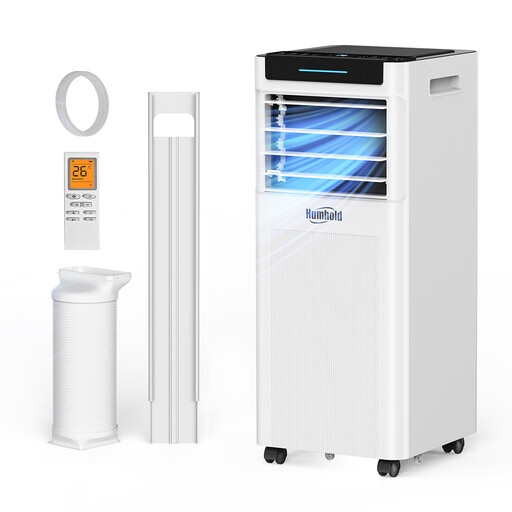
Why this choice suits this profile : With 2.0 kW of power and stated coverage of up to 28 m², this model is suitable for bedrooms, offices and smaller living rooms that do not require 12,000 BTU.
It prevents you from choosing an oversized appliance for a small room and includes a window kit, exhaust hose and 24 hour timer.
Three modes, R290 refrigerant, night mode rated at under 49 dB and washable filter.
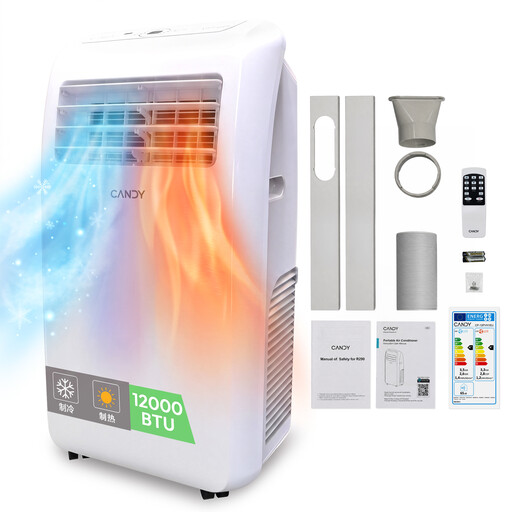
Why this choice suits this profile : Its stated capacity is suitable for a room of up to 35 m² in cooling mode, while the heating function makes it useful all year round.
The specification clearly distinguishes the capacities: 35 m² in cooling mode and up to 25 m² in heating mode. The window kit is supplied to simplify exhaust installation.
Four modes, A+ rating stated for both functions, airflow of 400 m³/h and remote control.
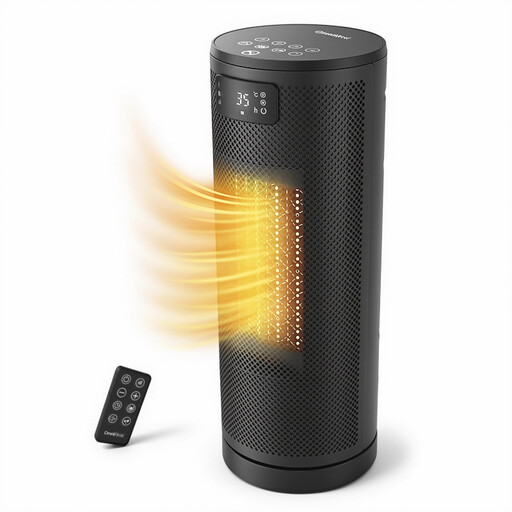
Why this choice suits this profile : For a home that already has an air conditioner and needs a separate appliance for occasional heating in an office or bedroom.
It is not presented as an air conditioner: it is a supplementary heater intended solely for a separate heating requirement.
1800 W power, adjustable thermostat from 5 to 35 °C, four heating modes and overheat and tip-over protection.
We have selected a complete, real-time updated list of products that meet these exacting selection criteria and European safety standards.
Place the appliance on a stable surface near a window, avoiding excessively tight bends in the hose. Follow the clearance specified in the instructions and plug it into a suitable socket, without using multiple extension leads or adaptors.
After transportation, some models must be left standing still before being switched on. For the Candy CP-12PVH1EU, the product information recommends waiting two hours if the appliance has been tilted. When the tank is full, an indicator may signal that it needs draining, particularly during periods of high humidity.
It may be suitable for a room of up to 35 m², depending on the characteristics of your home. Strong exposure to sunlight, poor insulation or a high ceiling can reduce the area that is effectively cooled.
Consumption depends on the appliance’s power, requested temperature, insulation and operating time. Check the kWh values provided by the manufacturer and use the timer to avoid unnecessary running times.
There is no universal duration. Following the ventilation instructions, cleaning the filter regularly, keeping the grilles unobstructed and storing the appliance in a sheltered place when not in use all help preserve its service life. The instruction manual remains the definitive reference for maintenance and inspection intervals.