
Livraison le jour même ou le lendemain

Qualité garantie

Débloquez vos offres de bienvenue: Livraison GRATUITE | Jusqu'à -80 % | 30 jours d'essai gratuits à JoyPlus
Téléchargez l'application
A set of 12-colour dual-tip watercolour markers can be used for colouring, drawing, lettering or your first attempts at watercolour painting. However, not every model is equally suited to every use. A nib that is too flexible for a child, ink that bleeds through the paper or colours that are difficult to blend can quickly turn an appealing purchase into an impractical set of tools.
Here are the key points to consider before choosing your watercolour markers, whether they are for home, school or a creative hobby project.
The term “dual tip” does not always refer to the same configuration. Some markers combine a brush tip with a chisel tip, while others offer a fine tip and a broad tip. For colouring, a broad tip covers large areas efficiently. For details, outlines or lettering, a fine or brush tip provides greater precision.
Before ordering, check the exact shape of both tips, rather than relying solely on the number of ends.
Twelve shades make a compact palette for beginners, but the richness of the result also depends on whether the colours can be layered or diluted. A multicoloured set may look complete while offering very few intermediate shades.
To create watercolour effects, choose paper that is sufficiently thick and able to withstand moisture. On paper that is too thin, the ink may bleed through or cause the page to buckle.
Colouring markers intended for children should be suitable for their age. Supervision is also recommended when the product contains small parts or caps. The term “washable” should likewise be interpreted with care: it does not necessarily guarantee that every stain will disappear from every type of fabric.
Recap each marker after use and store it in its case or horizontally when recommended by the manufacturer. This simple habit helps prevent the tips from drying out.
For creating varied illustrations, look for a combination that includes:
Brush-tip watercolour markers are particularly well suited to gradients and creative lettering. Chisel-tip models are often easier for children and beginners to handle.
Water-based ink generally makes it easier to dilute the colour with a damp brush. However, the result depends on the paper used, the amount of water and the drying time. To avoid disappointment, always test the marker on a scrap of paper before starting your drawing.
Claims such as “non-toxic”, “alcohol-free” or “odour-free” should be checked on the product page. They describe the stated composition, but do not replace safe-use precautions, particularly with young children.
For a purchase in France, check the product page, recommended age, warnings and the information supplied by the manufacturer or the responsible person in the European Union. The required markings and regulatory information should be consistent with the product category.
A practical case, numbered colours and a swatch card can also make storage and shade identification easier, especially for school or regular use.

Why this choice suits this profile: This set offers the sought-after 12-colour format and is suitable for drawing, colouring and your first experiments with water, without filling your pencil case with several different products.
The dual-tip design means you do not need to buy several types of marker separately. However, check the tip description before buying, depending on the technique you intend to use.
A set of 12 assorted colours with a dual-tip design, ideal for a compact creative pencil case.
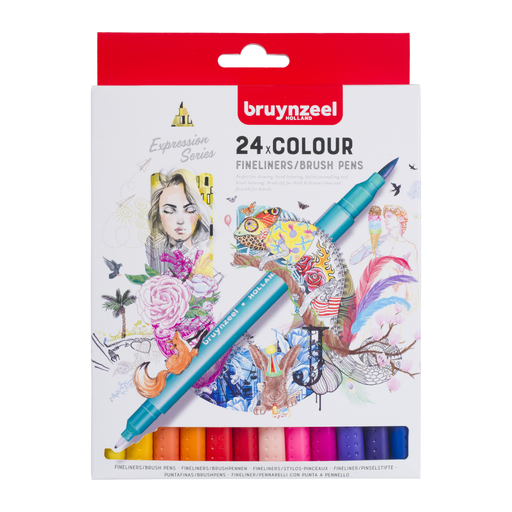
Why this choice suits this profile: If you want more shades for creative journalling, sketching or lettering, this 24-colour palette and its two distinct tips give you much more creative freedom.
The brush tip and 0.4 mm fine liner are clearly differentiated, helping you avoid confusing the tips intended for filling areas and adding details.
24 shades, a flexible brush tip and a 0.4 mm fine tip, with water-based ink according to the product page.
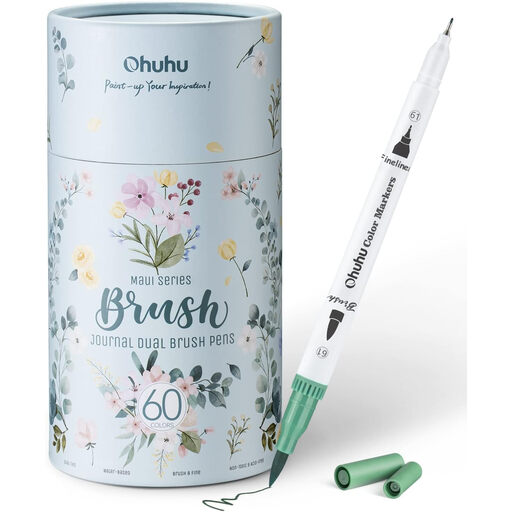
Why this choice suits this profile: For regular illustration, detailed colouring or calligraphy, an extensive palette and two complementary tips offer far more creative possibilities.
The swatch card makes it easier to identify shades, while the replacement tips included reduce the risk of having to replace a worn marker too soon.
60 colours, a 1–6 mm brush tip, a 0.4 mm fine liner and water-based ink advertised as acid-free.
We have put together a complete, real-time updated list of products that fully meet these strict selection criteria as well as European safety regulations.
Colour a small area on thick paper, then spread the colour with a slightly damp brush. Work in small sections to maintain control over the result. Test the paper first: a sheet that is too thin may become distorted.
Its usable life depends on how often it is used, the pressure applied to the tips and how the caps are replaced. Store the markers away from heat and recap them immediately after use. A fraying tip or ink that no longer flows evenly indicates that it is time to check the condition of the marker.
Yes, for colouring and creative activities, provided you follow the age recommendation on the packaging and the warnings. For younger children, choose a sufficiently thick, ergonomic barrel, ventilated caps where this feature is specified and water-based ink. Adult supervision is still recommended, particularly when small parts are present.