
Livraison le jour même ou le lendemain

Qualité garantie

Débloquez vos offres de bienvenue: Livraison GRATUITE | Jusqu'à -80 % | 30 jours d'essai gratuits à JoyPlus
Téléchargez l'application
For any electric vehicle owner, installing a home charging solution is an almost essential step. If your home has a three-phase electrical supply, an 11 kW three-phase EV charger is the perfect balance between charging speed and technical constraints. The problem is, the market is flooded with models making tempting promises, and it's easy to fall into traps that can become costly in the long run.
Before you take the plunge, let's review two common pitfalls:
This guide is here to arm you with the technical knowledge needed to make an informed and future-proof choice.
When choosing the right three-phase electric car charger, power isn't everything. Three technical elements deserve close examination.
An 11 kW charger operates on a three-phase supply (3 phases + Neutral + Ground) and delivers a current of 16 A per phase. This is what allows it to reach its charging power of 11 kW (3 x 230 V x 16 A).
In Europe, and therefore in France, the standard connector for alternating current (AC) charging is the Type 2 (sometimes called Mennekes). Almost all electric and plug-in hybrid vehicles sold in our market are equipped with it. Choosing a Type 2 charging station ensures near-universal compatibility with your current car and future ones.
A smart wallbox with an app must go beyond simple charge monitoring. The truly useful features are those that put you in control and generate savings:
Rather than a random laundry list, we have selected models that meet specific user profiles, based on our criteria for performance, safety, and the relevance of their smart features.
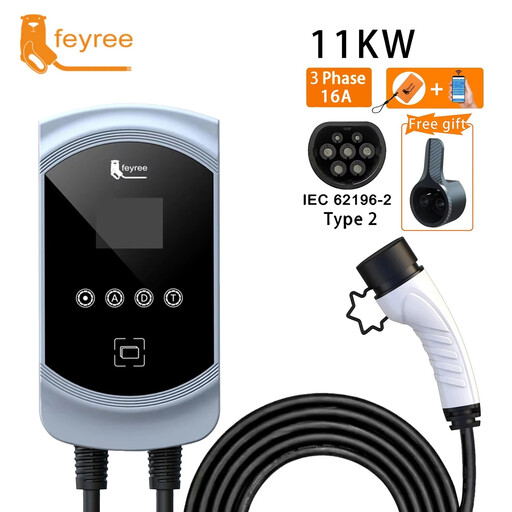
User Profile: This is the simple, effective solution for EV owners with a three-phase connection who want optimised 11 kW home charging without the hassle. The attached cable simplifies daily use: you park, you plug in. That's it.
It relies on the Tuya Smart ecosystem, a widespread, free, and proven app. This helps you avoid the unpleasant surprises of unreliable or abandoned "in-house" apps.
It integrates a full suite of protections (overvoltage, overheat, current leakage). Its LCD screen displays clear, real-time information about the charging session.
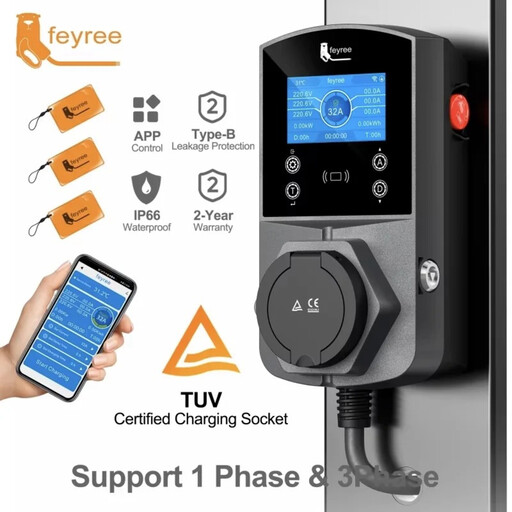
User Profile: Perfect for those who value flexibility. The socket version allows you to use your own cable (of any length) and doesn't lock you into a fixed setup. It also lets you future-proof for a new vehicle that may accept a higher charging power.
This charger can deliver up to 22 kW, but it automatically adapts to the maximum power accepted by the vehicle and permitted by the installation. You're not buying power you can't use, but rather the capacity to evolve in the future.
Integrated Type B RCD (AC 30mA + DC 6mA), a true mark of safety. Its weatherproof design (IP66) allows for outdoor installation without any worry.
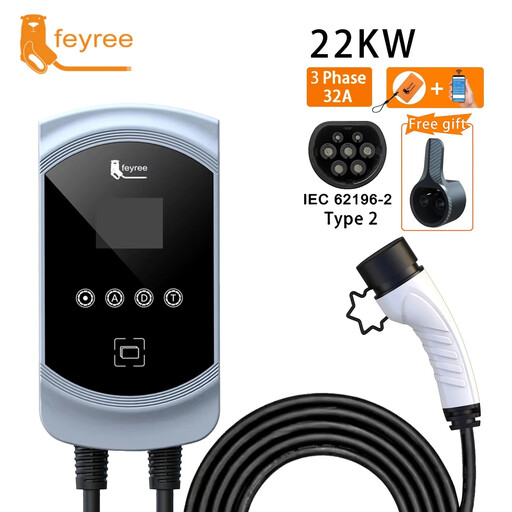
User Profile: Designed for those who want to get the full potential out of their three-phase installation. If your vehicle accepts 22 kW charging (or you plan to get one that does), this charger offers the fastest AC charging speed on the market.
Even though it's extremely powerful, it remains fully controllable via the app. You can adjust the current from 8A to 32A, allowing you to use it at 11 kW if needed, while keeping the 22 kW capability up your sleeve.
Maximum power of 22 kW for lightning-fast charging. It retains all the smart features (Wi-Fi, Tuya App, scheduling) and safety protections of the 11 kW model.
We have compiled a complete and up-to-date selection of products that meet our strict selection criteria and French safety standards.
Yes, and it's non-negotiable. The installation of a charging station, especially an 11 kW three-phase model, must be carried out by a qualified electrician, ideally one with an EVSE certification (like the IRVE certification in France). This is a legal requirement to guarantee the safety of your installation, its compliance with standards (notably NF C 15-100 in France), and it is a sine qua non for benefiting from tax credits and other government grants.
A 7.4 kW single-phase charger allows you to recover about 40 km of range per hour of charging. With an 11 kW three-phase charger, that increases to about 60-65 km of range in the same amount of time. For a full charge, the time saved is around 30% to 40%, which is a game-changer for daily use.
Yes. The primary cost-saving lever is charge scheduling. By using your smart wallbox's app to charge your vehicle only during off-peak hours (if your electricity contract includes this option), you can reduce the cost of each kWh by 25% to 40%. Over a year, the savings are substantial and allow you to recoup the cost of the charger more quickly.