
Livraison le jour même ou le lendemain

Qualité garantie

Débloquez vos offres de bienvenue: Livraison GRATUITE | Jusqu'à -80 % | 30 jours d'essai gratuits à JoyPlus
Téléchargez l'application
Lighting is the final touch that can completely transform an interior. When chosen well, a 10m LED strip can turn a dull living room into a cosy space, a bedroom into a snug retreat, or a gaming setup into a truly immersive arena. The problem? The market is saturated with products that promise the world but often disappoint in practice. Our mission: to help you see clearly and make a smart, long-lasting choice.
But before you pull out your credit card, let's review the classic pitfalls that too often turn a fun decor project into a real headache.
10m LED strip behind the TV stand, and after a few days, it starts to dangle miserably. The culprit is simply a low-quality adhesive.To avoid these traps, a few technical criteria are all you need to sort the good from the bad. These are the true guarantors of the quality of your future decorative LED light strip.
The quality of the light output is directly related to the number of LEDs per meter. A high density (at least 60 LEDs/m) ensures a more uniform light and reduces the "dotted" effect. But density isn't everything; the chip technology is also essential:
bedroom ambient lighting with a flawless finish.A good LED strip is one that stays put. Check if the brand provides information on the quality of its adhesive (3M is often a sign of reliability). Also, consider the IP (Ingress Protection) rating, which indicates its resistance to the elements. For indoor use away from water sources, an IP20 rating is sufficient. It guarantees protection against solid objects (like fingers) but not against liquids.
The majority of kits include an LED strip with remote. There are two main types:
For a multicolour LED strip, make sure the remote offers intuitive control over colours, brightness, and various dynamic modes (fade, strobe, etc.).
Rather than an endless list, we've selected a few products that meet specific needs while adhering to the quality criteria we've just discussed.
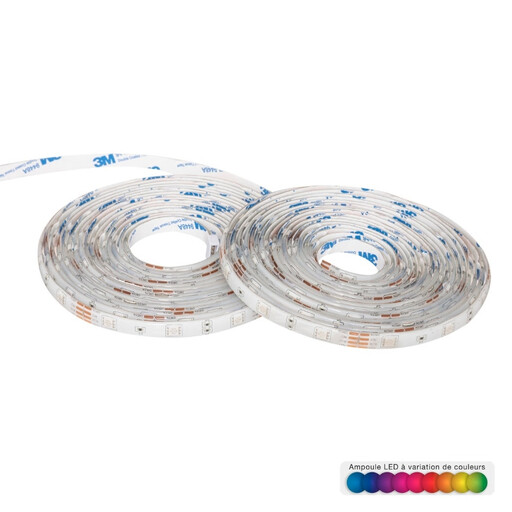
Why we recommend it: Perfect for illuminating a large area: the perimeter of a room, a staircase railing, or a large TV stand. Its 10-meter length makes it a very practical all-in-one solution.
This kit is a complete 10m solution (2x5m to be connected), which avoids unpleasant surprises. It comes with an infrared remote and a power adapter, so it's ready to use right out of the box.
A generous length for ambitious projects, with programmable colours and extremely simple installation.
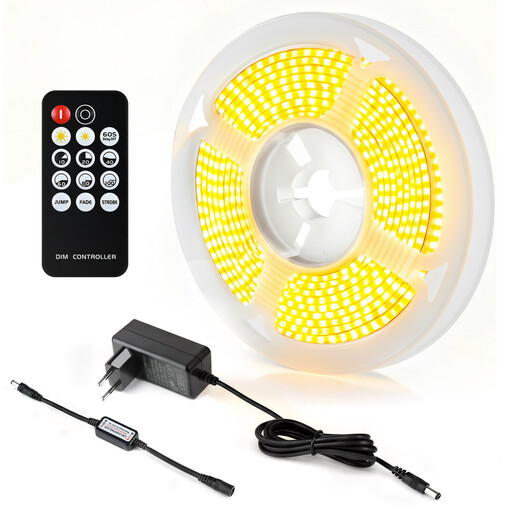
Why we recommend it: The solution for those who demand a perfect visual result over shorter distances. Ideal for highlighting shelves, lighting the inside of a wardrobe, or under a kitchen cabinet, where perfectly uniform light makes all the difference.
Thanks to COB technology, the "dotted" effect is a thing of the past! The output is a soft, perfectly continuous line of light. This is the direct answer to the first pitfall we mentioned.
Uniform, flicker-free lighting, an excellent CRI (92) for true-to-life colours, and an RF remote that works even when the receiver is hidden.
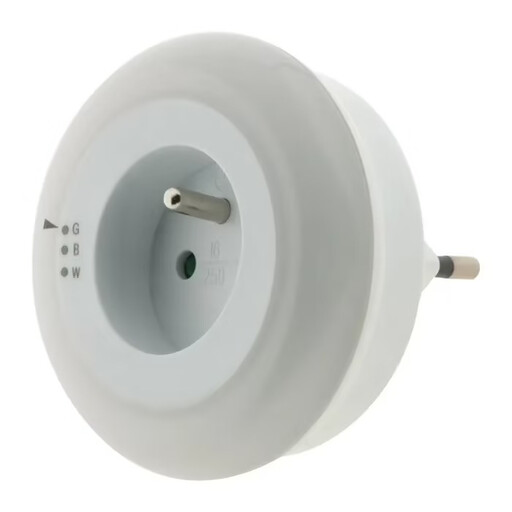
Why we recommend it: For anyone who wants a touch of ambient light with zero installation. Perfect for lighting a hallway at night or as a night light in a child's room, you just plug it into an outlet.
This product completely bypasses installation and adhesive issues. It's a standalone "plug-and-play" solution: you plug it in, and it works.
Its "passthrough" design keeps the electrical outlet free, and its dusk-to-dawn sensor makes it 100% autonomous.
Discover our full selection of products that meet our quality criteria and current safety standards.
Yes, most LED strips are cuttable. They have cutting marks (often a scissors icon) at regular intervals, usually every 5 or 10 cm. It is imperative to cut precisely on these marks to avoid damaging the circuit. If you cut in the wrong place, the affected section will no longer light up. Note that specific connectors are available to reuse the offcuts.
The lifespan of an LED strip, typically between 25,000 and 50,000 hours, is an excellent indicator of its quality. In practical terms, for an average use of 5 hours per day, this translates to a lifespan of over 13 years. This longevity, of course, depends on several factors: the quality of the chips, heat dissipation (a strip that overheats wears out faster), and the stability of its power supply.
Rest assured, the consumption is very low. It depends on its power, expressed in watts (W). For example, a 10-meter strip with a power of 24W consumes 0.024 kilowatt-hours (kWh) per hour. If used for 4 hours a day, its annual consumption would be about 35 kWh. At current electricity prices, this represents only a few dollars on your annual bill.