
Livraison le jour même ou le lendemain

Qualité garantie

Débloquez vos offres de bienvenue: Livraison GRATUITE | Jusqu'à -80 % | 30 jours d'essai gratuits à JoyPlus
Téléchargez l'application
Whether you're powering your devices on a camping trip, ensuring your camper van stays off-grid, or simply preparing for a power outage, a 100W portable solar panel is a flexible and accessible energy solution. However, the market is saturated with marketing promises that often fizzle out in the field. To help you see things more clearly, we're breaking down the traps to avoid and the criteria that truly matter before you buy.
Juggling technical specs can quickly become a headache. As a result, many people end up with a disappointing product that falls far short of the initial promises. Here are the mistakes you shouldn't make.
To ensure you make the right choice, scrutinise these three essential points that determine the performance and versatility of your future solar panel.
The type of photovoltaic cells directly determines how much energy your panel can generate for a given surface area.
For a camping solar panel or for use in an RV, a monocrystalline model with an efficiency of around 23% is a guarantee of performance and compactness.
A good solar panel is one that can charge anything. Make sure it has several types of outputs for bulletproof compatibility.
Portability isn't just about weight. A smart design makes all the difference in the field.
Here is an option that meets our criteria for performance and versatility, suitable for different user profiles.
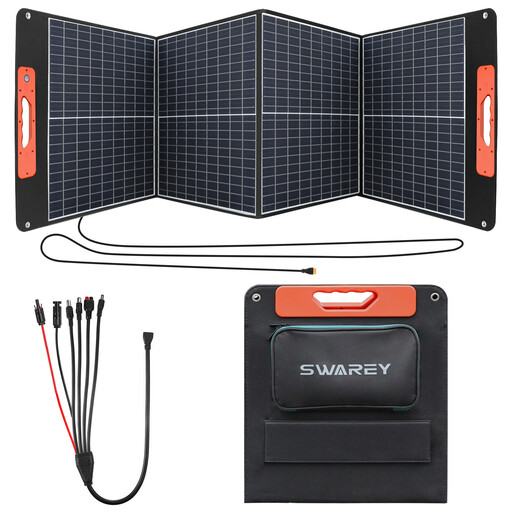
Why we love it: Perfect for getaways, this panel is a featherlight (around 3.5 kg) option that deploys in an instant. Its USB ports let you charge a smartphone and tablet directly, saving you from lugging a heavy power station on a simple hike.
Its 4-panel design and light weight make it truly portable. Its integrated "Ray Tracer" solar sight puts an end to guesswork: it guarantees perfect alignment for maximum output and bypasses the disappointing "peak" power trap.
Its effortless simplicity: unfold, aim with the sight, and plug in. Ideal for those who want power, not headaches.
Why we love it: For road nomads, compatibility is king. This panel comes with an XT60 to 5-in-1 cable (Anderson/MC4/DC), making it compatible with almost every power station on the market. It's the guarantee you can recharge your setup, regardless of your battery's brand.
It shatters the limited compatibility trap. No more hunting for adapters or stressing about connectors. Its high-efficiency monocrystalline cells (up to 23% advertised) ensure a fast recharge for your auxiliary battery.
Its "plug-and-play" universal connectivity offers absolute peace of mind. A real plus for pairing it with any solar panel for a power station.
Why we love it: For those who work in the great outdoors or want to be prepared for any contingency, direct and fast charging is non-negotiable. This panel includes a 60W USB-C PD port, capable of powering most modern laptops without any intermediary.
It bypasses the trap of a panel that is merely a battery accessory. By functioning as a standalone charger for power-hungry devices like a laptop, it becomes a complete energy source in its own right.
Its 60W USB-C PD output: the guarantee of uninterrupted productivity while working remotely outdoors, and an energy lifeline for your essential devices during an outage.
A good adventure is, above all, a well-prepared one.
To complete your kit, discover our selection of supplies chosen for their practicality and quality, perfect for planning your nomadic projects.
In practice, you can expect a real-world output of 60 to 80 watts in good sunlight conditions. This output can drop to between 15 and 30 watts on a very cloudy day. The quality of the cells, heat, and the panel's angle are the three key factors that impact actual performance.
Yes, a monocrystalline solar panel will continue to produce electricity on an overcast day, but with a significantly reduced power output. It will be enough to maintain a smartphone's charge or slow the discharge of a power bank, but don't expect a fast recharge.
It all depends on your station's capacity (in Wh) and the sun. For example, for a 500?Wh station and a panel delivering an average of 75?W, the calculation is simple: 500?Wh / 75?W ≈ 6.7 hours of full sun. Always plan for a generous safety margin.