
Livraison le jour même ou le lendemain

Qualité garantie

Débloquez vos offres de bienvenue: Livraison GRATUITE | Jusqu'à -80 % | 30 jours d'essai gratuits à JoyPlus
Téléchargez l'application
A 1000 W ATX 3.1 PC power supply is designed for systems fitted with a recent graphics card, a power-hungry processor or several components under heavy load. For a demanding gamer, content creator or workstation user, it can help support overall PC stability. However, you need to look beyond the marketing claims and check the specifications that really matter.
A 1000 W power supply is not automatically suitable for every high-end computer. Power consumption depends on the graphics card, processor, number of drives, fans and any overclocking.
Allowing some headroom is still sensible to handle the power spikes generated by modern graphics cards. In particular, check:
An oversized power supply is not necessarily more economical to run. To maintain good efficiency, it needs to operate within a load range suited to your system.
The ATX 3.0, ATX 3.1 and PCIe 5.1 specifications do not cover exactly the same features. For a recent build, choose a unit equipped with a native 12V-2x6 connector, rather than a model that requires several adaptors.
The 12V-2x6 connector is designed for PCIe 5.1-compatible graphics cards. It must be pushed fully into place and should not be sharply bent close to the socket. A poorly positioned cable can cause the connector to heat up, regardless of the unit’s rated wattage.
An 80 PLUS Titanium power supply delivers high efficiency under the conditions specified by the certification programme. This can limit heat losses and reduce electricity consumption. However, the label alone does not tell you about:
Certification should therefore be considered alongside the other technical specifications, rather than treated as a general guarantee of quality.
For a recent high-end graphics card, a PCIe 5.1 power supply with a native 12V-2x6 cable makes installation easier. Older 6+2-pin PCIe connectors remain useful for graphics cards and accessories that still use them.
The ATX 3.1 standard covers, among other things, how modern components handle load variations and power spikes. If your model is limited to ATX 3.0, like the XPG CORE REACTOR II 1000W featured below, check the supplied connectors and your graphics card manufacturer’s recommendations.
Efficiency determines how much energy is converted into heat. An 80 PLUS Gold-certified power supply can be perfectly suitable for a powerful system, while an 80 PLUS Titanium model is better suited to users looking for maximum efficiency and improved temperature control.
Efficiency should not be confused with output power. A Gold-certified 1000 W power supply can still deliver up to 1000 W according to its specifications, but it will draw more energy from the mains than a more efficient model to provide the same power to the PC.
A modular PC power supply lets you connect only the cables you need. The benefits include more room inside the case, easier installation and better-organised airflow.
Even so, check that all the essential cables are included before placing your order: 24-pin ATX, EPS processor power, PCIe or 12V-2x6 cables, as well as the SATA connectors required for your SSDs and accessories.
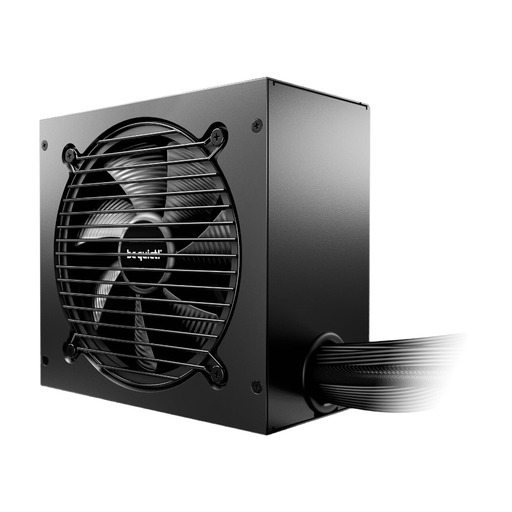
Why this choice suits this profile : With 550 W and ATX 3.0 compatibility, this model is aimed at everyday computers, office systems and entry-level or mid-range gaming PCs. It is not a substitute for a 1000 W power supply when using a particularly power-hungry graphics card.
Its clearly stated wattage helps you avoid paying for unnecessary capacity when your system does not require 1000 W.
550 W of power, ATX 3.0 compatibility and thermal control designed to support quiet operation.
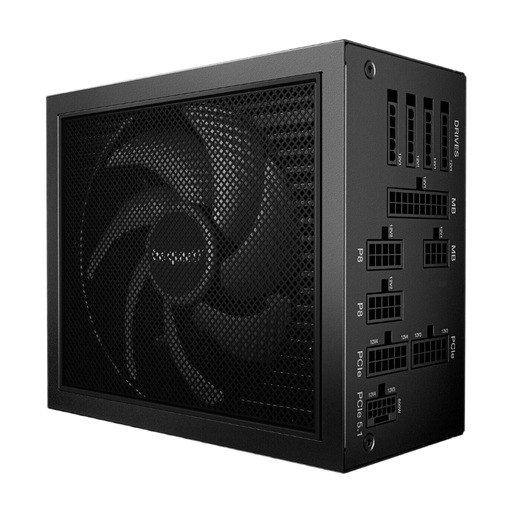
Why this choice suits this profile : This unit is aimed at high-end builds, workstations and systems fitted with a recent graphics card or multiple GPUs. It combines 1000 W, the ATX 3.1 standard and a native 12V-2x6 connector.
Native graphics connectivity reduces the need for adaptors, while the wattage and standard are clearly stated and easy to verify.
80 PLUS Titanium certification rated at up to 95.6%, a 12V-2x6 connector, four 6+2 PCIe sockets and fully modular cables.
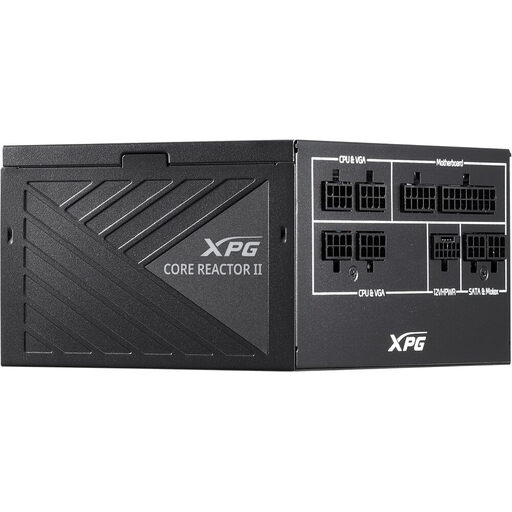
Why this choice suits this profile : This model is designed for users looking for a modular 1000 W power supply for a powerful system, without necessarily moving up to Titanium certification.
Its fully modular design reduces the number of unused cables, while its OVP, OCP, OPP, SCP and UVP protections cover a range of electrical scenarios.
1000 W, 80 PLUS Gold certification, Japanese capacitors rated at 105 °C and an optimised fan curve.
We have put together a comprehensive, real-time updated selection of products that meet these demanding criteria, as well as European safety requirements.
Before installing the unit, switch off the computer, unplug the mains cable, then hold down the power button for a few seconds. Use only the cables supplied with the power supply in question: modular cables are not necessarily interchangeable between different brands or series.
When connecting it:
Never open a mains power supply. Its capacitors can retain an electrical charge even after it has been unplugged. Cleaning should be limited to the ventilation grilles, with the computer switched off and without using liquids or metal tools.
Not always. It can be useful with a high-end graphics card, a heavily loaded processor, several storage drives or an overclocking project. For a more modest build, a lower wattage can reduce the purchase price without compromising operation, provided you follow the manufacturers’ recommendations.
Both connectors are used to power recent graphics cards, but the 12V-2x6 is an evolution of the design intended to improve connector positioning and make it easier to check that it is properly connected. In all cases, the cable must be inserted correctly and kept sufficiently far away from the case’s side panel.
Noise levels depend on temperature, load and the fan profile. A power supply with an optimised fan curve or semi-passive mode can reduce noise when demand remains low. At full power, however, the fan may speed up to dissipate heat. Check the manufacturer’s data and ensure good airflow inside the case.