
Livraison le jour même ou le lendemain

Qualité garantie

Débloquez vos offres de bienvenue: Livraison GRATUITE | Jusqu'à -80 % | 30 jours d'essai gratuits à JoyPlus
Téléchargez l'application
Whether you're a passionate maker, a professional creating prototypes, or a teacher introducing students to 3D printing, choosing the right filament is a critical step. With an overwhelming number of options available, finding the right 1.75?mm PLA filament for your needs can quickly become a headache. Our mission: to guide you to the best choice with clear benchmarks and practical advice—no marketing fluff.
Our team has tested and selected reliable options for you that combine quality and performance for all your FDM 3D printing projects.
Before diving into our selection, let's review the essential criteria to consider when buying PLA filament.
The standard for most desktop 3D printers is a diameter of 1.75?mm. But the consistency of this diameter, or its tolerance, is even more critical. A high-quality PLA is distinguished by a very tight dimensional tolerance, around ±0.02?mm. This precision ensures consistent extrusion, which drastically reduces the risk of nozzle clogging and guarantees a flawless finish. It's the secret to a truly reliable filament.
PLA (Polylactic Acid) comes in several variants, each with its own unique finish:
PLA is a hygroscopic material, meaning it absorbs moisture from the air. Filament that has absorbed moisture becomes brittle and causes failed prints (bubbles, under-extrusion, etc.). Make sure the 1?kg PLA spool you buy is properly vacuum-sealed and comes with a desiccant packet. Once the spool is opened, store it in an airtight container to protect it.
Here is a selection of 3D printer filaments that have caught our attention for their performance and positive user reviews.
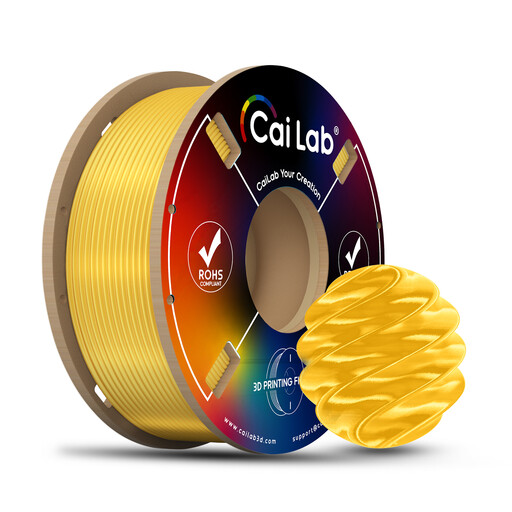
Why we love it: This filament stands out for its silky finish and intense golden colour that catches the light. It transforms the simplest object into a stunning decorative piece, right off the print bed, with no post-processing required.
Advantages:
Who is it for?: Perfect for creators and makers who want to print decorative objects, trophies, costume jewellery, or display pieces with a premium visual appeal.
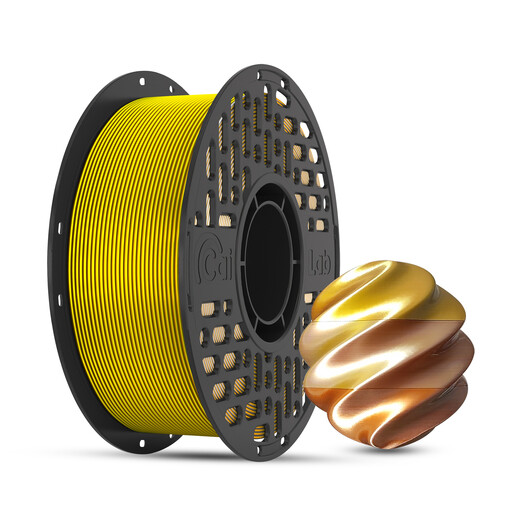
Why we love it: This filament takes aesthetics a step further by blending three colours (gold, silver, copper) on a single strand. The result is a subtle gradient that changes with the viewing angle and the object's geometry, creating unique pieces with every print.
Advantages:
Who is it for?: Aimed at advanced users and artists who love to experiment with original visual effects. It is particularly well-suited for models with curved or organic shapes, which will beautifully showcase the colour transitions.
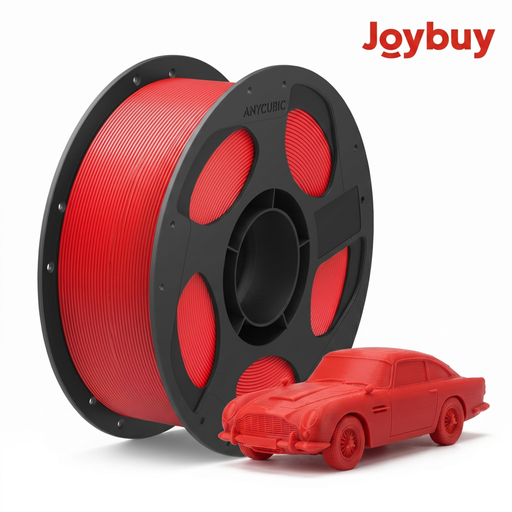
Why we love it: This is a practical choice, focused on reliability and versatility. As the result of a partnership with a reputable brand, it's designed to deliver a smooth and hassle-free printing experience. A reliable choice for a multitude of projects.
Advantages:
Who is it for?: This is the go-to filament for beginners, schools, or professionals looking for a reliable material for rapid prototyping, functional parts, or validation models.
Usage Tips: Even though PLA is known for its low odour, it is always advisable to print in a well-ventilated room. The nozzle can reach very high temperatures (up to 230?°C): never touch the print head or the bed during or immediately after a print.
This selection is just a glimpse of the possibilities offered by PLA filament. For other colours, materials with specific properties (flexible, heat-resistant, etc.), or simply more choice, feel free to explore our full catalogue.
? Explore our full collection of 3D printer materials
PLA and ABS are the two most popular plastics in FDM (Fused Deposition Modeling) 3D printing. PLA is easier to print, doesn't necessarily require a heated bed (though it helps), warps less, and emits few odours. ABS, on the other hand, is more resistant to heat and impact, but it is also more demanding to print (a heated bed and an enclosed chamber are almost essential) and emits potentially harmful fumes. For home and general use, PLA remains the preferred choice.
To prevent your filament from absorbing moisture, proper storage is crucial. The ideal method is to keep it in an airtight bag or box with several silica gel (desiccant) packets. The most demanding users even invest in vacuum-sealed storage boxes or dedicated filament dryers to ensure optimal quality over the long term.
Nozzle clogging can have several causes. The most common are a poor-quality 1.75?mm PLA filament with an inconsistent diameter, dust on the filament, or an incorrectly set extrusion temperature. Insufficient cooling of the print head's heatsink (the infamous heat creep) can also cause the filament to soften too far up the feed path. Using a quality filament and keeping your printer clean are the best practices to prevent this problem.