
Livraison le jour même ou le lendemain

Qualité garantie

Débloquez vos offres de bienvenue: Livraison GRATUITE | Jusqu'à -80 % | 30 jours d'essai gratuits à JoyPlus
Téléchargez l'application
Choosing a spool of 1.75 mm 3D filament isn't just about picking a colour or comparing the speed claims on product pages. An unsuitable material can quickly lead to prints that peel off, stringing between parts, a clogged nozzle, or a finish that looks nothing like what you expected.
For hobbyists, makers, designers and prototyping professionals in the UK, three mistakes crop up time and again:
The 1.75 mm format is very common on desktop FDM printers. Tolerance refers to the possible variation in diameter along the length of the filament. Some JOYBUY x ANYCUBIC 1 kg PLA filaments, for example, claim a tolerance of ±0.02 mm. Limited variation helps ensure consistent feeding, but it doesn't remove the need to adjust temperature, retraction and flow rate.
Also remember to check:
A 1 kg 3D filament spool is practical for regular projects and large parts. For testing a new colour or material, a smaller format helps you limit waste.
PLA is often the go-to choice for figurines, visual prototypes, decorative objects and first prints. It's generally easy to print and has a low tendency to shrink. On the downside, it's less suitable for parts exposed to high heat or repeated impact.
PETG is better suited to functional parts, brackets, objects exposed to moisture and prototypes that need better impact resistance. It usually requires more precise tuning of temperature, cooling and retraction. Manufacturers often recommend a nozzle temperature between 220 and 250 °C, with a heated bed set between 60 and 80 °C. These values still need fine-tuning depending on your printer, nozzle and the model being printed.
For outdoor use or contact with water, the claimed resistance of PETG doesn't guarantee the part will be waterproof or suitable for all environments. Geometry, wall count and infill percentage also play a significant role.
A matte PLA filament generally hides layer lines better. It works well for busts, architectural models and objects intended for display. A silk PLA filament gives a glossy surface, particularly suited to decorative items. As for multicolour or gradient PLA filament, it lets you achieve colour transitions without manually changing spools.
High-speed PLA filaments, such as certain eSUN references, claim speeds of up to 300 mm/s under very specific conditions. This figure depends on the printer model, maximum volumetric flow rate, nozzle, cooling and part geometry. The speed stated on the packaging isn't enough to compare two products.
For technical parts, a carbon-fibre-reinforced PETG filament can be interesting when you need greater rigidity and a distinctive look. You'll then need an abrasion-resistant nozzle: the fibres wear out a brass nozzle much more quickly.
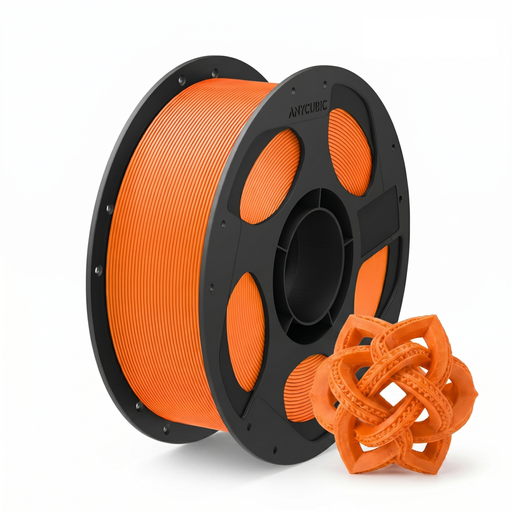
Why this choice suits this profile: This orange PLA filament in a 1 kg spool offers a practical format for getting started, making decorative parts and testing different settings without juggling multiple references.
The 1.75 mm diameter and claimed ±0.02 mm tolerance make it easier to choose a suitable profile, provided your printer is compatible.
An easy-to-use PLA, a 1 kg spool and a vibrant colour for creative models.
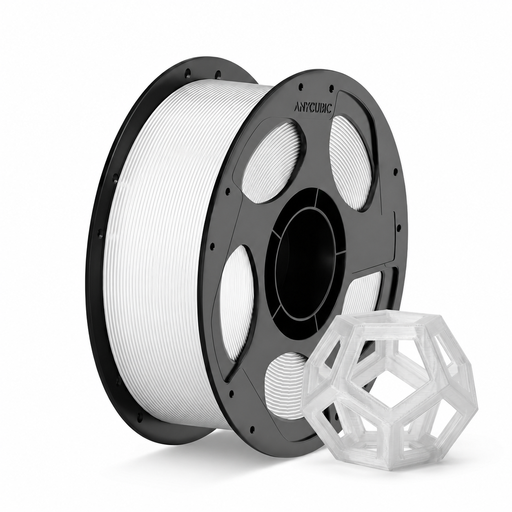
Why this choice suits this profile: This clear PETG combines a glossy finish with a material suited to functional prototypes, enclosures and objects where visibility matters.
The product page mentions vacuum packaging with desiccant – a good point for limiting moisture effects from the moment you open it.
A clear PETG in 1 kg format, with good layer adhesion and claimed resistance to moisture and impact.
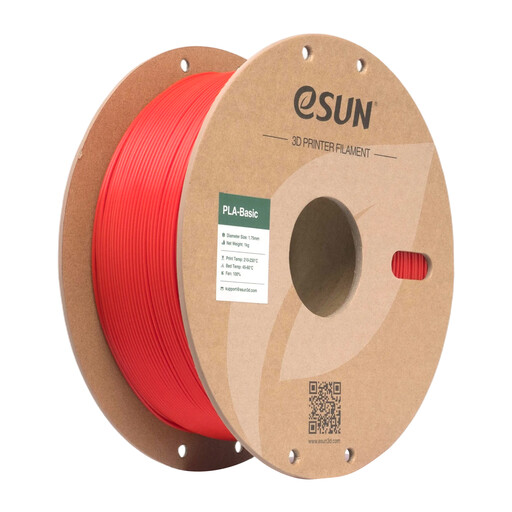
Why this choice suits this profile: This PLA formulation designed for fast printing is aimed at users with a compatible printer who want to reduce production time for batches or prototypes.
The claimed speed must be considered alongside volumetric flow rate, nozzle and print profile. It is not a guarantee that works on every machine.
A 1.75 mm diameter, 1 kg spool and a formulation designed to promote flow on certain fast printers.
We've put together a comprehensive, real-time selection of products that meet these demanding criteria and European safety requirements.
Before starting an important print, run a test on a small part. Adjust gradually:
After use, store your 3D printer filament in an airtight bag with desiccant. PLA and PETG don't absorb moisture to the same degree, but neither is completely immune. Drying may be necessary if you notice bubbles, inconsistent extrusion or a rough surface. Follow the temperatures and durations recommended by the brand: avoid using a domestic oven, as its temperature is often unstable.
Most desktop FDM printers use this diameter, but always check your model's manual or technical specifications. Also verify the extruder type, maximum nozzle temperature and the diameter accepted by the filament path.
It all depends on the packaging, humidity level and storage conditions. An opened spool should be kept in an airtight bag or box with desiccant. If the filament becomes brittle or crackles during extrusion, drying may be necessary.
The material price is only part of the equation. PETG may require more tuning, a higher temperature and more precise retraction management. Its real cost also depends on print time, failure rate, power consumption and part size.