
Livraison le jour même ou le lendemain

Qualité garantie

Débloquez vos offres de bienvenue: Livraison GRATUITE | Jusqu'à -80 % | 30 jours d'essai gratuits à JoyPlus
Téléchargez l'application
By the Joybuy Team, Your Tooling Experts
The dreaded "crack" of a stripped bolt or a damaged thread... a sound that every mechanic, whether a hobbyist or a seasoned pro, fears. On expensive components like a carbon fibre MTB frame or delicate engine parts, over-tightening is simply not an option. This is where a precision tool becomes your best ally. Forget the guesswork: the 1/4" digital torque wrench is the modern solution for guaranteeing perfect, secure, and manufacturer-compliant fastening.
Whether you are a meticulous cyclist, a mechanically-minded motorcyclist, or a demanding DIY enthusiast, this guide will help you choose the wrench best suited to your needs. We will break down the essential criteria and present a selection of the best models currently available.
Switching from a mechanical wrench to an electronic model can seem intimidating at first, but the gains in accuracy and ease of use are considerable. Here are the key points to check to make the right choice.
This is the number one criterion. Expressed in Newton-metres (Nm), the torque range determines the scope of your wrench's application. For precision mechanics (maintaining a bicycle or motorcycle), a tool specialising in low torque is essential. For example, many bolts on a carbon MTB require values between 4 and 10?Nm. A wrench covering a range of 1.5 to 30?Nm will therefore be exceptionally versatile.
Next, check the accuracy stated by the manufacturer. A tolerance of ±2% in the clockwise direction (when tightening) is a hallmark of reliability for the most sensitive tasks. It's the assurance that you'll never exceed the recommended value.
A good electronic torque wrench stands out for its ease of use. The backlit LCD screen provides a clear, instant reading of the torque value, eliminating the parallax errors common with mechanical vernier-scale wrenches.
Another major advantage is the alert system. The most practical models combine an audible alert (beep), a vibration, and a light signal (LED) to notify you when the target torque is reached. This triple alert is particularly useful in a noisy workshop or a poorly lit space. The ability to preset frequently used torque values is also a significant time-saver.
The 1/4-inch drive square is the standard for low-torque applications. It offers compatibility with a very wide range of sockets and bits. If you're starting from scratch or looking to upgrade your equipment, opting for a torque wrench set is often the most cost-effective and convenient solution. These kits typically include the wrench, a selection of sockets and bits (Torx, Allen/Hex, etc.), and a hard-shell carrying case to protect your tool over the long term.
To help you make an informed decision, here are three models that stand out for their technical specifications and their suitability for amateur and seasoned mechanics alike.
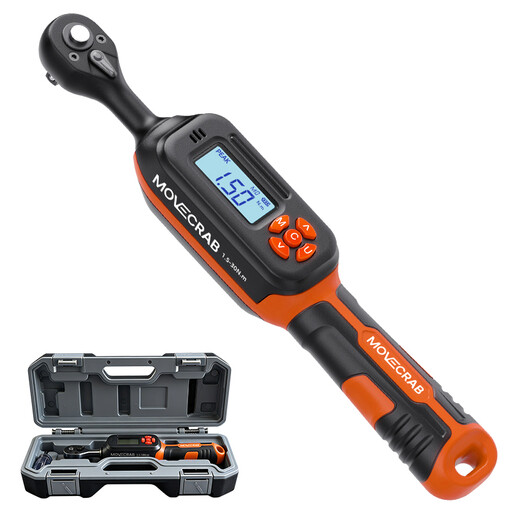
Why it stands out: This model is an excellent entry point into the world of digital precision. Its torque range of 1.5 to 30?Nm makes it highly versatile, covering the majority of needs for carbon MTB maintenance, motorcycle servicing, and minor automotive repairs. Its triple alert system (vibration, sound, light) ensures you never exceed the target torque.
Pros:
Who is it for? Ideal for the demanding amateur mechanic looking for a reliable and versatile tool for regular maintenance of their bike or motorcycle, without necessarily investing in a complete set.
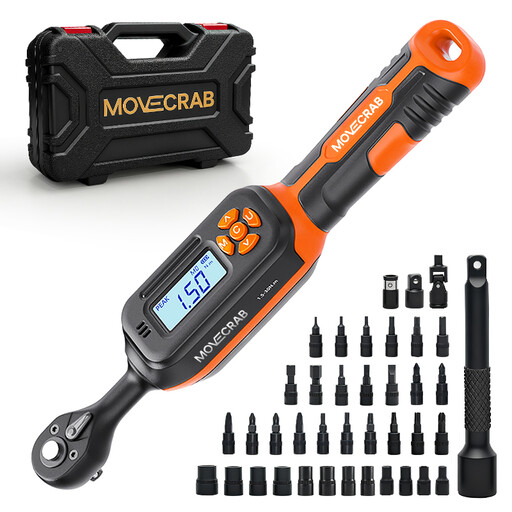
Why it stands out: The ultimate all-in-one solution. This package takes the excellent features of the previous wrench (accuracy, modes, alerts) and integrates them into a very comprehensive 40-piece torque wrench set. With 23 bits, 12 sockets, and 4 adapters, you are equipped for almost any light mechanical task.
Pros:
Who is it for? The smart choice for someone equipping their workshop for the first time or wanting to upgrade their tools with a complete and well-organised solution. Perfect for bike and motorcycle maintenance, and for minor automotive jobs.
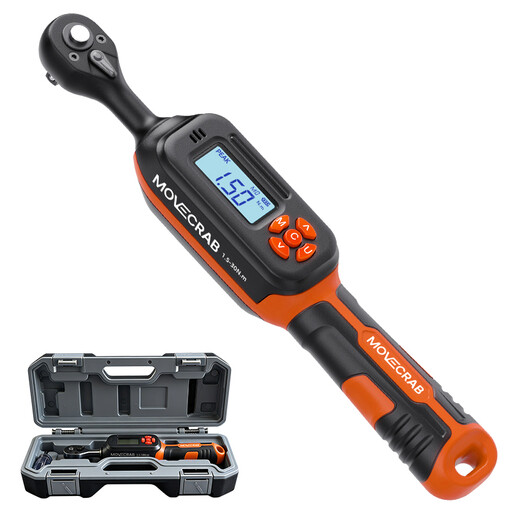
Why it stands out: This model is aimed at specialists in very low torque. With an operating range of 0.6 to 12?Nm, it is specifically designed for the most fragile components: stems, brake levers, and derailleurs on carbon frames, as well as certain electronic and plastic parts in cars.
Pros:
Who is it for? Intended for the discerning bike mechanic, especially for assembling and performing carbon MTB maintenance, or for any professional working on delicate assemblies that require absolute precision below 15?Nm.
If the models presented don't exactly match your needs, or if you want to explore a wider range of tools for your workshop, feel free to browse our complete selection.
? Explore our full range of precision tools
The digital version offers several decisive advantages: a direct, error-free reading on an LCD screen, alerts (audible, visual, vibration) that prevent you from exceeding the torque, the ability to change measurement units (Nm, ft.lb, etc.), and memory for storing values. It provides increased comfort and reliability while drastically reducing the risk of human error.
Like any precision instrument, it requires minimal care. After each use, set it to the lowest value in its range to avoid leaving the internal sensor under tension. Store it in its case, away from moisture, impacts, and extreme temperatures. Also, remember to remove the batteries if you don't plan to use it for an extended period.
There is no single value. Each component (seatpost, stem, handlebar, etc.) has its own torque setting, recommended by the manufacturer. These values are generally very low, often between 4 and 8?Nm. It is therefore imperative to always consult the technical documentation for your bike or the component before any tightening. Using a precise bicycle torque wrench is non-negotiable to avoid damaging the carbon fibres.